1,267 posters, 47 videos, 13 topics, 4 sessions, 853 authors
ePostersLive by SciGen Technologies S.A. All rights reserved.
SOHO 2026 Annual Meeting
September 9 - 12, 2026 | George R. Brown Convention Center, Houston, Texas

CT - 705
Impact of Chronic Kidney Disease on Clinical Outcomes and Resource Utilization in Hematopoietic Stem Cell Transplantation: Insights from the Nationwide Readmissions Database
Poster Presenter
Authors
Part of Topic
Cellular Therapy (CT)
Title: Impact of Chronic Kidney Disease on Clinical Outcomes and Resource Utilization in Hematopoietic Stem Cell Transplantation: Insights from the Nationwide Readmissions Database
Context: Pre-existing chronic kidney disease (CKD) presents considerable obstacles in hematopoietic stem cell transplantation (HSCT), yet nationally representative data on readmission trends are scarce.
Objective: This analysis aims to characterize the clinical and economic burden of CKD in HSCT patients and also to identify modifiable risk factors that could inform and update transplant eligibility criteria, accordingly, optimize post-discharge surveillance, and guide evidence-based resource allocation within transplant programs.
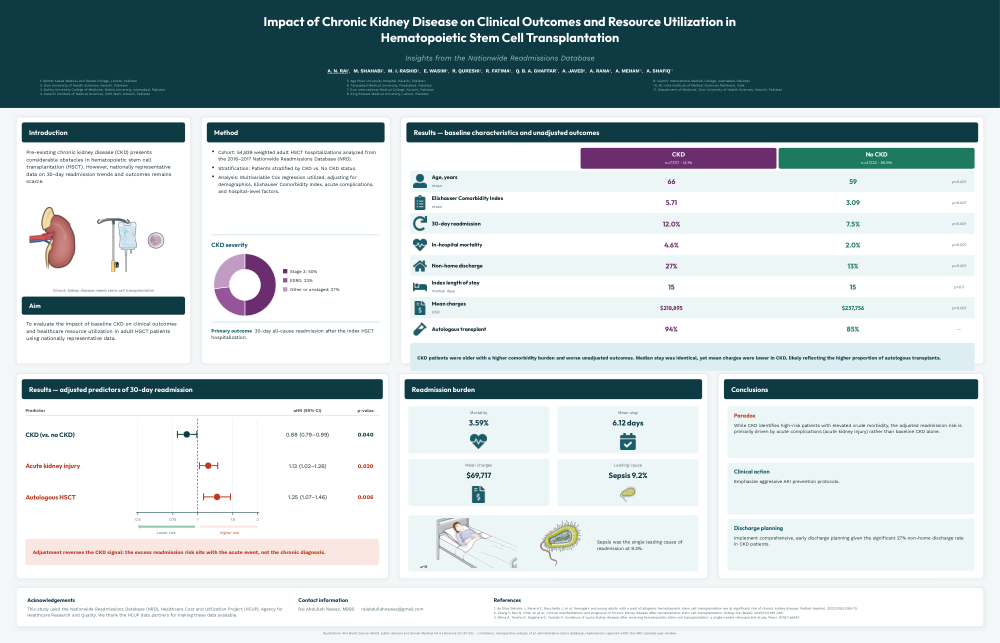
Method: The study has analyzed 54,839 weighted adult HSCT hospitalizations from the 2016–2017 Nationwide Readmissions Database, stratified by CKD status. Multivariable Cox regression identified predictors of 30-day all-cause readmission, adjusting for demographics, comorbidities (Elixhauser Index), acute complications, and hospital factors.
Results: CKD patients (n=7,707; 14.1%) were older (66 vs. 59 years, p<0.001), had higher comorbidity burden (Elixhauser Index: 5.71 vs. 3.09, p<0.001), and predominantly had moderate-to-advanced disease (Stage 3: 50%; ESRD: 23%). Unadjusted outcomes were worse in CKD: 30-day readmission (12.0% vs. 7.5%, p<0.001) and in-hospital mortality (4.6% vs. 2.0%, p<0.001). Index hospitalization length of stay was comparable (median 15 days for both groups, p=0.5), but mean charges were paradoxically lower in CKD ($218,895 vs. $237,756, p<0.001), likely reflecting higher autologous transplant proportion (94% vs. 85%). Non-home discharge was substantially higher in CKD (27% vs. 13%, p<0.001). After adjustment, CKD showed reduced readmission hazard (aHR 0.88; 95% CI 0.79–0.99; p=0.040), while acute kidney injury (aHR 1.13; 95% CI 1.02–1.26; p=0.020) and autologous HSCT (aHR 1.25; 95% CI 1.07–1.46; p=0.006) predicted higher readmission risk. Readmissions resulted in 3.59% mortality, a 6.12-day mean stay, and $69,717 mean charges, with sepsis (9.2%) as the leading cause of returns.
Conclusion: While CKD identifies high-risk HSCT patients with elevated crude morbidity, adjusted readmission risk is primarily driven by acute complications—particularly acute kidney injury—rather than baseline CKD alone. These findings emphasize aggressive AKI prevention and comprehensive discharge planning, especially given the 27% non-home discharge rate in CKD patients.