1,267 posters, 47 videos, 13 topics, 4 sessions, 853 authors
ePostersLive by SciGen Technologies S.A. All rights reserved.
SOHO 2026 Annual Meeting
September 9 - 12, 2026 | George R. Brown Convention Center, Houston, Texas

AML - 703
Real-World Experience with Revumenib: A Single-Center Analysis of Efficacy and Tolerability
Poster Presenter
Authors
Part of Topic
Acute Myeloid Leukemia (AML)
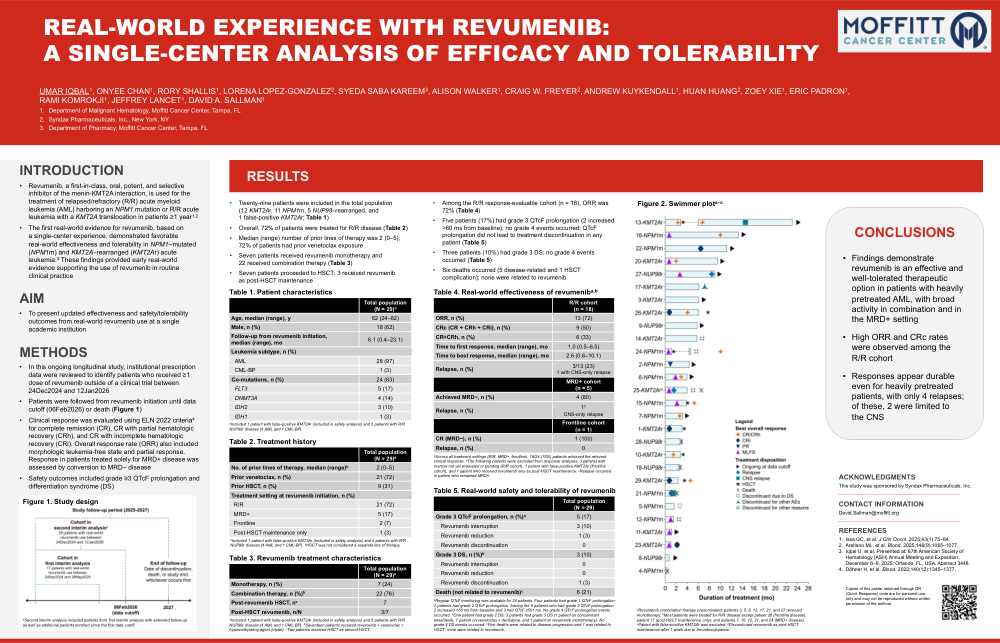
AML-703 · Publication and Poster presentation Real-World Experience With Revumenib: A Single-Center Analysis of Efficacy and Tolera bility Umar Iqbal 1 , Onyee Chan1, Rory Shallis1, Lorena Lopez-Gonzalez2, Syeda Saba Kareem1, Alison Walker1, Craig W Freyer2, Andrew Kuykendall1, Huan Huang2, Zoey Xie1, Eric Padron1, Rami Komrokji1, Jeffrey Lancet1, David A Sallman1 1 Moffitt Cancer Center, Tampa, FL, USA 2 Syndax Pharmaceuticals, Inc, New York, NY, USA Abstract Background Revumenib, a first-in-class, oral, selective menin inhibitor, is used for treatment of relapsed/refractory AML with NPM1 mutation (NPM1 m) or relapsed/refractory acute leukemia with KMT2A translocation in patients aged ≥1 year. Objective To present efficacy and safety/tolerability data from real-world use of revumenib at a single academic institution. Methods For this second interim analysis, results are presented for patients who received ≥1 revumenib dose between December 12, 2024, and January 12, 2026, outside a clinical trial. Patients were followed from revumenib start date until February 6, 2026, or death. Efficacy was evaluated using ELN 2022 criteria for CR, CR with partial hematologic recovery (CRh), and CR with incomplete hematologic recovery (CRi). ORR also included patient status of morphologic leukemia-free state (MLFS) and partial response (PR). Grade ≥3 nonhematological treat ment-related adverse events were captured. Results In total, 29 patients were included (13 KMT2A r, 11 NPM1 m, 4 NUP98 r, 1 KMT2A false positive). Median age was 61 years; 38% were women. Most patients (72%) were treated for relapsed/refractory disease. Median number of prior lines of therapy was 2; 72% received prior venetoclax and 31% underwent prior HSCT. Of the group, 7 patients received revumenib monotherapy; 22 received revumenib combination therapy. Median follow-up was 6.1 months (range, 0.3–23.1 months). In all, 23 patients were efficacy evaluable (19 relapsed/refractory, 4 MRD⁺ only). Among 19 patients with relapsed/refractory disease, ORR was 74% (14/19), including CR in 4 (21%), CRh in 1 (5%), CRi in 4 (21%), MLFS in 4 (21%), PR in 1 (5%), and no response in 5 (26%). Median (range) time to first and best response was 0.9 months (0.5–6.4 months) and 2 months (0.6–10 months), respectively. Six patients underwent HSCT after revumenib; three received revumenib as post-HSCT maintenance. In the safety population (n=29), 6 deaths occurred (5 disease progression, 1 HSCT-related). Grade 3 QTcF prolongation occurred in 5 patients and resolved (2 with interruptions, 1 with interruptions and reductions; no discontinuations). Three patients experienced grade 3 differentiation syndrome, with one discontinuation. Conclusions These findings support revumenib as a safe and effective therapeutic option in heavily pretreated AML, with broad activity in combination and in the MRD⁺ setting. AML: acute myeloid leukemia, CR: complete remission, ELN: European LeukemiaNet, HSCT: hematopoietic stem cell transplantation; KMT2A r: lysine methyltransferase 2A–rearranged, MRD: measurable residual disease, NPM1 : nucleophosmin 1, NUP98 r: nucleoporin 98 and 96 precursor–rearranged, ORR: overall response rate, QTcF: corrected QT interval using Fridericia’s formula Research funding provided by Syndax. Keywords AML, revumenib, menin inhibitor, relapsed, refractory, NPM1 , KMT2A