1,267 posters, 47 videos, 13 topics, 4 sessions, 853 authors
ePostersLive by SciGen Technologies S.A. All rights reserved.
SOHO 2026 Annual Meeting
September 9 - 12, 2026 | George R. Brown Convention Center, Houston, Texas

MM - 673
Efficacy and Safety of Teclistamab in Extramedullary Relapsed/Refractory Multiple Myeloma: A Systematic Review and Meta-Analysis
Poster Presenter
Authors
Part of Topic
Multiple Myeloma (MM)
Title:
Efficacy and Safety of Teclistamab in Extramedullary Relapsed/Refractory Multiple Myeloma: A Systematic Review and Meta-Analysis
INTRODUCTION:
- Extramedullary disease (EMD) in multiple myeloma is associated with:
- Aggressive disease biology
- Treatment resistance
- Poor survival outcomes
- Teclistamab is a B-cell maturation antigen (BCMA) × CD3 bispecific antibody that has demonstrated efficacy in relapsed/refractory multiple myeloma (RRMM).
- However, its efficacy and safety in patients with EMD remain incompletely characterized.
- To date, no dedicated systematic review and meta-analysis has comprehensively evaluated Teclistamab specifically in EMD-associated RRMM.
- Therefore, this study aimed to systematically evaluate the efficacy and safety of Teclistamab in patients with EMD-RRMM.
Methods:
- Study design: Systematic review and meta-analysis conducted according to PRISMA 2020 guidelines.
- Literature search: Databases searched through May 2026:
- PubMed
- Embase
- Scopus
- Web of Science
- ClinicalTrials.gov
- Major hematology conference proceedings
- Eligibility: Studies evaluating Teclistamab in patients with EMD-associated RRMM were included.
- Primary outcome: Overall response rate (ORR) in patients with EMD.
- Secondary outcomes:
- Progression-free survival (PFS)
- Overall survival (OS)
- Cytokine release syndrome (CRS)
- Immune effector cell-associated neurotoxicity syndrome (ICANS)
- Infections
- Statistical analysis: Random-effects single-arm proportion meta-analysis using logit transformation.
RESULTS:
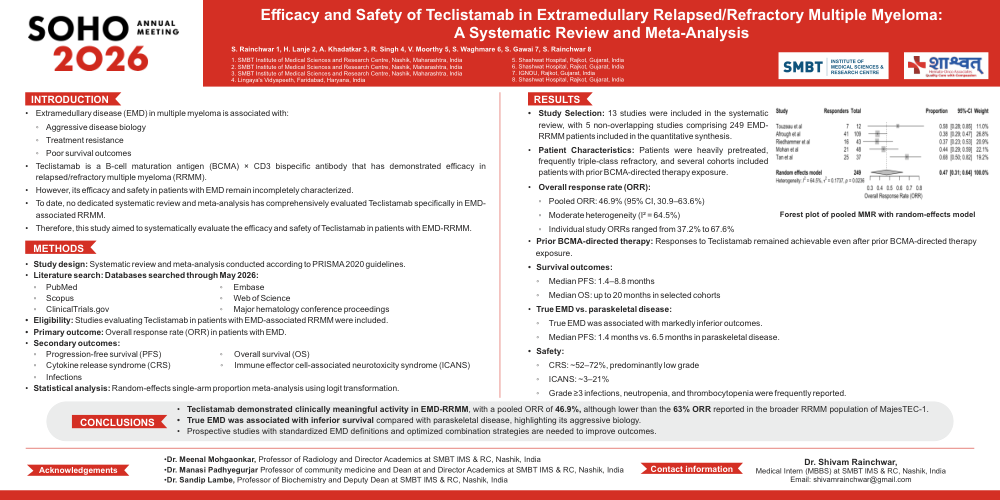
- Study selection: 13 studies were included in the systematic review, with 5 non-overlapping studies comprising 249 EMD-RRMM patients included in the quantitative synthesis.
- Patient characteristics: Patients were heavily pretreated, frequently triple-class refractory, and several cohorts included patients with prior BCMA-directed therapy exposure.
- Overall response rate (ORR):
- Pooled ORR: 46.9% (95% CI, 30.9–63.6%)
- Moderate heterogeneity (I² = 64.5%)
- Individual study ORRs ranged from 37.2% to 67.6%
- Prior BCMA-directed therapy: Responses to Teclistamab remained achievable even after prior BCMA-directed therapy exposure.
- Survival outcomes:
- Median PFS: 1.4–8.8 months
- Median OS: up to 20 months in selected cohorts
- True EMD vs. paraskeletal disease:
- True EMD was associated with markedly inferior outcomes.
- Median PFS: 1.4 months vs. 6.5 months in paraskeletal disease.
- Safety:
- CRS: ~52–72%, predominantly low grade
- ICANS: ~3–21%
- Grade ≥3 infections, neutropenia, and thrombocytopenia were frequently reported.
Conclusion:
- Teclistamab demonstrated clinically meaningful activity in EMD-RRMM, with a pooled ORR of 46.9%, although lower than the 63% ORR reported in the broader RRMM population of MajesTEC-1.
- True EMD was associated with inferior survival compared with paraskeletal disease, highlighting its aggressive biology.
- Prospective studies with standardized EMD definitions and optimized combination strategies are needed to improve outcomes.