1,267 posters, 47 videos, 13 topics, 4 sessions, 853 authors
ePostersLive by SciGen Technologies S.A. All rights reserved.
SOHO 2026 Annual Meeting
September 9 - 12, 2026 | George R. Brown Convention Center, Houston, Texas

MM - 626
GLP-1 Receptor Agonist Exposure and Survival Outcomes in Newly Diagnosed Multiple Myeloma Treated With Daratumumab-Based Quadruplet Therapy: A Target Trial Emulation
Poster Presenter
Authors
Part of Topic
Multiple Myeloma (MM)
GLP-1 Receptor Agonist Exposure and Survival Outcomes in Newly Diagnosed Multiple Myeloma Treated With Daratumumab-Based Quadruplet Therapy: A Target Trial Emulation
Background
Obesity, insulin resistance, and chronic inflammation are associated with inferior outcomes in multiple myeloma (MM). Glucagon-like peptide-1 receptor agonists (GLP-1RAs) exert anti-inflammatory and immunomodulatory effects, including IL-6/NF-κB suppression and enhancement of cytotoxic immune cell function, that may synergize with anti-CD38-based immunotherapy. Retrospective data suggest GLP-1RA use is associated with reduced hematologic malignancy incidence and improved survival in patients with type 2 diabetes (T2DM), but no study has evaluated their impact specifically among patients receiving frontline daratumumab, bortezomib, lenalidomide, and dexamethasone (D-VRd).
Methods
We emulated a target trial using the TriNetX Global Collaborative Network (>150 million patients, 112 healthcare organizations). Eligible patients were adults (≥18 years) with newly diagnosed MM, concurrent T2DM or obesity (BMI ≥30), initiating D-VRd. A landmark design at 90 days post-treatment initiation was employed to mitigate immortal time bias. The exposed cohort had documented GLP-1RA prescriptions spanning the landmark; controls were non-users. Propensity score matching (1:1) balanced age, sex, race, BMI, HbA1c, Charlson Comorbidity Index, ISS stage, and transplant receipt. The primary endpoint was overall survival (OS). Secondary endpoints included complete response (CR) or better and relapse. E-values were calculated to assess susceptibility to unmeasured confounding.
Results
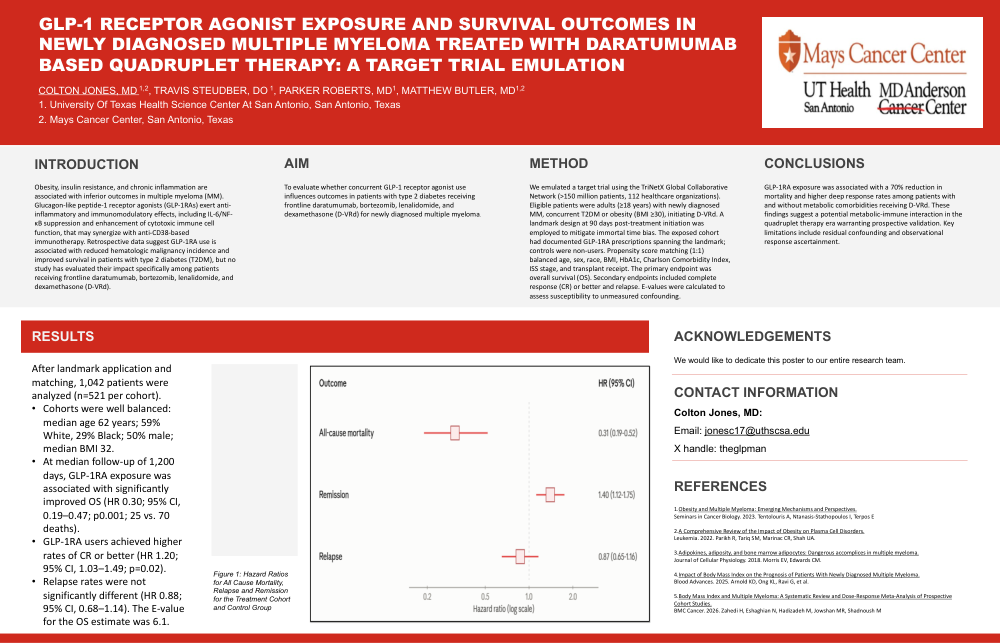
After landmark application and matching, 1,042 patients were analyzed (n=521 per cohort). Cohorts were well balanced: median age 62 years; 59% White, 29% Black; 50% male; median BMI 32. At median follow-up of 1,200 days, GLP-1RA exposure was associated with significantly improved OS (HR 0.30; 95% CI, 0.19–0.47; p0.001; 25 vs. 70 deaths). GLP-1RA users achieved higher rates of CR or better (HR 1.20; 95% CI, 1.03–1.49; p=0.02). Relapse rates were not significantly different (HR 0.88; 95% CI, 0.68–1.14). The E-value for the OS estimate was 6.1.
Conclusions
GLP-1RA exposure was associated with a 70% reduction in mortality and higher deep response rates among patients with and without metabolic comorbidities receiving D-VRd. These findings suggest a potential metabolic-immune interaction in the quadruplet therapy era warranting prospective validation. Key limitations include residual confounding and observational response ascertainment.