1,267 posters, 47 videos, 13 topics, 4 sessions, 853 authors
ePostersLive by SciGen Technologies S.A. All rights reserved.
SOHO 2026 Annual Meeting
September 9 - 12, 2026 | George R. Brown Convention Center, Houston, Texas

AML - 585
The Prognostic Value of Day 14 Bone Marrow Blast Clearance Is Mutation-Dependent in Newly Diagnosed, Intensively Treated Acute Myeloid Leukemia (AML)
Poster Presenter
Authors
Part of Topic
Acute Myeloid Leukemia (AML)
INTRODUCTION
Assessment of bone marrow blast clearance at day 14 (D14) is routine during intensive AML induction, yet its prognostic value, and its usefulness for deciding which patients require a second induction, remains uncertain. Molecularly defined subgroups may differ in how quickly blasts clear, so a single D14 threshold may not be universally prognostic across all patients.
AIM
To compare the prognostic role of D14BM across mutation subgroups in an AML cohort treated with intensive chemotherapy.
METHODS
We analysed 428 patients with AML treated in the PALG-AML/2016 trial with DA-90 or DAC induction; all had an assessable D14 marrow. Outcomes were composite complete remission (cCR, i.e. CR/CRi after up to two inductions), overall survival (OS) and event-free survival (EFS), with time zero at randomisation. Mutation × D14 interactions were tested for each outcome. Youden's index identified the optimal D14 blast cutoff for cCR failure, overall and within each subgroup. Kaplan– Meier analysis and Cox models were applied at the subgroup-tailored cutoffs. A sensitivity analysis excluded patients who received a second induction.
RESULTS
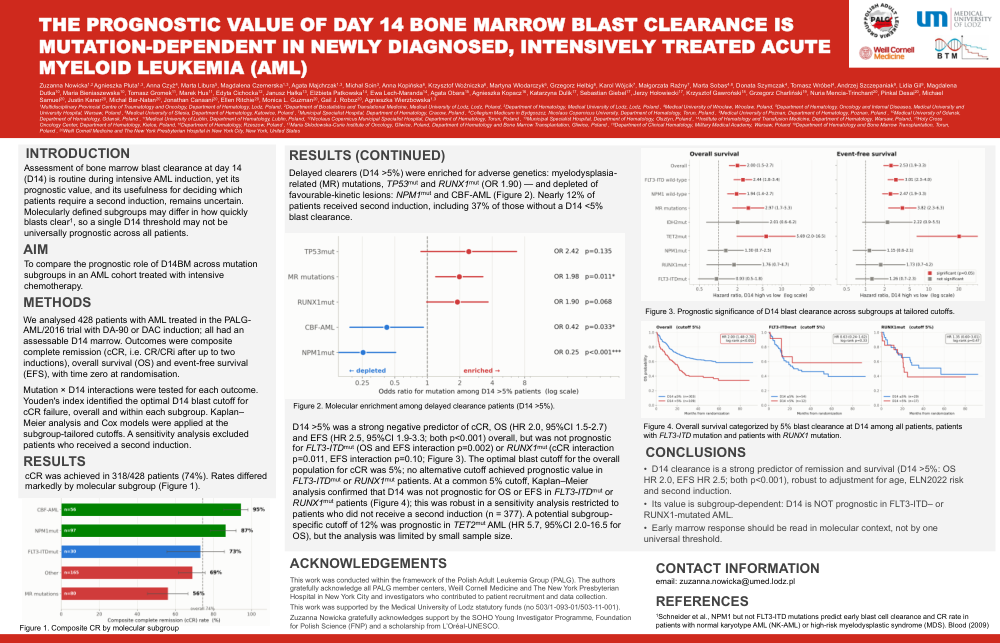
cCR was achieved in 318/428 patients (74%). Rates differed markedly by molecular subgroup (Figure 1). Delayed clearers (D14 >5%) were enriched for adverse genetics: myelodysplasia-related (MR) mutations, TP53mut and RUNX1mut (OR 1.90) — and depleted of favourable-kinetic lesions: NPM1mut and CBF-AML (Figure 2). Nearly 12% of patients received second induction, including 37% of those without a D14 <5% blast clearance.
D14 >5% was a strong negative predictor of cCR, OS (HR 2.0, 95%CI 1.5-2.7) and EFS (HR 2.5, 95%CI 1.9-3.3; both p<0.001) overall, but was not prognostic for FLT3-ITDmut (OS and EFS interaction p=0.002) or RUNX1mut (cCR interaction p=0.011, EFS interaction p=0.10; Figure 3). The optimal blast cutoff for the overall population for cCR was 5%; no alternative cutoff achieved prognostic value in FLT3-ITDmut or RUNX1mut patients. At a common 5% cutoff, Kaplan–Meier analysis confirmed that D14 was not prognostic for OS or EFS in FLT3-ITDmut or RUNX1mut patients (Figure 4); this was robust in a sensitivity analysis restricted to patients who did not receive a second induction (n = 377). A potential subgroup- specific cutoff of 12% was prognostic in TET2mut AML (HR 5.7, 95%CI 2.0-16.5 for OS), but the analysis was limited by small sample size.
CONCLUSIONS
• D14 clearance is a strong predictor of remission and survival (D14 >5%: OS HR 2.0, EFS HR 2.5; both p<0.001), robust to adjustment for age, ELN2022 risk and second induction.
• Its value is subgroup-dependent: D14 is NOT prognostic in FLT3-ITD– or RUNX1-mutated AML.
• Early marrow response should be read in molecular context, not by one universal threshold.