1,267 posters, 47 videos, 13 topics, 4 sessions, 853 authors
ePostersLive by SciGen Technologies S.A. All rights reserved.
SOHO 2026 Annual Meeting
September 9 - 12, 2026 | George R. Brown Convention Center, Houston, Texas

ABCL - 517
HIV-Associated Plasmablastic Lymphoma Presenting With Spontaneous Tumor Lysis Syndrome and Hypercalcemia of Malignancy
Poster Presenter
Authors
Part of Topic
Aggressive B-Cell Lymphoma (ABCL)
HIV-Associated Plasmablastic Lymphoma Presenting With Spontaneous Tumor Lysis Syndrome and Hypercalcemia of Malignancy
Ritwik Dey1, Virali Gulla1, Harshitha Popuri1, Eric Kawana2, Ruben Delgado Cotarro2, Claudia Didia1, Javier Corral3
1Department of Internal Medicine, Texas Tech University Health Sciences Center, El Paso, TX, USA
2Department of Pathology, Texas Tech University Health Sciences Center, El Paso, TX, USA
3Department of Hematology/Oncology, Texas Tech University Health Sciences Center, El Paso, TX, USA
KEYWORDS: Plasmablastic lymphoma, HIV, tumor lysis syndrome, hypercalcemia, EPOCH
CONTEXT: Plasmablastic lymphoma (PBL) is a rare, aggressive variant of large B-cell lymphoma predominantly affecting immunosuppressed individuals with HIV. Spontaneous tumor lysis syndrome (sTLS) and hypercalcemia are each exceedingly rare in PBL; their simultaneous occurrence has not been previously described.
OBJECTIVE: To describe a case of HIV-associated PBL presenting simultaneously with sTLS and hypercalcemia as the initial manifestation of undiagnosed HIV infection.
SETTING: A safety-net academic medical center at the U.S.–Mexico border.
PATIENT: A 40-year-old male with a history of unprotected intercourse with male and female partners, with no prior HIV diagnosis, presented with a two-day history of right facial and neck swelling. Physical examination revealed oral candidiasis.
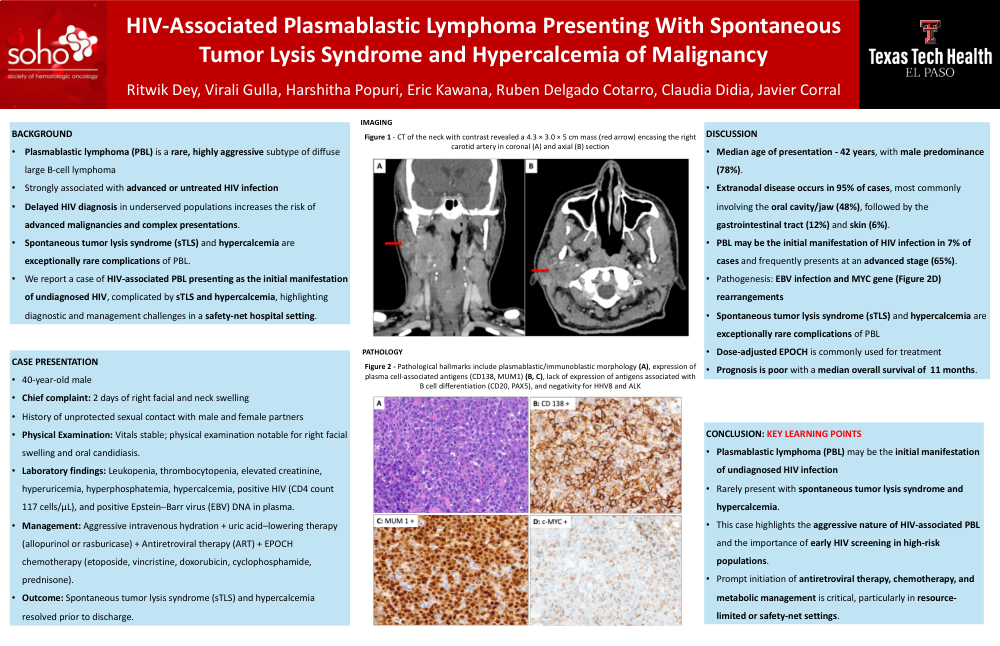
RESULTS: Contrast CT showed a 4.3 cm right neck mass encasing the carotid artery with bilateral cervical, mediastinal, and right axillary lymphadenopathy. Laboratory studies demonstrated leukopenia, thrombocytopenia, elevated creatinine, hyperuricemia, hyperphosphatemia, and hypercalcemia, meeting Cairo-Bishop criteria for sTLS. HIV was newly diagnosed with a CD4 count of 117 cells/µL. Lymph node biopsy showed plasmacytoid cells with immunoblastic features. Immunohistochemistry was positive for plasma cell-associated antigens (CD138, MUM1) and negative for B cell differentiation antigens (CD20, PAX5), HHV8, and ALK, confirming PBL. Primary hyperparathyroidism was excluded, and 1,25-dihydroxyvitamin D was not elevated, implicating cytokine-mediated mechanisms in the hypercalcemia.
INTERVENTIONS: He was initiated on aggressive intravenous hydration, allopurinol, antiretroviral therapy (ART), and dose-adjusted etoposide, vincristine, doxorubicin, cyclophosphamide, and prednisone (EPOCH) chemotherapy, following which complete resolution of sTLS and hypercalcemia was achieved before discharge.
CONCLUSIONS: HIV-associated PBL presents at a median age of 42 years, 78% are males, 65% in an advanced clinical stage, and 7% are the initial presentation of HIV. Extra-nodal involvement is seen in 95% of cases: oral cavity/jaw (48%), gastrointestinal tract (12%), and skin (6%). EBV infection and MYC gene rearrangements play a role in pathogenesis. PBL often follows an aggressive course with early relapses and chemotherapy resistance. Large tumor burden and high proliferative rate may predispose to sTLS. Dose-adjusted EPOCH has shown the most benefit in limited clinical trials. ART does not improve outcomes. PBL has a poor prognosis with 11 months of median overall survival. Prompt multidisciplinary management, including oncology and infectious disease specialists, is critical to improve outcomes.