1,267 posters, 47 videos, 13 topics, 4 sessions, 853 authors
ePostersLive by SciGen Technologies S.A. All rights reserved.
SOHO 2026 Annual Meeting
September 9 - 12, 2026 | George R. Brown Convention Center, Houston, Texas

MM - 479
Diagnostic and Therapeutic Access Gaps in Newly Diagnosed Multiple Myeloma: Real-World Evidence From a North Indian Tertiary Care Center
Poster Presenter
Authors
Part of Topic
Multiple Myeloma (MM)
Diagnostic and Therapeutic Access Gaps in Newly Diagnosed Multiple Myeloma: Real-World Evidence From a North Indian Tertiary Care Center
Context
The Revised International Staging System (R-ISS) requires fluorescence in situ hybridization (FISH) cytogenetics and lactate dehydrogenase (LDH), which remain inconsistently available in many public-sector settings. The impact of limited diagnostic access on staging feasibility and treatment patterns in newly diagnosed multiple myeloma (NDMM) is poorly characterized in resource-constrained environments.
Objective
To evaluate ISS-R-ISS concordance, FISH access, and first-line treatment patterns in a North Indian public-sector NDMM cohort.
Design
Single-center retrospective cohort study (January 2015–December 2025).
Setting
Public-sector tertiary care hematology-oncology center in North India.
Patients or Other Participants
A total of 112 consecutive NDMM patients diagnosed per International Myeloma Working Group criteria were identified through retrospective review of paper-based medical records. Median age was 56 years (range, 27–84 years); 61.4% were male.
Interventions
International Staging System and R-ISS staging were assigned using available diagnostic data. First-line bortezomib-based regimens were selected at the physician’s discretion within public-sector resource constraints.
Main Outcome Measures
The primary outcome was weighted Cohen’s κ for ISS-R-ISS concordance. Secondary outcomes included FISH completion rate, high-risk cytogenetic prevalence, first-line treatment distribution, and autologous stem cell transplantation (ASCT) uptake.
Results
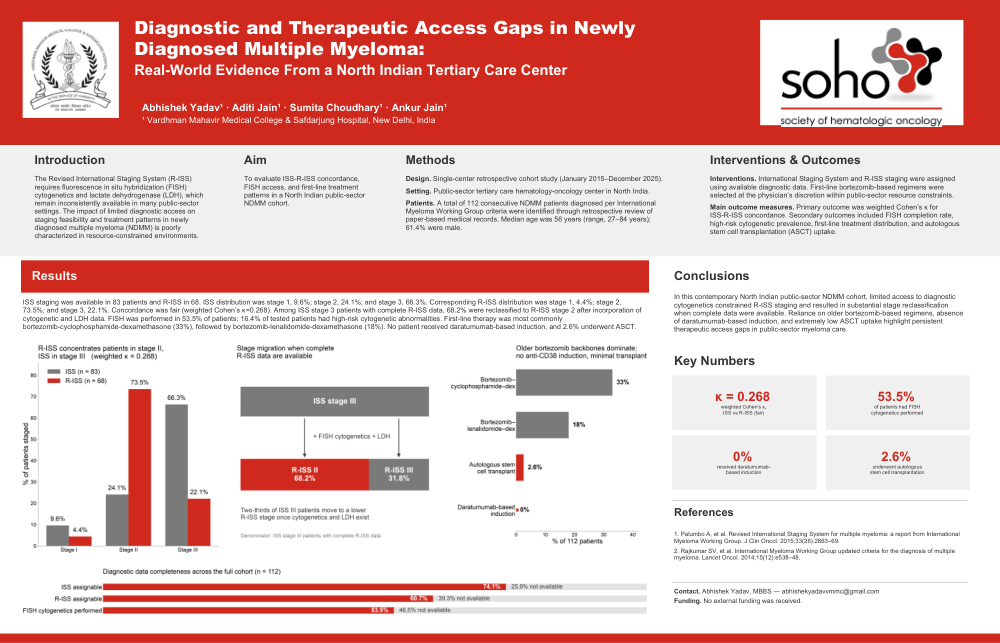
ISS staging was available in 83 patients and R-ISS in 68. ISS distribution was stage 1, 9.6%; stage 2, 24.1%; and stage 3, 66.3%. Corresponding R-ISS distribution was stage 1, 4.4%; stage 2, 73.5%; and stage 3, 22.1%. Concordance was fair (weighted Cohen’s κ=0.268). Among ISS stage 3 patients with complete R-ISS data, 68.2% were reclassified to R-ISS stage 2 after incorporation of cytogenetic and LDH data. FISH was performed in 53.5% of patients; 16.4% of tested patients had high-risk cytogenetic abnormalities. First-line therapy was most commonly bortezomib-cyclophosphamide-dexamethasone (33%), followed by bortezomib-lenalidomide-dexamethasone (18%). No patient received daratumumab-based induction, and 2.6% underwent ASCT.
Conclusions
In this contemporary North Indian public-sector NDMM cohort, limited access to diagnostic cytogenetics constrained R-ISS staging and resulted in substantial stage reclassification when complete data were available. Reliance on older bortezomib-based regimens, absence of daratumumab-based induction, and extremely low ASCT uptake highlight persistent therapeutic access gaps in public-sector myeloma care. No external funding was received.