1,267 posters, 47 videos, 13 topics, 4 sessions, 853 authors
ePostersLive by SciGen Technologies S.A. All rights reserved.
SOHO 2026 Annual Meeting
September 9 - 12, 2026 | George R. Brown Convention Center, Houston, Texas

HL - 459
Did Novel Agents Change the Curve? Survival Acceleration in Hodgkin Lymphoma After 2016: SEER Analysis
Poster Presenter
Authors
Part of Topic
Hodgkin Lymphoma (HL)
Background- Classical Hodgkin lymphoma is highly curable with frontline chemotherapy. Over the past 15 years, treatment evolved with the introduction of brentuximab vedotin for relapsed/refractory disease, PD-1 inhibitors, and brentuximab vedotin plus AVD as frontline therapy for advanced disease. Using SEER (2005–2022) data, we assessed era-specific survival trends and identified temporal inflection points in adults ≥18 with classical Hodgkin lymphoma, using follicular lymphoma as a negative control.
Methods- Adults with first-primary microscopically confirmed cHL diagnosed 2005–2022 in SEER-17 (Nov 2024) were identified. They were grouped into pre-novel-agent (2005–2010), BV (2012–2017), and BV+CPI (2018–2022). We used adjusted Cox models, sensitivity analyses, restricted mean survival time, and Joinpoint regression to assess temporal trends. Follicular lymphoma, identified using the same criteria, served as a negative control. An era-by-disease interaction compared survival trends between diseases.
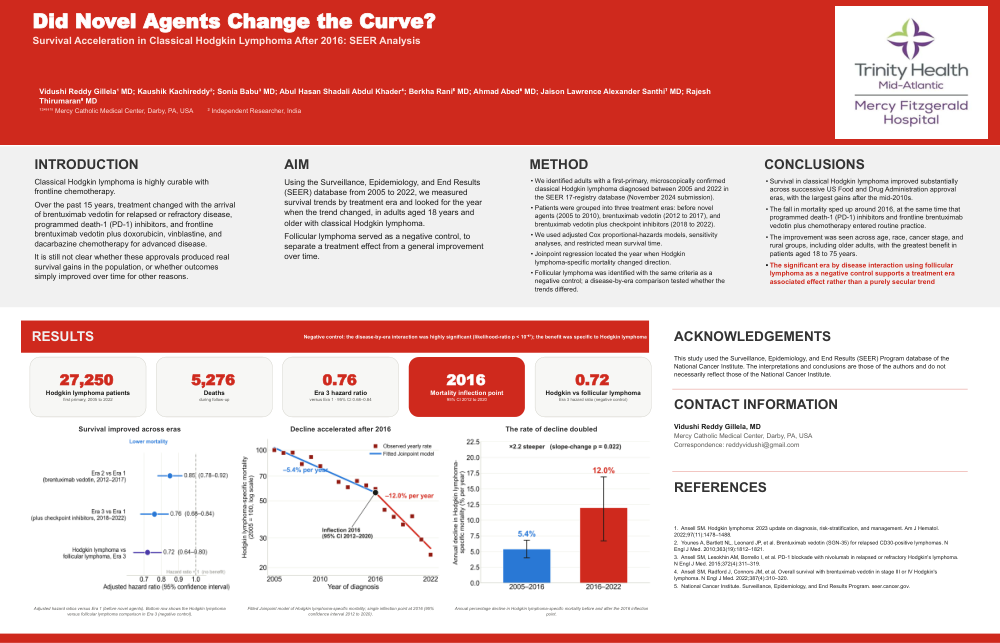
Results- Among 27,250 cHL patients (5,276 deaths), Era 1 was the reference (HR = 1.00); adjusted hazard ratios were 0.85 (95% CI 0.78–0.92) for Era 2 and 0.76 (95% CI 0.68–0.84) for Era 3.
Joinpoint regression identified a single inflection at 2016 (95% CI 2012–2020). The annual decline in HL-specific mortality steepened from 5.4%/yr (4.0–6.8) during 2005–2016 to 12.0%/yr (6.7–16.9) during 2016–2022, more than doubling the rate of decline (slope-change p = 0.022).Era 3 benefit was greatest at ages 18 to 75 ( p value <0.05) and was observed across racial, stage, and rural strata.
In a pooled cHL+FL Cox model with disease-stratified baseline, the era × disease interaction was highly significant (LR p < 10⁻⁹⁷); the cHL Era 3 hazard ratio was 28% lower than FL Era 3 (cHL/FL HR ratio 0.72, 95% CI 0.64–0.80; p < 10⁻⁸).
Conclusion- Population-level survival in classical Hodgkin lymphoma improved substantially across successive FDA approval eras, with the largest gains after the mid-2010s. Mortality declines accelerated around 2016, coinciding with the introduction of PD-1 inhibitors and frontline brentuximab vedotin plus AVD. Improvements were observed across demographic and disease subgroups, including older adults. The significant era-by-disease interaction, using follicular lymphoma as a negative control, supports a treatment-era–associated effect rather than a purely secular trend.