1,267 posters, 47 videos, 13 topics, 4 sessions, 853 authors
ePostersLive by SciGen Technologies S.A. All rights reserved.
SOHO 2026 Annual Meeting
September 9 - 12, 2026 | George R. Brown Convention Center, Houston, Texas

MM - 458
Secondary Primary Malignancies Associated With BCMA-Directed Bispecific Antibodies in Relapsed/Refractory Multiple Myeloma: A FAERS Pharmacovigilance Analysis
Poster Presenter
Authors
Part of Topic
Multiple Myeloma (MM)
Background
Four BCMA-directed bispecific antibodies (BsAbs), teclistamab, talquetamab, elranatamab, and linvoseltamab,
are FDA-approved for relapsed/refractory multiple myeloma (RRMM) after at least four prior lines of therapy.
While immune-related toxicities and infections from these T-cell redirecting agents have been studied, the risk of
secondary primary malignancies (SPMs) is not well defined. We evaluated SPM frequency, characteristics, and
safety signals for the four BsAbs using real-world pharmacovigilance data.
Methods
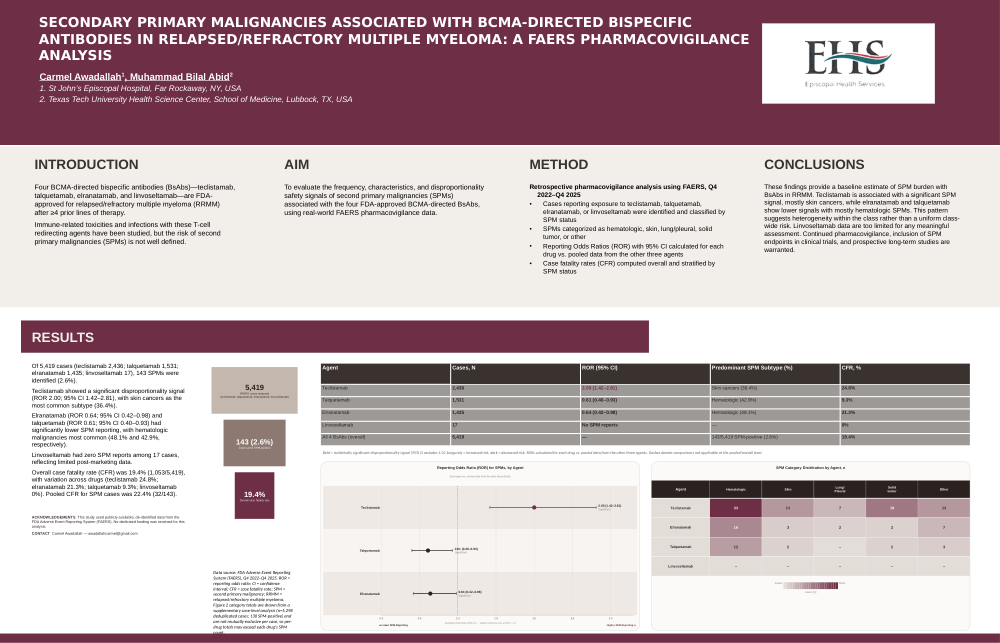
We performed a retrospective analysis of the FDA Adverse Event Reporting System (FAERS) from Q4 2022 to Q4
2025. Cases reporting exposure to the four agents were classified by SPM status and grouped by cancer type
(hematologic, skin, lung/pleural, solid tumor, other). Reporting odds ratios (ROR) with 95% confidence intervals
were calculated for each drug using pooled data from the remaining three as comparators. Case fatality rates
(CFR) were calculated overall and by SPM status.
Results
Of 5419 cases (teclistamab: 2436; talquetamab: 1531; elranatamab: 1435; linvoseltamab: 17), 143 SPMs were
identified (2.6%). Teclistamab showed a significant disproportionality signal (ROR, 2.00; 95% CI, 1.42–2.81), with
skin cancers as the most common subtype (36.4%). Elranatamab (ROR, 0.64; 95% CI, 0.42–0.98) and talquetamab
(ROR, 0.61; 95% CI, 0.40–0.93) had significantly lower SPM reporting, with hematologic malignancies
most common (48.1% and 42.9%, respectively). Linvoseltamab had zero SPM reports among 17 cases, reflecting
limited post-marketing data. Overall CFR was 19.4% (1053/5419), with variation across drugs (teclistamab: 24.8%;
elranatamab: 21.3%; talquetamab: 9.3%; linvoseltamab: 0%). Pooled CFR for SPM cases was 22.4% (32/143).
Conclusion
These findings provide a baseline estimate of SPM burden with BsAbs in RRMM. Teclistamab is associated with a
significant SPM signal, mostly skin cancers, while elranatamab and talquetamab show lower signals with mostly
hematologic SPMs. This pattern suggests heterogeneity within the class rather than a uniform class-wide risk.
Linvoseltamab data are too limited for any meaningful assessment. Continued pharmacovigilance, inclusion of
SPM endpoints in clinical trials, and prospective long-term studies are warranted.
BCMA: B-cell maturation antigen, FDA: Food and Drug Administration
Keywords
MM, secondary primary malignancies, bispecific antibodies, multiple myeloma, teclistamab, talquetamab,
elranatamab, linvoseltamab, FAERS, pharmacovigilance