1,267 posters, 47 videos, 13 topics, 4 sessions, 853 authors
ePostersLive by SciGen Technologies S.A. All rights reserved.
SOHO 2026 Annual Meeting
September 9 - 12, 2026 | George R. Brown Convention Center, Houston, Texas

AML - 454
Persistent DNMT3A Mutations Predicting Relapse After Acute Myeloid Leukemia Remission: A Systematic Review of Molecular Persistence and Circulating DNA Dynamics
Poster Presenter
Authors
Part of Topic
Acute Myeloid Leukemia (AML)
Background: DNA methyltransferase 3 alpha (DNMT3A ) mutations are among the most frequent genetic alterations in acute myeloid leukemia (AML) and also represent the hallmark of age-related clonal hematopoiesis of indeterminate potential (CHIP). Their detection during complete remission therefore poses a major diagnostic dilemma, as current assays cannot reliably distinguish benign preleukemic clones from truly leukemic measurable residual disease (MRD) that will drive relapse.
Objective: To evaluate whether persistent DNMT3A mutations in remission independently predict relapse and whether plasma cell-free DNA (cfDNA) dynamics improve the discrimination between residual leukemia and CHIP-derived clones.
Methods: A systematic review was conducted in accordance with Preferred Reporting Items for Systematic Reviews and Meta-Analyses (PRISMA) 2020, searching PubMed, Embase, Cochrane Library, and Web of Science from inception to 2026. Eligible studies enrolled adults with DNMT3A -mutated AML in first complete remission and assessed MRD by ultrasensitive next-generation sequencing (unique molecular identifier-based, error-corrected, or cfDNA assays) in bone marrow and/or plasma. The primary outcome was relapse-free survival; secondary outcomes included overall survival, cfDNA kinetics, and the influence of comutation status.
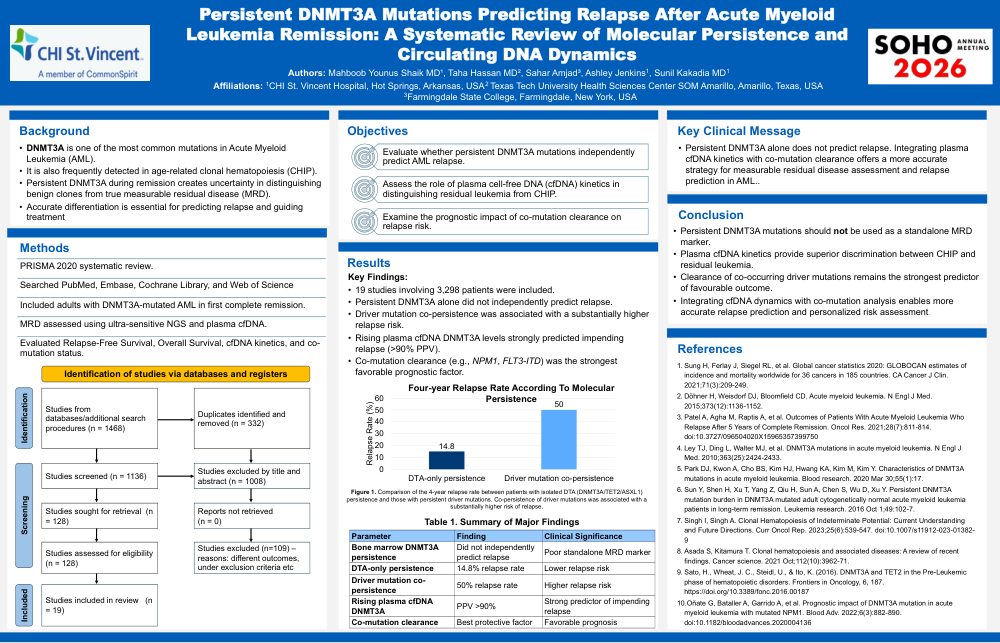
Results: Nineteen studies encompassing 3298 evaluable patients were assessed. Isolated persistence of DNMT3A in bone marrow did not independently predict relapse (4-year relapse rate, 14.8% for drug-tolerant persister-only vs 50% when driver mutations co-persisted). Rising plasma cfDNA DNMT3A variant allele frequency, in contrast, uniformly heralded hematologic relapse, with a positive predictive value exceeding 90% in recent prospective cohorts, whereas stable or declining signals were compatible with indolent CHIP. Co-clearance of actionable driver mutations (eg, nucleophosmin 1 [NPM1 ] and fms-like tyrosine kinase 3-internal tandem duplication [FLT3 -ITD]) was the strongest protective factor.
Conclusion: Persistent DNMT3A mutations in bone marrow must not be used as a standalone MRD marker. A risk-adapted framework incorporating plasma cfDNA kinetics, co-mutation clearance, and age-adjusted thresholds can resolve the CHIP ambiguity, sparing patients unnecessary treatment while capturing imminent relapse.