1,267 posters, 47 videos, 13 topics, 4 sessions, 853 authors
ePostersLive by SciGen Technologies S.A. All rights reserved.
SOHO 2026 Annual Meeting
September 9 - 12, 2026 | George R. Brown Convention Center, Houston, Texas

MM - 453
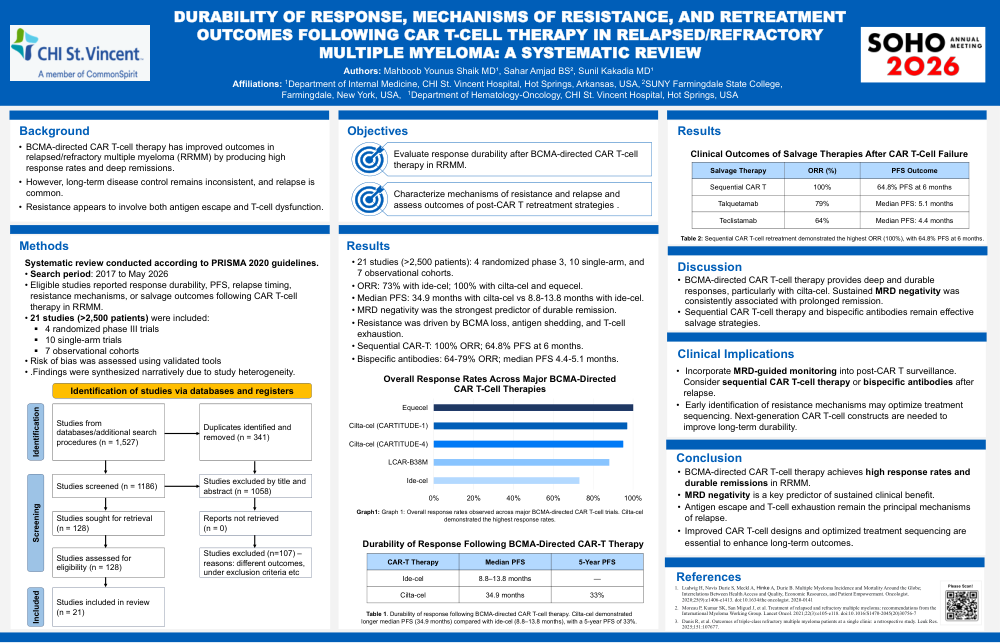
Durability of Response, Mechanisms of Resistance, and Retreatment Outcomes Following CAR T-Cell Therapy in Relapsed/Refractory Multiple Myeloma: A Systematic Review
Poster Presenter
Authors
Part of Topic
Multiple Myeloma (MM)
Background: BCMA-directed CAR-T has transformed the treatment landscape for RRMM, achieving high initial overall and complete response rates. However, durability remains inconsistent, and most patients ultimately experience relapse. The biological mechanisms driving resistance and the optimal management of post-CAR-T failure are incompletely understood.
Objective: To systematically evaluate durability patterns, mechanisms of resistance, and retreatment outcomes following BCMA-directed or investigational CAR-T in adults with RRMM. Methods A systematic review was conducted in accordance with PRISMA 2020 guidelines. PubMed, Embase, Scopus, Web of Science, and the Cochrane Library were searched from 2017 to May 2026 for prospective clinical trials and observational studies reporting duration of response, PFS, relapse timing, resistance mechanisms, or salvage therapy outcomes after CAR-T failure in RRMM. Risk of bias was assessed with validated tools. A narrative synthesis was performed.
Results: Twenty-one primary studies (4 randomized phase 3 trials, 10 single-arm trials, 7 observational cohorts; >2500 patients) were included. Overall response rates ranged from 73% (idecel) to 100% (ciltacel, equecel). Median PFS varied markedly: 34.9 months with ciltacel (5-year PFS, 33%) vs 8.8–13.8 months with idecel. Sustained MRD negativity was the strongest predictor of durable remission. Acquired biallelic TNFRSF17 (BCMA) deletions, γ-secretase-mediated antigen shedding, and early T-cell exhaustion (HAVCR2/TIGIT upregulation, CD8⁺ dysfunction) were dominant resistance mechanisms. Retreatment with sequential CAR-T infusion achieved 100% overall response and 6-month PFS of 64.8%, while bispecific antibodies (teclistamab/talquetamab) yielded 64%– 79% response rates but median PFS of only 4.4–5.1 months.
Conclusion: CAR-T provides unprecedented depth of response in RRMM, yet relapse remains an expected event for most patients. Resistance is multifactorial, involving dynamic antigen escape and T-cell exhaustion. Salvage strategies demonstrate activity but attenuate durability, emphasizing the need for rational sequencing, MRD-guided surveillance, and novel constructs designed to overcome tumor-immune co-evolution.