1,267 posters, 47 videos, 13 topics, 4 sessions, 853 authors
ePostersLive by SciGen Technologies S.A. All rights reserved.
SOHO 2026 Annual Meeting
September 9 - 12, 2026 | George R. Brown Convention Center, Houston, Texas

MM - 442
An Actionability Score for BCMA-, GPRC5D-, and CD38-targeted therapy selection in multiple myeloma
Poster Presenter
Authors
Part of Topic
Multiple Myeloma (MM)
An Actionability Score for BCMA-, GPRC5D-, and CD38-targeted therapy selection in multiple myeloma
Introduction / Background
In multiple myeloma (MM), the absence of predictive biomarkers forces clinical teams to select CAR-T and T-cell engager (TCE) therapies based solely on prior lines of treatment. This lack of precision leaves clinical development vulnerable to diluted efficacy, unoptimized trial cohorts, and critical guesswork in selecting both target (e.g., BCMA vs. GPRC5D) and therapeutic modality (e.g., CAR-T vs. TCE). To solve this bottleneck, we developed an NGS-based Actionability Score (AS) framework that integrates malignant plasma cell dynamics and tumor microenvironment (TME) features.
Methods
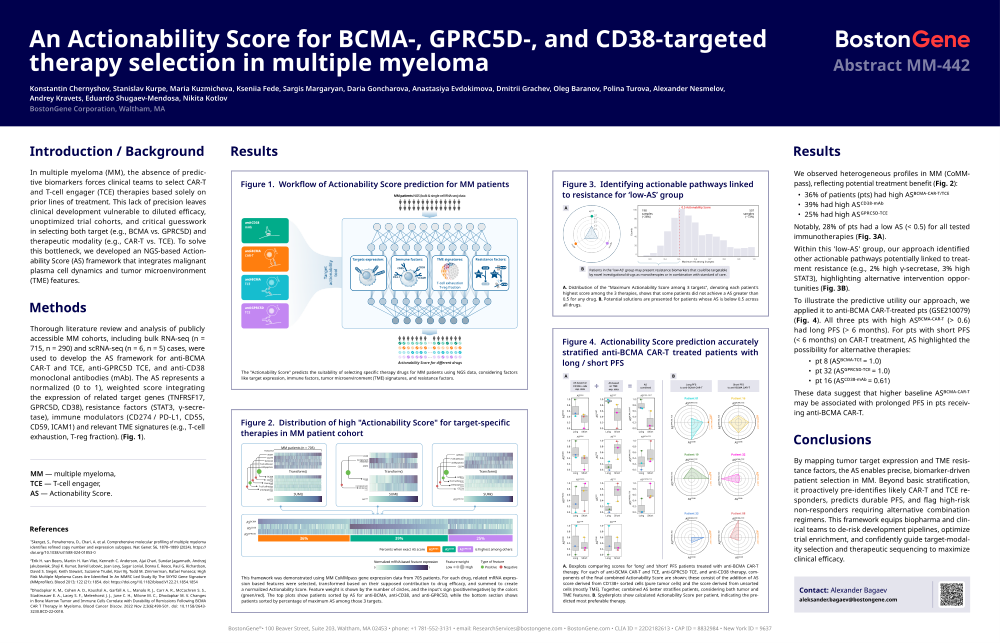
Thorough literature review and analysis of publicly accessible MM cohorts, including bulk RNA-seq (n = 715, n = 290) and scRNA-seq (n = 6, n = 5) cases, were used to develop the AS framework for anti-BCMA CAR-T and TCE, anti-GPRC5D TCE, and anti-CD38 monoclonal antibodies (mAb). The AS represents a normalized (0 to 1), weighted score integrating expression of target genes (TNFRSF17, GPRC5D, CD38), resistance factors (STAT3, γ-secretase), immune modulators (CD274 / PD-L1, CD55, CD59, ICAM1) and relevant TME signatures (e.g., T-cell exhaustion, T-reg fraction). (Fig. 1)
Results
We observed heterogeneous profiles in MM (CoMM-pass), reflecting potential treatment benefit (Fig. 2):
Within this 'low-AS' group, our approach identified other actionable pathways potentially linked to treat-ment resistance(e.g., 2% high γ-secretase, 3% high STAT3), highlighting alternative intervention oppor-tunities (Fig. 3B).
To illustrate the predictive utility our approach, we applied it to anti-BCMA CAR-T-treated pts (GSE210079)(Fig. 4).All three pts with high ASBCMA-CAR-T(> 0.6) had longPFS (> 6 months). For pts with short PFS (< 6 months) on CAR-T treatment, AS highlighted the possibility for alternative therapies:
- 36% of patients (pts) had high ASBCMA-CAR-T/TCE
- 39% had high ASCD38-mAb
- 25% had high ASGPRC5D-TCE
Within this 'low-AS' group, our approach identified other actionable pathways potentially linked to treat-ment resistance(e.g., 2% high γ-secretase, 3% high STAT3), highlighting alternative intervention oppor-tunities (Fig. 3B).
To illustrate the predictive utility our approach, we applied it to anti-BCMA CAR-T-treated pts (GSE210079)(Fig. 4).All three pts with high ASBCMA-CAR-T(> 0.6) had longPFS (> 6 months). For pts with short PFS (< 6 months) on CAR-T treatment, AS highlighted the possibility for alternative therapies:
-
- pt 8 (ASBCMA-TCE = 1.0)
- pt 32 (ASGPRC5D-TCE = 1.0)
- pt 16 (ASCD38-mAb = 0.61)
Conclusions
These data suggest that higher baseline ASBCMA-CAR-T may be associated with prolonged PFS in pts receiv-ing anti-BCMA CAR-T.
By mapping tumor target expression and TME resis-tance factors, the AS enables precise, biomarker-driven patient selection in MM. Beyond basic stratification, it proactively pre-identifies likely CAR-T and TCE re-sponders, predicts durable PFS, and flag high-risk non-responders requiring alternative combination regimens. This framework equips biopharma and clin-ical teams to de-risk development pipelines, optimize trial enrichment, and confidently guide target-modal-ity selection and therapeutic sequencing to maximize clinical efficacy.
Figure Legends & Captions
- Figure 1. Workflow of Actionability Score prediction for MM patients
The "Actionability Score" predicts the suitability of selecting specific therapy drugs for MM patients using NGS data, considering factors like target expression, immune factors, tumor microenvironment (TME) signatures, and resistance factors. - Figure 2. Distribution of high "Actionability Score" for target-specific therapies in MM patient cohort
This framework was demonstrated using MM (CoMMpass) gene expression data from 715 patients. For each drug, related mRNA expression-based features were calculated, transformed based on their supposed contribution to drug efficacy, and combined to create a normalized Actionability Score. Feature weight is shown by the number of circles, and the inputs sign (positive/negative) by the colored backgrounds. The top plots show patients sorted by AS for anti-BCMA, anti-CD38, and anti-GPRC5D, while the bottom section shows patients scaled by percentage of maximum AS among these 3 targets. - Figure 3. Identifying actionable pathways linked to resistance for 'low-AS' group
(A) Distribution of the "Maximum Actionability Score among 3 targets", mimicking each patient's highest score among the 3 therapies; shows that some patients did not achieve a high baseline AS for any drug. (B) Potential solutions are presented for patients whose AS is below 0.5 across all drugs. - Figure 4. Actionability Score prediction accurately stratified anti-BCMA CAR-T treated patients with long / short PFS
(A) Deep dive comparing scored for long and short PFS patients treated with anti-BCMA CAR-T therapy. For each of anti-BCMA CAR-T and TCE, anti-GPRC5D TCE, and anti-CD38 mAb, composition of the final combined Actionability Score are shown: regular components of the addition of score derived from CD138+ sorted cells (tumor cells) and the score derived from unmatched cells (mostly TME). Together, combined AS better stratifies patients, considering both tumor and TME features. (B) Spider plots show combined Actionability Score per patient, indicating the predicted preferred therapy.