1,267 posters, 47 videos, 13 topics, 4 sessions, 853 authors
ePostersLive by SciGen Technologies S.A. All rights reserved.
SOHO 2026 Annual Meeting
September 9 - 12, 2026 | George R. Brown Convention Center, Houston, Texas

CML - 426
Efficacy and Safety of Asciminib as Second-Line or Later Therapy in Chronic-Phase Chronic Myeloid Leukemia: An Updated Systematic Review and Meta-Analysis
Poster Presenter
Authors
Part of Topic
Chronic Myeloid Leukemia (CML)
Title:
Efficacy and Safety of Asciminib As Second-Line or Later Therapy in Chronic-Phase Chronic Myeloid Leukemia: An Updated Systematic Review and Meta-Analysis
INTRODUCTION:
- Chronic myeloid leukemia in chronic phase (CML-CP) patients who develop resistance or intolerance to prior tyrosine kinase inhibitors (TKIs) remain a major therapeutic challenge, particularly in later-line settings.
- Asciminib, a first-in-class Specifically Targeting the ABL Myristoyl Pocket (STAMP) inhibitor, represents a novel therapeutic strategy for previously treated CML-CP.
- A prior meta-analysis by Fan et al. reported a pooled major molecular response (MMR) rate of approximately 47% with asciminib beyond first-line therapy.
- Since that publication, additional clinical and real-world studies have become available, including studies evaluating earlier-line use of asciminib.
Methods:
- Study objective: To provide updated pooled estimates of the efficacy and safety of asciminib as second-line or later therapy for chronic myeloid leukemia in chronic phase (CML-CP) and evaluate the influence of treatment line on molecular response.
- Study design: Systematic review and meta-analysis conducted according to Preferred Reporting Items for Systematic Reviews and Meta-Analyses (PRISMA) 2020 guidelines.
- Literature search: PubMed, EMBASE, Web of Science, and Cochrane Library were searched through October 2025.
- Eligibility: Studies including adult patients with CML-CP receiving asciminib as second-line or later therapy and reporting molecular response or safety outcomes were eligible.
- Study types: Randomized trials, comparative studies, and observational cohorts were included.
- Primary outcome: Pooled major molecular response (MMR).
- Secondary outcomes:MR4, Grade ≥3 adverse events (AEs)
- Subgroup analysis: Molecular response was compared between second-line therapy (2L) and third-line or later therapy (≥3L).
RESULTS:
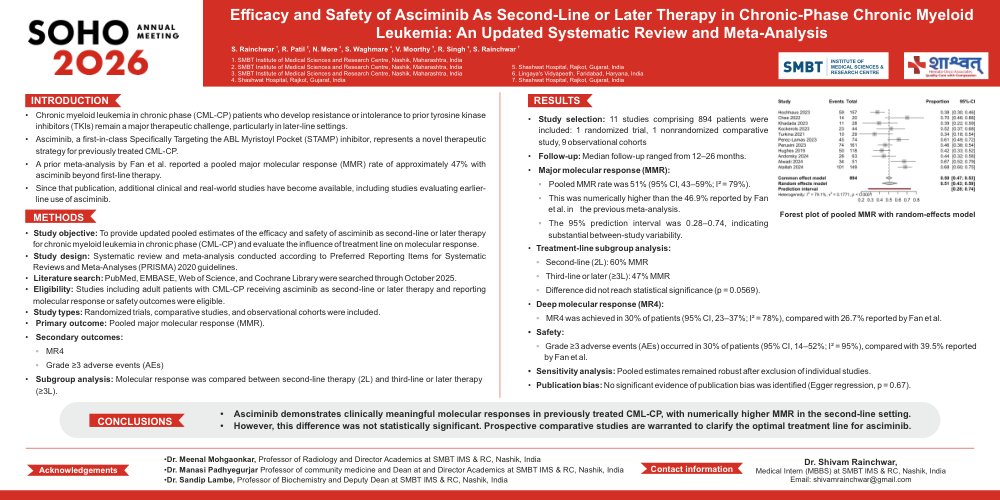
- Study selection: 11 studies comprising 894 patients were included: 1 randomized trial, 1 nonrandomized comparative study, 9 observational cohorts
- Follow-up: Median follow-up ranged from 12–26 months.
- Major molecular response (MMR):
- Pooled MMR rate was 51% (95% CI, 43–59%; I² = 79%).
- This was numerically higher than the 46.9% reported by Fan et al. in the previous meta-analysis.
- The 95% prediction interval was 0.28–0.74, indicating substantial between-study variability.
- Treatment-line subgroup analysis:
- Second-line (2L): 60% MMR
- Third-line or later (≥3L): 47% MMR
- Difference did not reach statistical significance (p = 0.0569).
- Deep molecular response (MR4):
- MR4 was achieved in 30% of patients (95% CI, 23–37%; I² = 78%), compared with 26.7% reported by Fan et al.
- Safety:
- Grade ≥3 adverse events (AEs) occurred in 30% of patients (95% CI, 14–52%; I² = 95%), compared with 39.5% reported by Fan et al.
- Sensitivity analysis: Pooled estimates remained robust after exclusion of individual studies.
- Publication bias: No significant evidence of publication bias was identified (Egger regression, p = 0.67).
Conclusions:
- Asciminib demonstrates clinically meaningful molecular responses in previously treated CML-CP, with numerically higher MMR in the second-line setting.
- However, this difference was not statistically significant. Prospective comparative studies are warranted to clarify the optimal treatment line for asciminib.