1,267 posters, 47 videos, 13 topics, 4 sessions, 853 authors
ePostersLive by SciGen Technologies S.A. All rights reserved.
SOHO 2026 Annual Meeting
September 9 - 12, 2026 | George R. Brown Convention Center, Houston, Texas

MM - 386
Baseline Risk Modifiers for Multiple Myeloma Following Herpes Zoster: A Multicenter Retrospective Cohort Study
Poster Presenter
Authors
Part of Topic
Multiple Myeloma (MM)
Baseline Risk Modifiers for Multiple Myeloma Following Herpes Zoster: A Multicenter Retrospective Cohort Study
A Anand, MBBS; X Zhang, MD; P Ezhilarasu, MBBS; A Kumar, MBBS
Jacobi Medical Center, Bronx, NY, USA
Keywords: MM, zoster, Cox proportional hazards
INTRODUCTION
-
Herpes zoster (HZ) has been proposed as a marker of impaired immune surveillance related to aging and comorbidities.
-
Retrospective studies and meta-analyses have demonstrated an association between HZ and hematologic malignancies, particularly multiple myeloma (MM) and non-Hodgkin lymphoma.
-
The risk appears greatest during the first 1–2 years and attenuates thereafter.
-
Data regarding risk factors remain limited. We evaluated risk modifiers associated with development of MM following HZ infection.
AIM
To identify baseline risk factors for multiple myeloma (MM) following herpes zoster (HZ) and evaluate the impact of cumulative risk-factor burden on MM risk at 1 and 5 years.
METHODS
-
Design: Multicenter retrospective cohort study using the TriNetX Global Collaborative Network.
-
Population: Adult patients with a first instance of HZ and no prior hematologic malignancy between January 1, 2015, and December 31, 2019.
-
Analysis: Cox proportional hazards modeling identified risk factors associated with incident MM up to 5 years following HZ diagnosis.
-
Patients were stratified into groups with 1–2, 3–4, or 5 risk factors and compared with HZ patients without identified risk factors.
-
Incidence of MM was evaluated at 1- and 5-year follow-up.
RESULTS
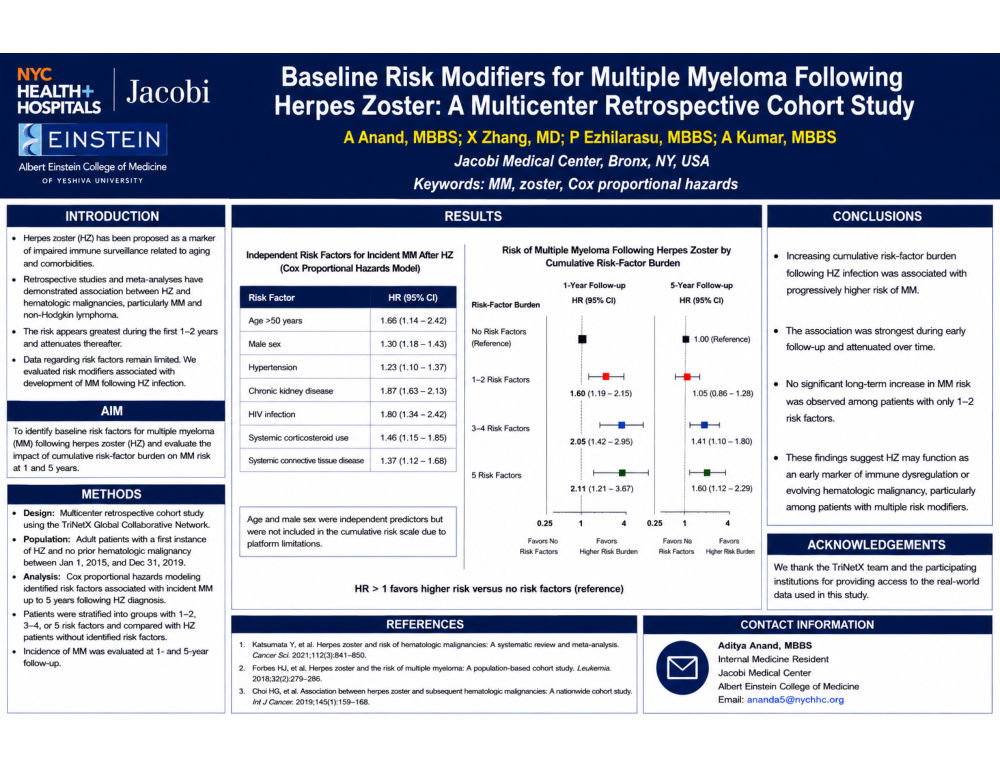
Independent Risk Factors for Incident MM After HZ
(Cox Proportional Hazards Model)
| Risk Factor | HR (95% CI) |
|---|---|
| Age >50 years | 1.66 (1.14–2.42) |
| Male sex | 1.30 (1.18–1.43) |
| Hypertension | 1.23 (1.10–1.37) |
| Chronic kidney disease | 1.87 (1.63–2.13) |
| HIV infection | 1.80 (1.34–2.42) |
| Systemic corticosteroid use | 1.46 (1.15–1.85) |
| Systemic connective tissue disease | 1.37 (1.12–1.68) |
Age and male sex were independent predictors but were not included in the cumulative risk scale due to platform limitations.
Risk of Multiple Myeloma Following Herpes Zoster by Cumulative Risk-Factor Burden
| Risk-Factor Burden | 1-Year HR (95% CI) | 5-Year HR (95% CI) |
|---|---|---|
| No risk factors | Reference | Reference |
| 1–2 risk factors | 1.60 (1.19–2.15) | 1.05 (0.86–1.28) |
| 3–4 risk factors | 2.05 (1.42–2.95) | 1.41 (1.10–1.80) |
| 5 risk factors | 2.11 (1.21–3.67) | 1.60 (1.12–2.29) |
Forest plot interpretation: HR >1 indicates higher MM risk compared with patients without identified risk factors.
CONCLUSIONS
-
Increasing cumulative risk-factor burden following HZ infection was associated with progressively higher risk of MM.
-
The association was strongest during early follow-up and attenuated over time.
-
No significant long-term increase in MM risk was observed among patients with only 1–2 risk factors.
-
These findings suggest HZ may function as an early marker of immune dysregulation or evolving hematologic malignancy, particularly among patients with multiple risk modifiers.
ACKNOWLEDGEMENTS
We thank the TriNetX team and the participating institutions for providing access to the real-world data used in this study.
CONTACT INFORMATION
Aditya Anand, MBBS
Internal Medicine Resident
Jacobi Medical Center
Albert Einstein College of Medicine
Email: ananda5@nychhc.org