1,267 posters, 47 videos, 13 topics, 4 sessions, 853 authors
ePostersLive by SciGen Technologies S.A. All rights reserved.
SOHO 2026 Annual Meeting
September 9 - 12, 2026 | George R. Brown Convention Center, Houston, Texas

AML - 350
Suicide Mortality Among Hematological Malignancy Survivors: A Population-Based SEER-CDC analysis
Poster Presenter
Authors
Part of Topic
Acute Myeloid Leukemia (AML)
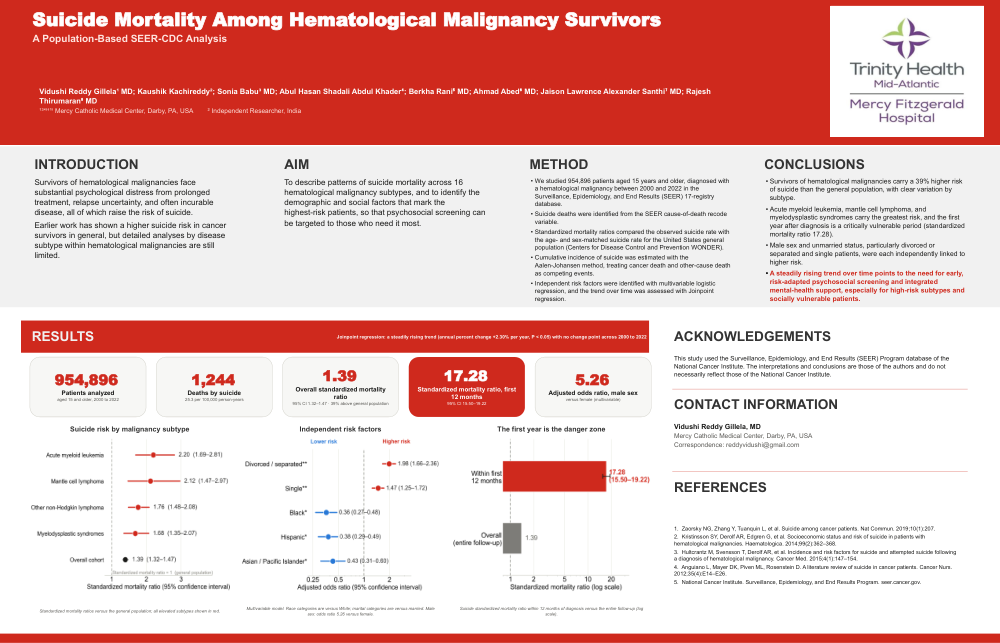
Background: Survivors of hematological malignancies experience substantial psychological distress due to prolonged treatment, relapse uncertainty, and often incurable disease, contributing to increased suicide risk. Although prior studies have shown elevated suicide risk in this population, detailed analyses across hematologic malignancy subtypes remain limited. We evaluated suicide mortality patterns across 16 hematological malignancy subtypes to identify high-risk groups and associated demographic and social risk factors.
Methods- We identified 954,896 patients aged ≥15 years diagnosed with hematological malignancies (2000-2022) from the Surveillance, Epidemiology, and End Results (SEER) 17-registry database. Suicide deaths were identified using the cause-of-death recode variable. Standardized mortality ratios (SMRs) were calculated using age- and sex-matched US general population suicide rate . Cumulative incidence of suicide was estimated using the Aalen-Johansen method with cancer death and other-cause death as competing events. Multivariable logistic regression was used to identify independent risk factors.
Results - Among 954,896 patients 56.2% of the cohort were males and 43.8% were females. Out of which1,244 died by suicide (crude rate: 25.3 per 100,000 person-years) over 4.92 million person-years. The overall SMR was 1.39 (95% CI: 1.32-1.47). The highest SMRs by subtype were: AML (2.20; 1.69-2.81), mantle cell lymphoma (2.12; 1.47-2.97), other NHL (1.76; 1.48-2.08), and MDS (1.68; 1.35-2.07). Risk was dramatically elevated within the first 12 months of diagnosis (SMR=17.28; 15.50-19.22). On multivariable analysis, male sex (OR=5.26), divorced/separated status (OR=1.98; 1.66-2.36), and single status (OR=1.47; 1.25-1.72) were independently associated with increased risk. Black (OR=0.36 ;0.27-0.48), Hispanic (OR=0.38; 0.29-0.49), and Asian/Pacific Islander (OR=0.43;0.31-0.60) patients had lower risk versus White patients. Joinpoint regression demonstrated a significant increasing trend (APC=2.30%, P<0.05) with no inflection points over the study period.
Conclusion- Hematological malignancy survivors have a 39% higher suicide risk than the general population, with marked subtype variation. AML, mantle cell lymphoma, and MDS carry the greatest risk, with the first year post diagnosis being a critically vulnerable period(SMR=17.28). Male sex and unmarried status, particularly divorced/separated and single patients, were independently associated with increased risk. A statistically significant increasing temporal trend calls for the need for early, risk-adapted psychosocial screening and integrated mental health support, especially for high-risk subtypes and socially vulnerable patients.