1,267 posters, 47 videos, 13 topics, 4 sessions, 853 authors
ePostersLive by SciGen Technologies S.A. All rights reserved.
SOHO 2026 Annual Meeting
September 9 - 12, 2026 | George R. Brown Convention Center, Houston, Texas

AML - 296
ADAM17-Driven NKG2D Ligand Shedding Defines a Leukemia-Intrinsic Immune Evasion Program That Predicts Venetoclax Resistance and Reveals MEK and PI3K As Therapeutic Vulnerabilities in AML
Poster Presenter
Authors
Part of Topic
Acute Myeloid Leukemia (AML)
Title: ADAM17-Driven NKG2D Ligand Shedding Defines a Leukemia-Intrinsic Immune Evasion Program That Predicts Venetoclax Resistance and Reveals MEK and PI3K as Therapeutic Vulnerabilities in AML
Authors: Abdelrahman Masheh (presenting), Ahmad Alyamani, Abdallah Attiyeh, Ayah Nueirat, Ahmad Shawish, Abdallah Abusafieh
Affiliations: Faculty of Medicine, The Hashemite University, Zarqa, Jordan; Department of Pharmacy, King Hussein Cancer Center, Amman, Jordan
Keywords: acute myeloid leukemia, AML, venetoclax resistance, immune evasion, ADAM17, NKG2D ligand shedding, NK cell, MEK inhibitors, PI3K inhibitors, BeatAML, TCGA-LAML
Background: Venetoclax-based combinations have transformed acute myeloid leukemia (AML) therapy, yet primary resistance remains common and is inadequately predicted by existing molecular classifiers. Leukemia-intrinsic immune evasion, particularly the shedding of NKG2D ligands from the blast surface may represent an underappreciated resistance mechanism that shapes innate immune escape and downstream survival signaling.
Objective: To link a transcriptional natural killer (NK) evasion program directly to ex vivo venetoclax sensitivity in a primary AML cohort.
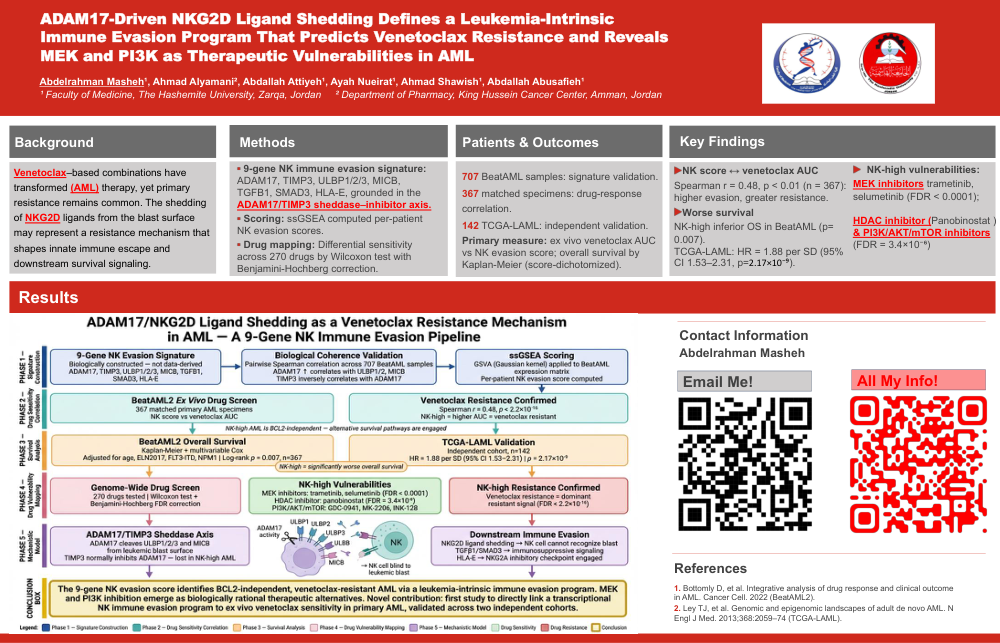
Methods: Retrospective in silico analysis defining a 9-gene NK immune evasion signature (ADAM17, TIMP3, ULBP1, ULBP2, ULBP3, MICB, TGFB1, SMAD3, HLA-E), grounded in the ADAM17/TIMP3 sheddase-inhibitor axis. Internal biological coherence was validated by pairwise Spearman correlation. ssGSEA computed per-patient NK evasion scores. Differential sensitivity across 270 drugs was assessed by Wilcoxon test with Benjamini-Hochberg correction.
Patients and outcomes: 707 BeatAML samples for signature validation; 367 matched specimens for drug-response correlation; independent validation in TCGA-LAML (n=142). Primary measure: ex vivo venetoclax AUC correlated with NK evasion score; overall survival compared by Kaplan-Meier between score-dichotomized (median) groups.
Results: The NK evasion score correlated strongly with ex vivo venetoclax AUC (Spearman r = 0.48, p < 2.2×10⁻¹⁶, n=367), higher evasion, greater resistance. NK-high patients (above median) had significantly inferior overall survival in BeatAML (log-rank p = 0.007, n=367), replicated in TCGA-LAML (HR = 1.88 per SD, 95% CI 1.53–2.31, p = 2.17×10⁻⁹, n=142). Drug vulnerability mapping identified selective activity in NK-high AML for MEK inhibitors (trametinib, selumetinib; FDR < 0.0001), the HDAC inhibitor panobinostat (FDR = 3.4×10⁻⁶), and PI3K/AKT/mTOR inhibitors (GDC-0941, MK-2206, INK-128). Venetoclax resistance was the dominant resistant signal (FDR < 2.2×10⁻¹⁶).
Conclusions: An ADAM17-centered NK immune evasion score identifies venetoclax-resistant AML across two independent cohorts and associates with a survival disadvantage equivalent to an 88% increase in hazard per standard deviation of score. This phenotype is consistent with BCL2 independence and engagement of compensatory MAPK and PI3K survival signaling, nominating MEK and PI3K inhibitors as biologically rational alternatives for refractory patients. Prospective biomarker-stratified trials are required before clinical implementation.
References: (1) Bottomly D, et al. Integrative analysis of drug response and clinical outcome in AML. Cancer Cell. 2022 (BeatAML2).
(2) Ley TJ, et al. Genomic and epigenomic landscapes of adult de novo AML. N Engl J Med. 2013;368:2059–74 (TCGA-LAML).