1,267 posters, 47 videos, 13 topics, 4 sessions, 853 authors
ePostersLive by SciGen Technologies S.A. All rights reserved.
SOHO 2026 Annual Meeting
September 9 - 12, 2026 | George R. Brown Convention Center, Houston, Texas

IBCL - 291
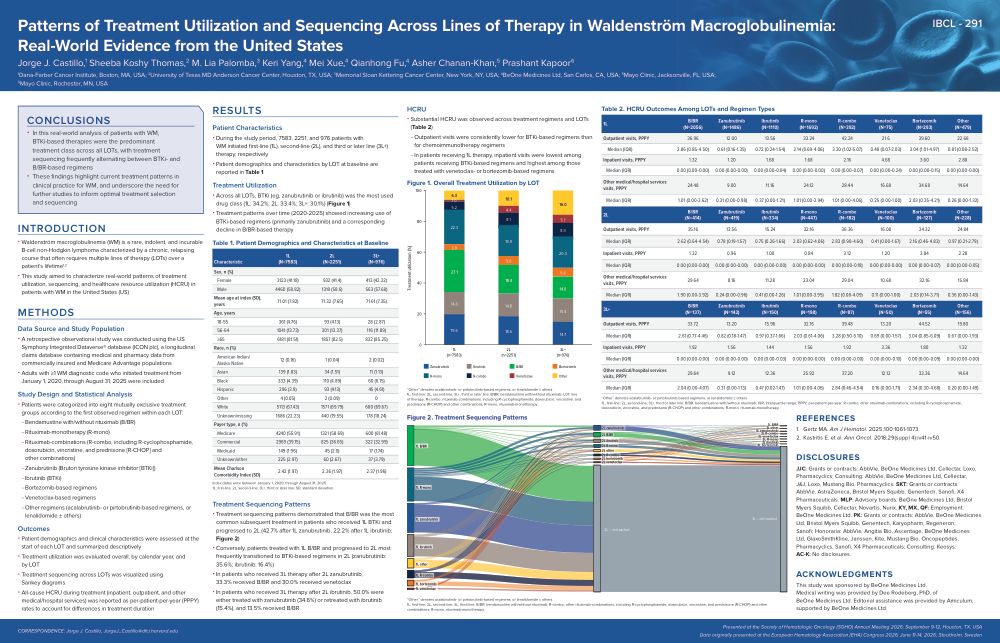
Patterns of Treatment Utilization and Sequencing Across Lines of Therapy in Waldenstrφm Macroglobulinemia: Real-World Evidence From the United States
Poster Presenter
Authors
Part of Topic
Indolent B-Cell Lymphoma (IBCL)
Video
Patterns of Treatment Utilization and Sequencing Across Lines of Therapy in Waldenström Macroglobulinemia: Real-World Evidence from the United States
Jorge J. Castillo,1 Sheeba Koshy Thomas,2 M. Lia Palomba,3 Keri Yang,4 Mei Xue,4 Qianhong Fu,4 Asher Chanan-Khan,5 Prashant Kapoor6
1Dana-Farber Cancer Institute, Boston, MA, USA; 2University of Texas MD Anderson Cancer Center, Houston, TX, USA; 3Memorial Sloan Kettering Cancer Center, New York, NY, USA; 4BeOne Medicines Ltd, San Carlos, CA, USA; 5Mayo Clinic, Jacksonville, FL, USA; 6Mayo Clinic, Rochester, MN, USA
Presented at the Society of Hematologic Oncology (SOHO) Annual Meeting 2026; September 9-12, Houston, TX, USA
Data originally presented at the European Hematology Association (EHA) Congress 2026; June 11-14, 2026; Stockholm, Sweden
CORRESPONDENCE: Jorge J. Castillo, JorgeJ_Castillo@dfci.harvard.edu
CONCLUSIONS
• In this real‑world analysis of patients with WM, BTKi‑based therapies were the predominant treatment class across all LOTs, with treatment sequencing frequently alternating between BTKi- and B/BR-based regimens
• These findings highlight current treatment patterns in clinical practice for WM, and underscore the need for further studies to inform optimal treatment selection and sequencing
INTRODUCTION
• Waldenström macroglobulinemia (WM) is a rare, indolent, and incurable B‑cell non‑Hodgkin lymphoma characterized by a chronic, relapsing course that often requires multiple lines of therapy (LOTs) over a patient’s lifetime1,2
• This study aimed to characterize real-world patterns of treatment utilization, sequencing, and healthcare resource utilization (HCRU) in patients with WM in the United States (US)
METHODS
Data Source and Study Population
• A retrospective observational study was conducted using the US Symphony Integrated Dataverse® database (ICON plc), a longitudinal claims database containing medical and pharmacy data from commercially insured and Medicare Advantage populations
• Adults with ≥1 WM diagnostic code who initiated treatment from January 1, 2020, through August 31, 2025 were included
Study Design and Statistical Analysis
• Patients were categorized into eight mutually exclusive treatment groups according to the first observed regimen within each LOT:
– Bendamustine with/without rituximab (B/BR)
– Rituximab-monotherapy (R-mono)
– Rituximab-combinations (R-combo, including R-cyclophosphamide, doxorubicin, vincristine, and prednisone [R-CHOP] and other combinations)
– Zanubrutinib (Bruton tyrosine kinase inhibitor [BTKi])
– Ibrutinib (BTKi)
– Bortezomib-based regimens
– Venetoclax-based regimens
– Other regimens (acalabrutinib- or pirtobrutinib-based regimens, or lenalidomide ± others)
Outcomes
• Patient demographics and clinical characteristics were assessed at the start of each LOT and summarized descriptively
• Treatment utilization was evaluated overall, by calendar year, and by LOT
• Treatment sequencing across LOTs was visualized using
Sankey diagrams
• All-cause HCRU during treatment (inpatient, outpatient, and other medical/hospital services) was reported as per‑patient‑per‑year (PPPY) rates to account for differences in treatment duration
RESULTS
Patient Characteristics
• During the study period, 7583, 2251, and 976 patients with WM initiated first-line (1L), second-line (2L), and third or later line (3L+) therapy, respectively
• Patient demographics and characteristics by LOT at baseline are reported in Table 1 Treatment Utilization
• Across all LOTs, BTKi (eg, zanubrutinib or ibrutinib) was the most used drug class (1L: 34.2%; 2L: 33.4%; 3L+: 30.1%) (Figure 1)
• Treatment patterns over time (2020-2025) showed increasing use of BTKi‑based regimens (primarily zanubrutinib) and a corresponding decline in B/BR‑based therapy
Treatment Sequencing Patterns
• Treatment sequencing patterns demonstrated that B/BR was the most common subsequent treatment in patients who received 1L BTKi and progressed to 2L (42.7% after 1L zanubrutinib, 22.2% after 1L ibrutinib;Figure 2)
• Conversely, patients treated with 1L B/BR and progressed to 2L most frequently transitioned to BTKi‑based regimens in 2L (zanubrutinib: 35.6%; ibrutinib: 16.4%)
• In patients who received 3L therapy after 2L zanubrutinib, 33.3% received B/BR and 30.0% received venetoclax
• In patients who received 3L therapy after 2L ibrutinib, 50.0% were either treated with zanubrutinib (34.6%) or retreated with ibrutinib (15.4%), and 13.5% received B/BR
HCRU
• Substantial HCRU was observed across treatment regimens and LOTs (Table 2)
– Outpatient visits were consistently lower for BTKi-based regimens than for chemoimmunotherapy regimens
– In patients receiving 1L therapy, inpatient visits were lowest among patients receiving BTKi-based regimens and highest among those treated with venetoclax- or bortezomib‑based regimens
REFERENCES
1. Gertz MA. Am J Hematol. 2025;100:1061-1073.
2. Kastritis E, et al. Ann Oncol. 2018;29(suppl 4):iv41-iv50.
DISCLOSURES
JJC: Grants or contracts: AbbVie, BeOne Medicines Ltd, Cellectar, Loxo, Pharmacyclics; Consulting: AbbVie, BeOne Medicines Ltd, Cellectar, J&J, Loxo, Mustang Bio, Pharmacyclics. SKT: Grants or contracts: AbbVie, AstraZeneca, Bristol Myers Squibb, Genentech, Sanofi, X4 Pharmaceuticals. MLP: Advisory boards: BeOne Medicines Ltd, Bristol Myers Squibb, Cellectar, Novartis, Nurix. KY, MX, QF: Employment: BeOne Medicines Ltd. PK: Grants or contracts: AbbVie, BeOne Medicines Ltd, Bristol Myers Squibb, Genentech, Karyopharm, Regeneron, Sanofi; Honoraria: AbbVie, Angitia Bio, Ascentage, BeOne Medicines Ltd, GlaxoSmithKline, Janssen, Kite, Mustang Bio, Oncopeptides, Pharmacyclics, Sanofi, X4 Pharmaceuticals; Consulting: Keosys. AC-K: No disclosures.
ACKNOWLEDGMENTS
This study was sponsored by BeOne Medicines Ltd. Medical writing was provided by Dee Rodeberg, PhD, of BeOne Medicines Ltd. Editorial assistance was provided by Amiculum, supported by BeOne Medicines Ltd.