1,267 posters, 47 videos, 13 topics, 4 sessions, 853 authors
ePostersLive by SciGen Technologies S.A. All rights reserved.
SOHO 2026 Annual Meeting
September 9 - 12, 2026 | George R. Brown Convention Center, Houston, Texas

AML - 289
Integrating Molecular Profiling To Predict Immunophenotypic MRD Clearance in Acute Myeloid Leukemia
Poster Presenter
Authors
Part of Topic
Acute Myeloid Leukemia (AML)
CONTEXT: Minimal residual disease (MRD) is a powerful prognostic factor in acute myeloid leukemia (AML). However, molecular predictors of immunophenotypic MRD clearance remain unclear.
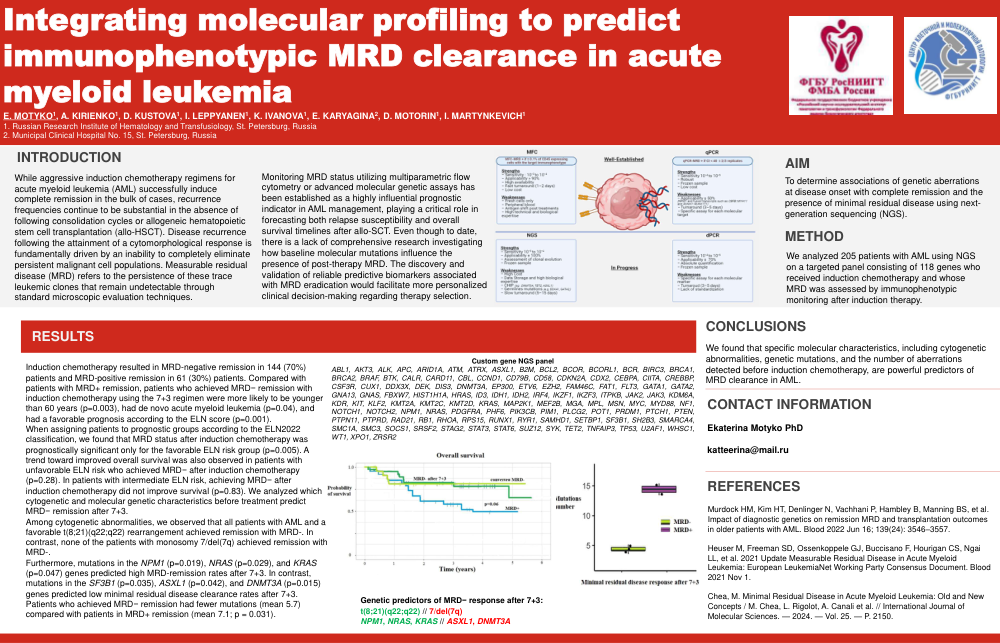
OBJECTIVE: To determine associations of genetic aberrations at disease onset with complete remission and the presence of minimal residual disease using next-generation sequencing (NGS).
METHODS: We analyzed 205 patients with AML using NGS on a targeted panel consisting of 118 genes who received induction chemotherapy and whose MRD was assessed by immunophenotypic monitoring after induction therapy.
RESULTS: Induction chemotherapy resulted in MRD-negative remission in 144 (70%) patients and MRD-positive remission in 61 (30%) patients. Compared with patients with MRD+ remission, patients who achieved MRD− remission with induction chemotherapy using the 7+3 regimen were more likely to be younger than 60 years (p=0.003), had de novo acute myeloid leukemia (p=0.04), and had a favorable prognosis according to the ELN score (p=0.001).
When assigning patients to prognostic groups according to the ELN2022 classification, we found that MRD status after induction chemotherapy was prognostically significant only for the favorable ELN risk group (p=0.005). A trend toward improved overall survival was also observed in patients with unfavorable ELN risk who achieved MRD− after induction chemotherapy (p=0.28). In patients with intermediate ELN risk, achieving MRD− after induction chemotherapy did not improve survival (p=0.83). We analyzed which cytogenetic and molecular genetic characteristics before treatment predict MRD− remission after 7+3.
Among cytogenetic abnormalities, we observed that all patients with AML and a favorable t(8;21)(q22;q22) rearrangement achieved remission with MRD-. In contrast, none of the patients with monosomy 7/del(7q) achieved remission with MRD-.
Furthermore, mutations in the NPM1 (p=0.019), NRAS (p=0.029), and KRAS (p=0.047) genes predicted high MRD-remission rates after 7+3. In contrast, mutations in the SF3B1 (p=0.035), ASXL1 (p=0.042), and DNMT3A (p=0.015) genes predicted low minimal residual disease clearance rates after 7+3.
Patients who achieved MRD− remission had fewer mutations (mean 5.7) compared with patients in MRD+ remission (mean 7.1; p = 0.031).
CONCLUSIONS: We found that specific molecular characteristics, including cytogenetic abnormalities, genetic mutations, and the number of aberrations detected before induction chemotherapy, are powerful predictors of MRD clearance in AML.