1,267 posters, 47 videos, 13 topics, 4 sessions, 853 authors
ePostersLive by SciGen Technologies S.A. All rights reserved.
SOHO 2026 Annual Meeting
September 9 - 12, 2026 | George R. Brown Convention Center, Houston, Texas

MM - 263
Reduced-Frequency Dosing of FDA-Approved Bispecific Antibodies in Relapsed/Refractory Multiple Myeloma: A Systematic Review of Maintaining Efficacy While Reducing Infection-Related Toxicity
Poster Presenter
Authors
Part of Topic
Multiple Myeloma (MM)
Background
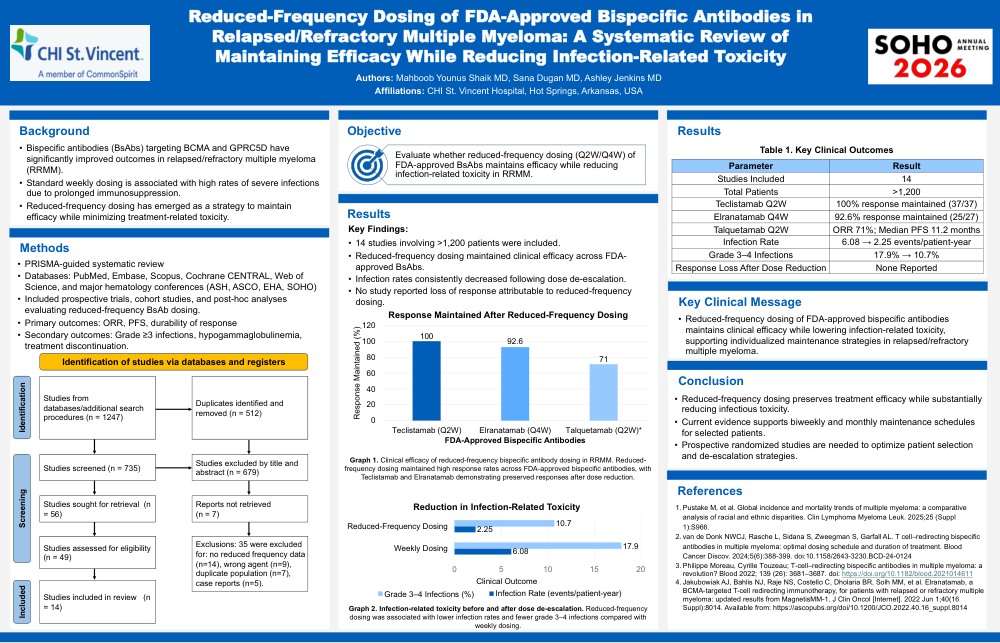
Bispecific antibodies (BsAbs) targeting BCMA, including teclistamab and elranatamab, and GPRC5D-targeted talquetamab have improved outcomes in relapsed/refractory multiple myeloma (RRMM), with ORR of 61% to 70% in heavily pretreated populations. However, standard weekly dosing produces substantial infectious toxicity, with grade 3 or higher infections reported in 45% to 55% of patients, largely related to prolonged hypogammaglobulinemia and T-cell dysfunction. Reduced-frequency dosing after deep response has emerged as a potential strategy to maintain efficacy while lowering toxicity.
Objective
To evaluate whether reduced-frequency dosing schedules (every two weeks [Q2W] or every four weeks [Q4W]) of FDA-approved BsAbs in RRMM preserve efficacy compared with weekly dosing and reduce infection-related adverse events.
Methods
A PRISMA-guided systematic review was performed using PubMed, Embase, Scopus, Cochrane CENTRAL, Web of Science, and major hematology conference proceedings (ASH, ASCO, EHA, SOHO; 2022–2026). Eligible studies included prospective trials, cohort studies, and post hoc analyses reporting reduced-frequency BsAb dosing in adults with RRMM. Primary outcomes included ORR, PFS, and durability of response after dose reduction. Secondary outcomes included grade 3 or higher infections, hypogammaglobulinemia, and treatment discontinuation. Risk of bias was assessed using ROBINS-I and the Newcastle-Ottawa Scale.
Results
Fourteen studies involving more than 1200 patients were included. In the MajesTEC-1 trial, switching teclistamab from weekly to Q2W dosing after 6 months or more of complete response maintained responses in 100% (37/37) of patients. Real-world studies demonstrated similar median PFS between weekly and reduced-frequency schedules (9.1 vs 11.3 months; P=0.141), while infection rates declined from 6.08 to 2.25 events per patient-year. With elranatamab, Q4W maintenance preserved responses in 92.6% (25/27) of patients, and grade 3 to 4 infections decreased from 17.9% to 10.7%. Talquetamab Q2W dosing achieved an ORR of 71% and median PFS of 11.2 months, with lower grade 3 or higher infection rates (21%). No study identified response loss attributable to dose de-escalation.
Conclusion
Reduced-frequency BsAb dosing in RRMM preserves efficacy while substantially lowering infectious toxicity. Current evidence supports biweekly and monthly maintenance schedules, although prospective randomized trials remain necessary to define optimal de-escalation strategies and patient selection.
ASCO: American Society of Clinical Oncology, ASH: American Society of Hematology, BCMA: B-cell maturation antigen, EHA: European Hematology Association, FDA: US Food and Drug Administration, GPRC5D: G-protein-coupled receptor class C group 5 member D, ORR: overall response rates, PFS: progression-free survival, PRISMA: Preferred Reporting Items for Systematic reviews and Meta-Analyses, SOHO: Society of Hematologic Oncology