1,267 posters, 47 videos, 13 topics, 4 sessions, 853 authors
ePostersLive by SciGen Technologies S.A. All rights reserved.
SOHO 2026 Annual Meeting
September 9 - 12, 2026 | George R. Brown Convention Center, Houston, Texas

AML - 256
“EASIX Score Predicts Severe Acute GVHD and Mortality After Allogeneic Hematopoietic Stem Cell Transplantation: A Single-Center Study”
Poster Presenter
Authors
Part of Topic
Acute Myeloid Leukemia (AML)
Prognostic Value of EASIX Score in Allogeneic Hematopoietic Stem Cell Transplantation
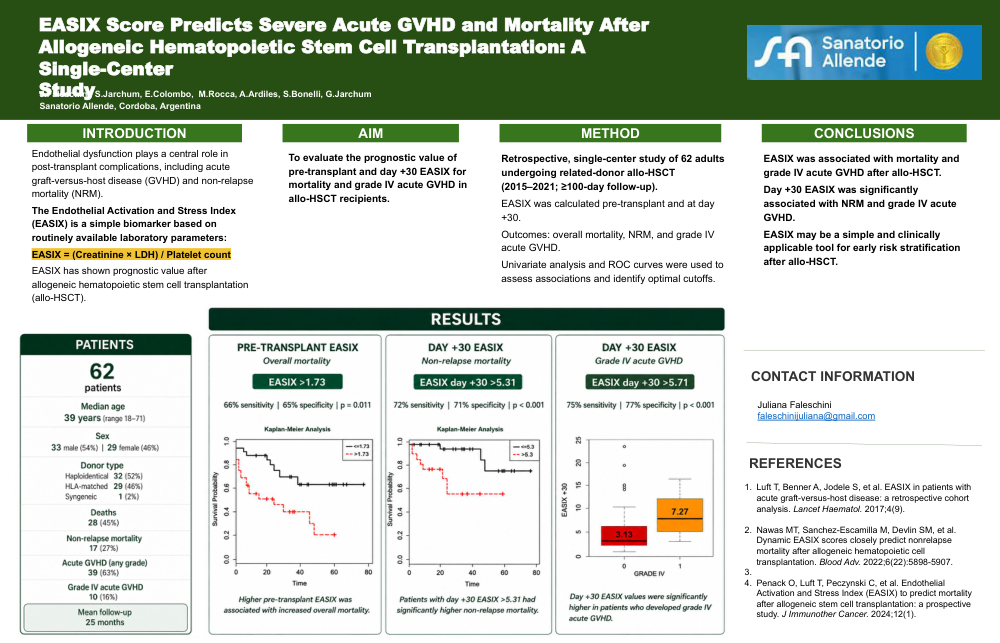
Introduction: The Endothelial Activation and Stress Index (EASIX; [(creatinine × LDH) ÷ thrombocytes]) has emerged as a validated predictor of overall mortality and non-relapse mortality (NRM) in allogeneic hematopoietic stem cell transplantation (allo-HSCT). It considers the key role of endothelial dysfunction in the development of post-transplant complications, including graft-versus-host disease (GVHD).
Objective: To evaluate the prognostic value of EASIX score regarding mortality and the risk of severe acute GVHD development in patients receiving allogeneic bone marrow transplantation in our institution.
Methods: We conducted a longitudinal, observational, retrospective, single-center study involving 90 patients who underwent transplantation between 2015 and 2021. The EASIX score was calculated both pre-transplant and on day +30 post-transplant. Parametric and non-parametric tests were employed, and significant cutoff points were determined using ROC curves.
Results: Patients had a mean age of 41 years (18-71) and the median follow-up was 25 months (3-87). Forty haploidentical, 46 histoidentical and 2 syngeneic transplants were performed. Total mortality was observed in 40 patients, 22 of which were unrelated to relapse. A total of 49 patients experienced acute GVHD as a complication, 14 of them Grade IV.
An existing relationship was observed between a higher EASIX value before and after transplant with overall mortality from any cause. A significant cutoff value for pre-transplant EASIX (>1.73) as a predictor of overall mortality (p=0.04). The cutoff value for EASIX at day +30 (>5.31) was a predictor of non-relapse mortality (p=<0.001) with a sensitivity of 72% and specificity of 71%.
Univariate analysis showed that both pre-transplant EASIX and EASIX at day +30 correlated with a higher probability of developing severe acute GVHD III-IV (p=0.04 and p=<0.001, respectively).
A cutoff value for EASIX at day +30 was determined using ROC curves (>5.71), which showed a sensitivity of 79% and specificity of 82% in predicting severe acute GVHD development (G IV).
Conclusions: Determination of the EASIX score emerges as a simple prognostic tool with independent predictive value in allogeneic bone marrow transplantation. It holds promise in identifying patients at higher risk of mortality and severe acute GVHD.