1,267 posters, 47 videos, 13 topics, 4 sessions, 853 authors
ePostersLive by SciGen Technologies S.A. All rights reserved.
SOHO 2026 Annual Meeting
September 9 - 12, 2026 | George R. Brown Convention Center, Houston, Texas

AML - 208
Profile and Treatment Outcomes of Filipino Acute Myeloid Leukemia Patients Managed at a Tertiary Institution: A Single-Center, 10-Year Retrospective Study
Poster Presenter
Authors
Part of Topic
Acute Myeloid Leukemia (AML)
Profile and Treatment Outcomes of Filipino Acute Myeloid Leukemia Patients Managed at a Tertiary Institution: A Single-Center 10-year Retrospective Study
R. ILANO1, C. GOROSPE1, AND F. MESINA1
1.University of Santo Tomas Hospital, Manila, Philippines
Introduction
Acute Myeloid Leukemia (AML) is the most common acute leukemia in adults. In the Philippines, leukemia ranks fifth among cancer-related mortalities in males, yet local data on Filipino AML patients remain limited.
Aim
This study aimed to describe the demographic and clinical characteristics, treatment patterns, and early treatment outcomes of adult AML patients managed at a tertiary institution.
Method
This retrospective, observational, cross-sectional study included patients aged ≥19 years diagnosed with AML at the University Hospital from January 2013 to December 2023.
Results
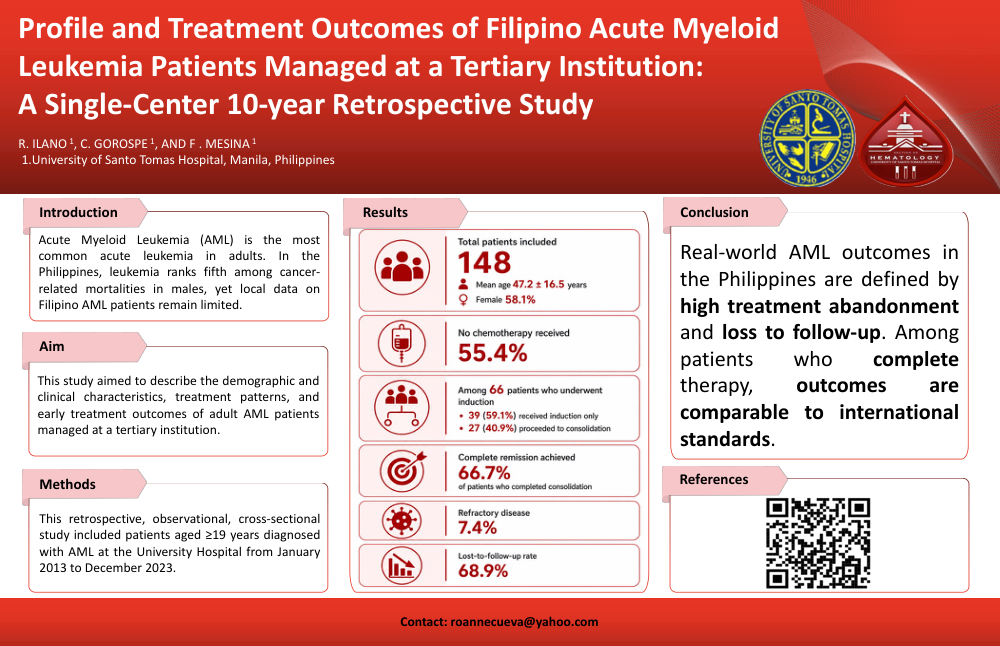
Total patients included: 148
Mean age: 47.2 +/- 16.5 years
Female 58.1%
No chemotherapy received in 55.4%
Among 66 patients who underwent induction, 39 received induction only and 27 proceeded to consolidation
Complete remission achieved in 66.7% of patients who completed consolidation
Refractory disease in 7.4%
Lost to follow-up rate of 68.9%
Conclusion
Real-world AML outcomes in the Philippines are defined by high treatment abandonment and loss to follow-up. Among patients who complete therapy, outcomes are comparable to international standards.