1,267 posters, 47 videos, 13 topics, 4 sessions, 853 authors
ePostersLive by SciGen Technologies S.A. All rights reserved.
SOHO 2026 Annual Meeting
September 9 - 12, 2026 | George R. Brown Convention Center, Houston, Texas

AML - 172
Insurance Status and In-Hospital Outcomes Among Adults With Acute Leukemia: A Nationwide Analysis (2016-2021)
Poster Presenter
Authors
Part of Topic
Acute Myeloid Leukemia (AML)
Study Rationale:Quantifying these disparities across Medicare, Medicaid, private insurance, and uninsured populations provides critical evidence to inform health policy and improve equitable access to life-saving care.
Title: Insurance Status and In-Hospital Outcomes Among Adults With Acute Leukemia: A Nationwide Analysis (2016–2021)
Authors & Affiliations: A. Parulkar¹, S. S. Saa¹, K. W. H. Hla¹, Y. M. Myat¹, M. Kalavar¹, L. Enayati¹, Y. N. Pinkhusovich¹, K. Panigrahi¹, and T. H. Oo²
-
One Brooklyn Health, Brooklyn, USA
-
The University of Texas MD Anderson Cancer Center, Houston, USA
Introduction
-
High-Acuity Need: Acute myeloid leukemia and acute lymphoblastic leukemia require rapid, intensive, and high-cost inpatient interventions to prevent early mortality.
-
Access Barrier: Health insurance coverage serves as the primary gateway to timely hematologic care, diagnostic testing, and specialized oncologic therapies.
-
Knowledge Gap: While health disparities in oncology are documented, the specific impact of insurance status on inpatient survival and resource consumption (hospital charges and length of stay) remains understudied at a national scale.
-
Study Rationale: Quantifying these disparities across Medicare, Medicaid, private insurance, and uninsured populations provides critical evidence to inform health policy and improve equitable access to life-saving care.
Aim
To evaluate the independent association between insurance status, in-hospital mortality, and healthcare resource utilization among older adults ($\ge 50$ years) hospitalized with acute leukemia using a nationally representative US cohort.
Methods
-
Dataset: National Inpatient Sample (NIS), 2016–2021.
-
Population: Adult patients ($\ge 50$ years) hospitalized with a primary diagnosis of AML or ALL ($N = 86,700$).
-
Stratification: Medicare, Medicaid, Private Insurance, Uninsured (reference group).
-
Statistical Analysis: Multivariable logistic and linear regression models adjusted for demographics, Charlson Comorbidity Index, and hospital characteristics.
Results
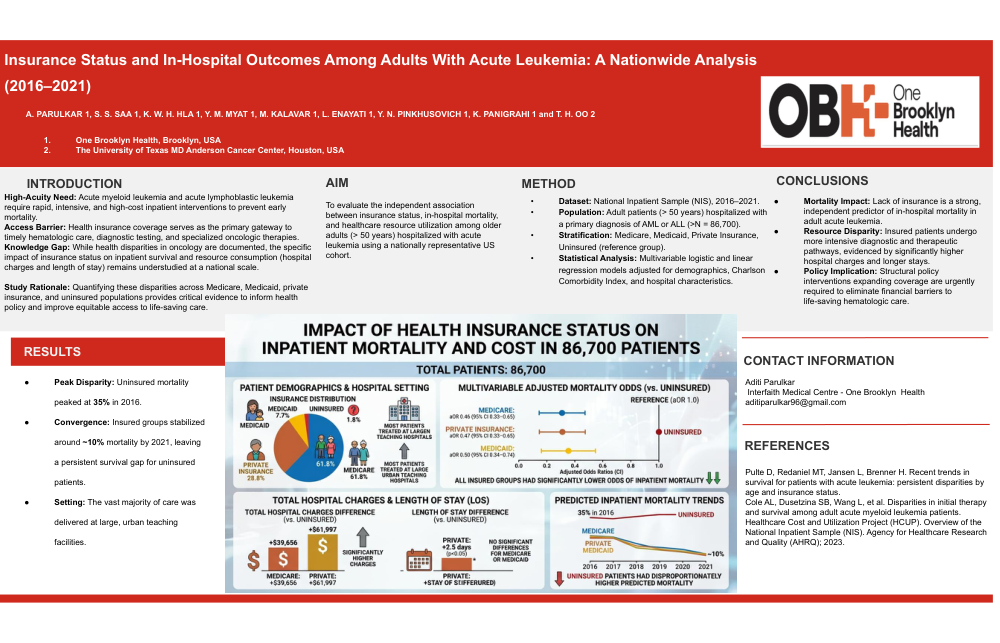
1. Patient Demographics & Insurance Distribution ($N = 86,700$)
-
Medicare: 61.8%
-
Private Insurance: 28.8%
-
Medicaid: 7.7%
-
Uninsured: 1.8%
-
Setting: Most patients were treated at large, urban teaching hospitals.
2. Multivariable Adjusted Mortality Odds (vs. Uninsured Reference, aOR 1.0)
-
Medicare: aOR 0.46 (95% CI: 0.33–0.65)
-
Private Insurance: aOR 0.47 (95% CI: 0.33–0.65)
-
Medicaid: aOR 0.50 (95% CI: 0.34–0.74)
-
Key Takeaway: All insured groups had significantly lower odds of inpatient mortality compared to uninsured patients.
3. Total Hospital Charges & Length of Stay (LOS) (vs. Uninsured)
-
Total Hospital Charges:
-
Medicare: +$39,656
-
Private: +$61,997
-
Key Takeaway: Medicare and private insurance incurred significantly higher total hospital charges.
-
-
Length of Stay:
-
Private: +2.5 days ($p < 0.05$)
-
Medicare & Medicaid: No significant differences observed.
-
4. Predicted Inpatient Mortality Trends (2016–2021)
-
Peak Disparity: Uninsured mortality peaked at 35% in 2016.
-
Convergence: Insured groups (Medicare, Private, Medicaid) stabilized around ~10% mortality by 2021.
-
Key Takeaway: Uninsured patients had disproportionately higher predicted mortality throughout the study period, leaving a persistent survival gap.
Conclusions
-
Mortality Impact: Lack of insurance is a strong, independent predictor of in-hospital mortality in adult acute leukemia.
-
Resource Disparity: Insured patients undergo more intensive diagnostic and therapeutic pathways, evidenced by significantly higher hospital charges and longer stays.
-
Policy Implication: Structural policy interventions expanding coverage are urgently required to eliminate financial barriers to life-saving hematologic care.