1,267 posters, 47 videos, 13 topics, 4 sessions, 853 authors
ePostersLive by SciGen Technologies S.A. All rights reserved.
SOHO 2026 Annual Meeting
September 9 - 12, 2026 | George R. Brown Convention Center, Houston, Texas

AML - 138
Comparative Effectiveness of Standard 3+7 Versus FLAG/FLAG-IDA Induction Chemotherapy in Newly Diagnosed Acute Myeloid Leukemia: A Propensity Score-Matched Cohort Study Using the TriNetX Global Network
Poster Presenter
Authors
Part of Topic
Acute Myeloid Leukemia (AML)
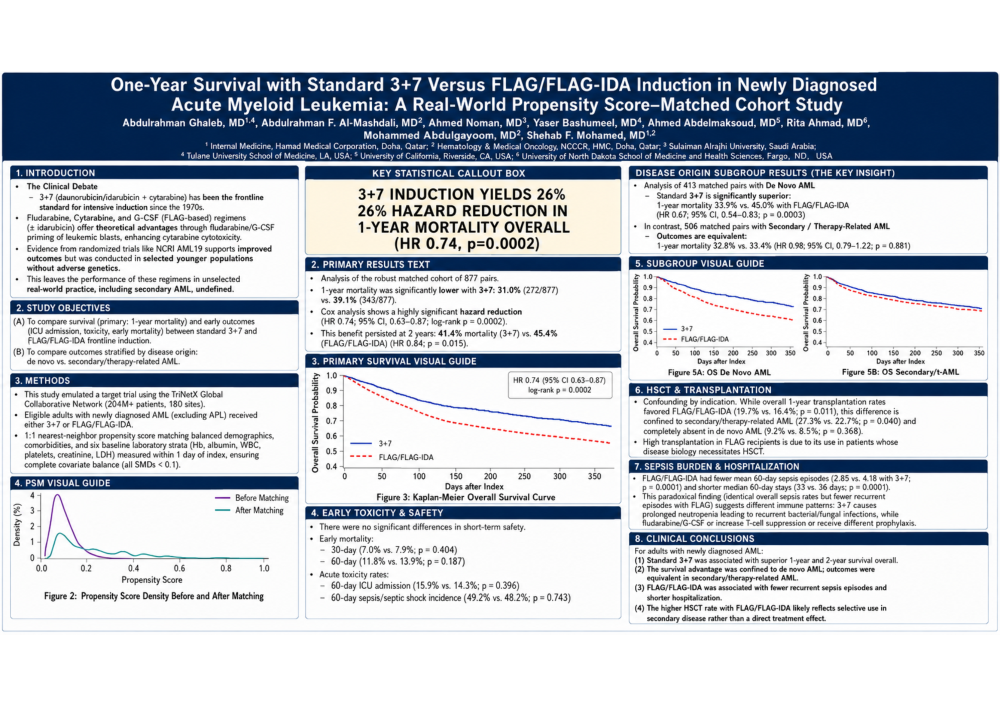
Background/Objectives: Standard 3+7 remains the backbone of intensive induction therapy for acute myeloid leukemia (AML), while FLAG/FLAG-IDA is frequently used in selected higher-risk patients. We compared survival and short-term outcomes between standard 3+7 and FLAG/FLAG-IDA as frontline induction in adults with newly diagnosed AML and evaluated whether treatment effects differed by disease origin.
Methods: We conducted a retrospective propensity score-matched cohort study using the TriNetX Global Collaborative Network. Adults with newly diagnosed AML receiving frontline 3+7 or FLAG/FLAG-IDA were matched 1:1 on demographics, comorbidities, and baseline laboratory values. The primary outcome was one-year all-cause mortality. Secondary outcomes included two-year and short-term mortality, ICU admission, sepsis, hospitalization, and hematopoietic stem cell transplantation (HSCT). Prespecified analyses examined de novo versus secondary/therapy-related AML.
Results: After matching, 877 pairs were analyzed for one-year mortality. One-year mortality was significantly lower with 3+7 than with FLAG/FLAG-IDA (31.0% vs 39.1%; HR 0.74, 95% CI 0.63–0.87; p=0.0002). Two-year mortality was also lower with 3+7 (41.4% vs 45.4%; HR 0.84; p=0.015). The survival advantage was confined to de novo AML (HR 0.67; p=0.0003), whereas outcomes were equivalent in secondary/therapy-related AML (HR 0.98; p=0.881). FLAG/FLAG-IDA was associated with fewer recurrent sepsis episodes (2.85 vs 4.18 at 60 days; p=0.0001) and shorter hospitalization (median 33 vs 36 days; p=0.0001).
Conclusions: Standard 3+7 was associated with superior one- and two-year survival overall, with the benefit confined to de novo AML. In secondary/therapy-related AML, 3+7 and FLAG/FLAG-IDA demonstrated comparable survival. FLAG/FLAG-IDA was associated with fewer recurrent infections and shorter hospitalization.
Keywords: acute myeloid leukemia; AML; 3+7; FLAG; FLAG-IDA; induction chemotherapy; propensity score matching; survival; de novo AML; secondary AML; therapy-related AML; HSCT; real-world evidence.