1,267 posters, 47 videos, 13 topics, 4 sessions, 853 authors
ePostersLive by SciGen Technologies S.A. All rights reserved.
SOHO 2026 Annual Meeting
September 9 - 12, 2026 | George R. Brown Convention Center, Houston, Texas

CT - 126
Does CAR-T Therapy Overcome TP53-Driven Resistance in Lymphoma? A Systematic Review of Clinical Outcomes
Poster Presenter
Authors
Part of Topic
Cellular Therapy (CT)
Abstract
Background:
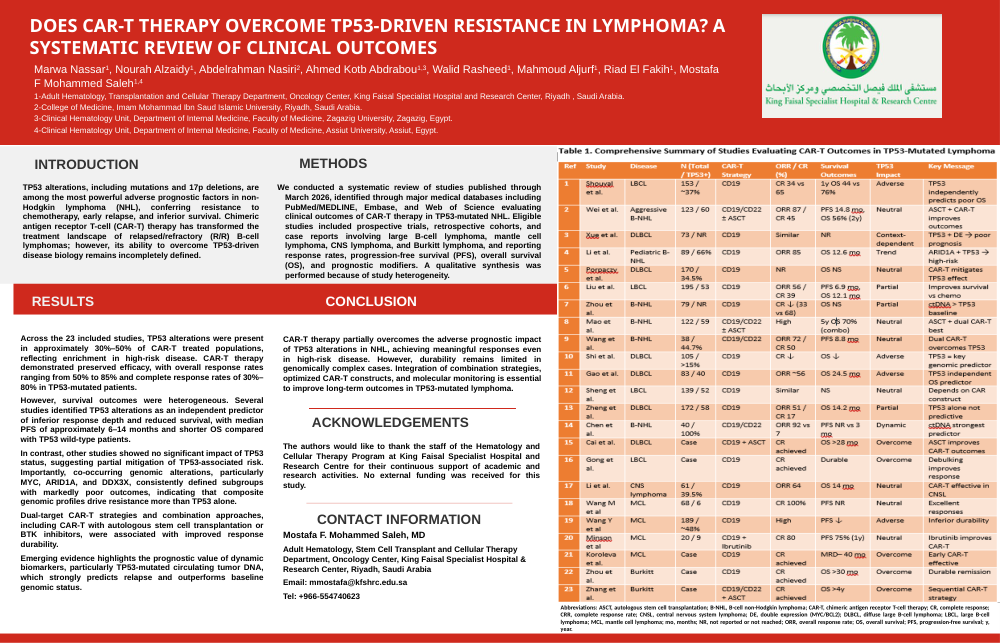
TP53 alterations, including mutations and 17p deletions, are among the most powerful adverse prognostic factors in non-Hodgkin lymphoma (NHL), conferring resistance to chemotherapy, early relapse, and inferior survival. Chimeric antigen receptor T-cell (CAR-T) therapy has transformed the treatment landscape of relapsed/refractory (R/R) B-cell lymphomas; however, its ability to overcome TP53-driven disease biology remains incompletely defined.
Methods:
We conducted a systematic review of studies published through March 2026, identified through major medical databases including PubMed/MEDLINE, Embase, and Web of Science evaluating clinical outcomes of CAR-T therapy in TP53-mutated NHL. Eligible studies included prospective trials, retrospective cohorts, and case reports involving large B-cell lymphoma, mantle cell lymphoma, CNS lymphoma, and Burkitt lymphoma, and reporting response rates, progression-free survival (PFS), overall survival (OS), and prognostic modifiers. A qualitative synthesis was performed because of study heterogeneity.
Results:
Across the 23 included studies, TP53 alterations were present in approximately 30%–50% of CAR-T treated populations, reflecting enrichment in high-risk disease. CAR-T therapy demonstrated preserved efficacy, with overall response rates ranging from 50% to 85% and complete response rates of 30%–80% in TP53-mutated patients. However, survival outcomes were heterogeneous. Several studies identified TP53 alterations as an independent predictor of inferior response depth and reduced survival, with median PFS of approximately 6–14 months and shorter OS compared with TP53 wild-type patients. In contrast, other studies showed no significant impact of TP53 status, suggesting partial mitigation of TP53-associated risk. Importantly, co-occurring genomic alterations, particularly MYC, ARID1A, and DDX3X, consistently defined subgroups with markedly poor outcomes, indicating that composite genomic profiles drive resistance more than TP53 alone. Dual-target CAR-T strategies and combination approaches, including CAR-T with autologous stem cell transplantation or BTK inhibitors, were associated with improved response durability. Emerging evidence highlights the prognostic value of dynamic biomarkers, particularly TP53-mutated circulating tumor DNA, which strongly predicts relapse and outperforms baseline genomic status.
Conclusion:
CAR-T therapy partially overcomes the adverse prognostic impact of TP53 alterations in NHL, achieving meaningful responses even in high-risk disease. However, durability remains limited in genomically complex cases. Integration of combination strategies, optimized CAR-T constructs, and molecular monitoring is essential to improve long-term outcomes in TP53-mutated lymphoma.