1,267 posters, 47 videos, 13 topics, 4 sessions, 853 authors
ePostersLive by SciGen Technologies S.A. All rights reserved.
SOHO 2026 Annual Meeting
September 9 - 12, 2026 | George R. Brown Convention Center, Houston, Texas

AML - 117
TP53 Functional Classification Association With Response and Survival Outcomes in AML and High-Risk MDS
Poster Presenter
Authors
Part of Topic
Acute Myeloid Leukemia (AML)
TP53 functional classification association with survival outcomes in AML and high risk MDS
Background
Tumor protein p53 (TP53)-mutated acute myeloid leukemia (AML) and high-risk myelodysplastic syndromes (MDS) are among the most biologically aggressive myeloid malignancies. TP53 mutations occur in approximately 8% -12% of AML and MDS, with incidence varying by subtype and clinical context. Currently, TP53 status is treated as a binary variable (mutated vs wild-type), and most studies correlated outcomes primarily with variant allele frequency (VAF). While high VAF (≥40%) predicts inferior outcomes in cytarabine-treated AML, this association is less consistent in hypomethylating agent-based therapy (Short et al, 2020). Because TP53 mutations exhibit substantial structural and functional heterogeneity, we hypothesized that functional classification stratifies outcomes in AML and MDS beyond binary status or VAF alone.
Method
We analyzed 2,148 TP53 mutations from 1,733 patients across four publicly available datasets: MDS IWG 2022, MSK-IMPACT 2022, Washington University Myeloid Malignancies 2016, and OHSU Beat AML 2022. Mutations were mapped to protein structure and functional domains using standardized annotation against the reference transcript (NM_000546.6). Each mutation was classified by structural location and predicted biological function, using the IARC TP53 function database and published functional reports, as gain-of-function (GOF), dominant-negative (DN), loss-of-function (LOF), variant of uncertain significance (VUS), or preserved function (PF).
Results
1 TP53 burden
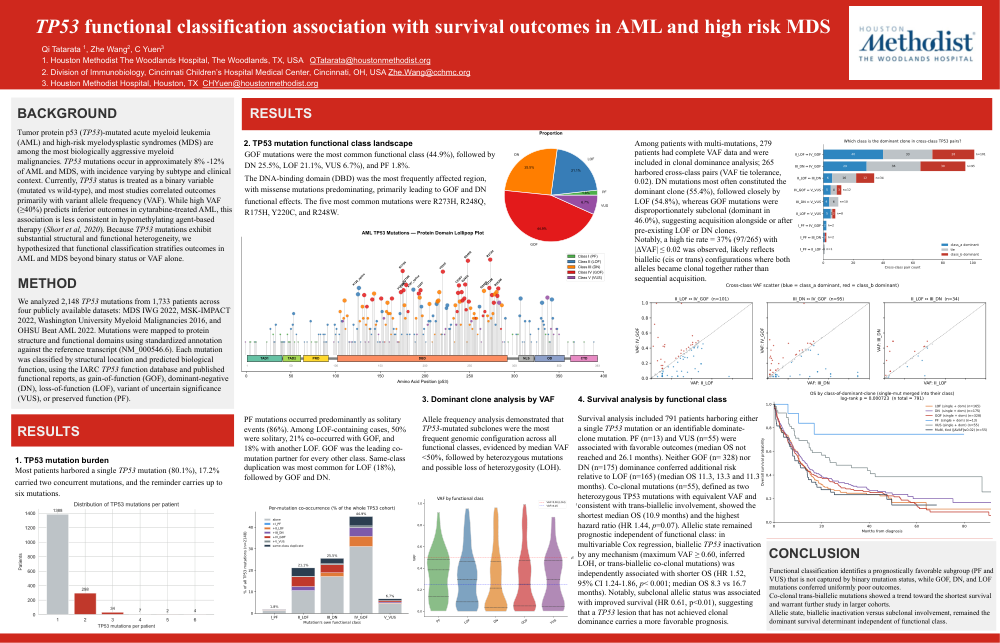
Most patients harbored a single TP53 mutation (80.1%), 17.2% carried two concurrent mutations, and the reminder carries up to six mutations.
2 TP53 functional class landscape
GOF mutations were the most common functional class (44.9%), followed by DN 25.5%, LOF 21.1%, VUS 6.7%), and PF 1.8%. The DNA-binding domain (DBD) was the most frequently affected region, with missense mutations predominating, primarily leading to GOF and DN functional effects. The five most common mutations were R273H, R248Q, R175H, Y220C, and R248W. PF mutations occurred predominantly as solitary events (86%). Among LOF-containing cases, 50% were solitary, 21% co-occurred with GOF, and 18% with another LOF. GOF was the leading co-mutation partner for every other class. Same-class duplication was most common for LOF (18%), followed by GOF and DN.
3 Dominant clone anlysis by VAF
Allele frequency analysis demonstrated that TP53-mutated subclones were the most frequent genomic configuration across all functional classes, evidenced by median VAF <50%, followed by heterozygous mutations and possible loss of heterozygosity (LOH).
Among patients with multi-mutations, 279 patients had complete VAF data and were included in clonal dominance analysis; 265 harbored cross-class pairs (VAF tie tolerance, 0.02). DN mutations most often constituted the dominant clone (55.4%), followed closely by LOF (54.8%), whereas GOF mutations were disproportionately subclonal (dominant in 46.0%), suggesting acquisition alongside or after pre-existing LOF or DN clones.
Notably, a high tie rate = 37% (97/265) with |ΔVAF| ≤ 0.02 was observed, likely reflects biallelic (cis or trans) configurations where both alleles became clonal together rather than sequential acquisition.
4 Survival analysis by functional class
Survival analysis included 791 patients harboring either a single TP53 mutation or an identifiable dominate-clone mutation. PF (n=13) and VUS (n=55) were associated with favorable outcomes (median OS not reached and 26.1 months). Neither GOF (n= 328) nor DN (n=175) dominance conferred additional risk relative to LOF (n=165) (median OS 11.3, 13.3 and 11.3 months). Co-clonal mutations (n=55), defined as two heterozygous TP53 mutations with equivalent VAF and consistent with trans-biallelic involvement, showed the shortest median OS (10.9 months) and the highest hazard ratio (HR 1.44, p=0.07). Allelic state remained prognostic independent of functional class: in multivariable Cox regression, biallelic TP53 inactivation by any mechanism (maximum VAF ≥ 0.60, inferred LOH, or trans-biallelic co-clonal mutations) was independently associated with shorter OS (HR 1.52, 95% CI 1.24-1.86, p< 0.001; median OS 8.3 vs 16.7 months). Notably, subclonal allelic status was associated with improved survival (HR 0.61, p<0.01), suggesting that a TP53 lesion that has not achieved clonal dominance carries a more favorable prognosis.
Conclusion
Functional classification identifies a prognostically favorable subgroup (PF and VUS) that is not captured by binary mutation status, while GOF, DN, and LOF mutations conferred uniformly poor outcomes.
Co-clonal trans-biallelic mutations showed a trend toward the shortest survival and warrant further study in larger cohorts.
Allelic state, biallelic inactivation versus subclonal involvement, remained the dominant survival determinant independent of functional class.