1,267 posters, 47 videos, 13 topics, 4 sessions, 853 authors
ePostersLive by SciGen Technologies S.A. All rights reserved.
SOHO 2026 Annual Meeting
September 9 - 12, 2026 | George R. Brown Convention Center, Houston, Texas

AML - 096
Real-World Outcomes of Azacitidine and Venetoclax in Newly Diagnosed AML and Related High-Risk Myeloid Neoplasms at a Community Hospital
Poster Presenter
Authors
Part of Topic
Acute Myeloid Leukemia (AML)
Title: Real-World Outcomes of Azacitidine and Venetoclax in Newly Diagnosed AML and Related High-Risk Myeloid Neoplasms at a Community Hospital
Authors: Ravjot Kaur Virdi, DO, MPH; Taha Alrifai, MD; Ronit Sturmwind, NP
Context & Objectives: Azacitidine plus venetoclax is a standard lower-intensity regimen for acute myeloid leukemia (AML) in patients unfit for intensive induction, but real-world data from community hospitals remain limited. We evaluated outcomes, toxicity, and transfusion needs in patients with newly diagnosed AML and related high-risk myeloid neoplasms treated with this regimen and explored the impact of antifungal prophylaxis and time from diagnosis to treatment initiation on outcomes.
Design, Setting, & Population: This single-center retrospective cohort study included 18 adults diagnosed at a community hospital in Park Ridge, Illinois between January 1-December 31, 2025, with follow-up through March 15, 2026. All were newly diagnosed and unfit for intensive induction. Diagnoses included AML (n=14), therapy-related myeloid neoplasm (n=2), and high-risk myelodysplastic neoplasm (n=2). Patients were aged 56-86 years, with 7 males and 11 females. Survival was estimated by Kaplan-Meier analysis.
Interventions & Outcome Measures: Azacitidine plus venetoclax were administered per institutional practice. Antifungal prophylaxis included azoles (voriconazole, isavuconzonium, posaconazole) and micafungin. Several patients required switches for QTc prolongation, cost, or drug interactions. Venetoclax dose adjustments were standardized. Outcomes included overall survival (OS), relapse-free survival (RFS), complete remission (CR) after cycle 1, time to count recovery, time from diagnosis to treatment initiation, mean combined transfusion burden, and treatment-related complications.
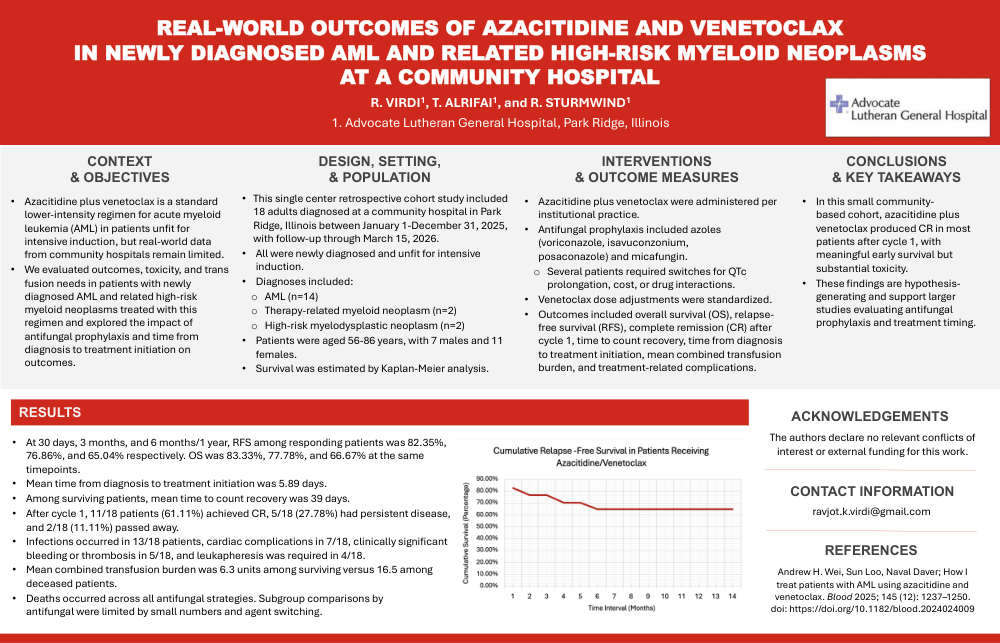
Results: At 30 days, 3 months, and 6 months/1 year, RFS among responding patients was 82.35%, 76.86%, and 65.04% respectively. OS was 83.33%, 77.78%, and 66.67% at the same timepoints. Mean time from diagnosis to treatment initiation was 5.89 days. Among surviving patients, mean time to count recovery was 39 days. After cycle 1, 11/18 patients (61.11%) achieved CR, 5/18 (27.78%) had persistent disease, and 2/18 (11.11%) passed away. Infections occurred in 13/18 patients, cardiac complications in 7/18, clinically significant bleeding or thrombosis in 5/18, and leukapheresis was required in 4/18. Mean combined transfusion burden was 6.3 units among surviving versus 16.5 among deceased patients. Deaths occurred across all antifungal strategies. Subgroup comparisons by antifungal were limited by small numbers and agent switching.
Conclusions: In this small community-based cohort, azacitidine plus venetoclax produced CR in most patients after cycle 1, with meaningful early survival but substantial toxicity. These findings are hypothesis-generating and support larger studies evaluating antifungal prophylaxis and treatment timing.