1,267 posters, 47 videos, 13 topics, 4 sessions, 853 authors
ePostersLive by SciGen Technologies S.A. All rights reserved.
SOHO 2026 Annual Meeting
September 9 - 12, 2026 | George R. Brown Convention Center, Houston, Texas

MM - 089
Is IgA Isotype an Independent Adverse Prognostic Factor in Multiple Myeloma? A Systematic Review and Meta-Analysis of Cytogenetic Risk, Survival, and Treatment Outcomes in the Modern Era
Poster Presenter
Authors
Part of Topic
Multiple Myeloma (MM)
Is IgA Isotype an Independent Adverse Prognostic Factor Multiple Myeloma? A Systematic Review and Meta‑Analysis of Cytogenetic Risk, Survival, and Treatment Outcomes in the Modern Era
Rithika Manjunatha Reddy, MD¹; Aaditya Jagadish, MD¹; Kala Seetharaman, MD²
Department of Haematology and Oncology, Saint Vincent Hospital, Worcester, Massachusetts, USA
KEYWORDS: multiple myeloma, immunoglobulin isotype, IgA myeloma, cytogenetics, meta‑analysis
CONTEXT: The prognostic significance of the IgA isotype in multiple myeloma (MM) remains uncertain, particularly in the modern therapeutic era, where cytogenetic and molecular risk factors dominate risk stratification. Clarifying its independent impact is essential for accurate prognostication and clinical trial design.
OBJECTIVE: To determine whether IgA isotype independently predicts overall survival (OS), progression‑free survival (PFS), or treatment response after adjustment for cytogenetic risk and therapeutic era.
DESIGN: A systematic review and meta‑analysis were conducted in accordance with PRISMA 2020 guidelines. PubMed, Embase, Web of Science, and Cochrane Library databases were searched from 2010 through March 2026. Random‑effects models pooled hazard ratios (HRs) for OS and PFS comparing IgA and IgG isotypes. Subgroup analyses evaluated outcomes by cytogenetic risk and treatment regimen.
SETTING: Multicenter retrospective cohorts, prospective trials, and registry analyses assessing modern MM therapies across North America, Europe, and Asia.
PATIENTS OR OTHER PARTICIPANTS: Thirty‑five studies including more than 15,000 patients with newly diagnosed or relapsed MM. Median follow‑up exceeded 40 months in most datasets.
INTERVENTIONS: Triplet and quadruplet regimens incorporating proteasome inhibitors, IMiDs, monoclonal antibodies, and/or autologous transplantation.
MAIN OUTCOME MEASURES: Hazard ratios for OS and PFS by immunoglobulin isotype.
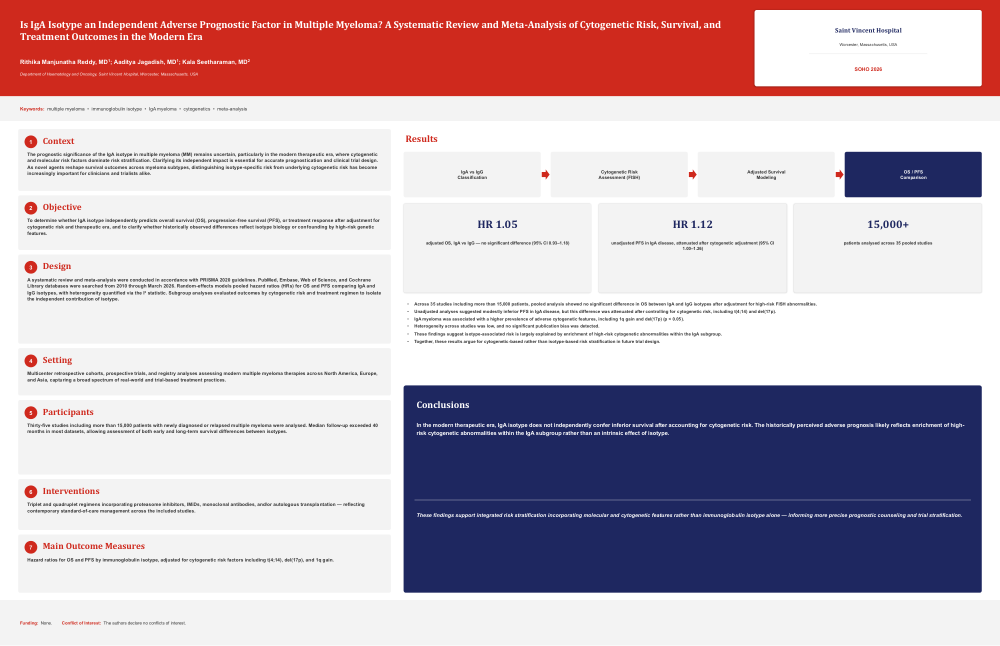
RESULTS: Across 35 studies including > 15,000 patients, pooled analysis demonstrated no significant difference in OS between IgA and IgG isotypes after adjustment for high‑risk FISH abnormalities (HR 1.05; 95% CI, 0.93–1.18). Unadjusted analyses suggested modestly inferior PFS in IgA disease (HR 1.12; 95% CI, 1.00–1.26), which was attenuated after controlling for cytogenetic risk including t(4;14) and del(17p). IgA myeloma was associated with a higher prevalence of adverse cytogenetic features, including 1q gain and del(17p) (p < 0.05). Heterogeneity was low, and no significant publication bias was detected.
CONCLUSIONS: In the modern therapeutic era, IgA isotype does not independently confer inferior survival after accounting for cytogenetic risk. The historically perceived adverse prognosis likely reflects enrichment of high‑risk cytogenetic abnormalities within the IgA subgroup rather than an intrinsic effect of isotype. These findings support integrated risk stratification incorporating molecular and cytogenetic features rather than immunoglobulin isotype alone.
Funding: None.
Conflict of Interest: The authors declare no conflicts of interest.