1,267 posters, 47 videos, 13 topics, 4 sessions, 853 authors
ePostersLive by SciGen Technologies S.A. All rights reserved.
SOHO 2026 Annual Meeting
September 9 - 12, 2026 | George R. Brown Convention Center, Houston, Texas

ABCL - 014
Toxicity and Outcomes of Rituximab With LMB-96 in Pediatric High-Risk B-Cell Non-Hodgkin Lymphoma: A Comparative Study From a Low- and Middle-Income Country
Poster Presenter
Authors
Part of Topic
Aggressive B-Cell Lymphoma (ABCL)
Background: The addition of rituximab to intensive chemotherapy has improved outcomes in high-income settings for pediatric high-risk B-cell non-Hodgkin lymphoma (B-NHL). However, data from low- and middle-income countries (LMICs) remain limited, particularly regarding toxicity and survival. This study compares toxicity profiles and outcomes of the LMB-96 regimen with or without rituximab in children and adolescents with high-risk B-NHL treated in an LMIC setting.
Methods: This retrospective comparative study included 106 patients less than 18 years treated between January 2019 and December 2022 at the Pediatric oncology department, National Cancer Institute, Cairo University, Egypt. Patients received either LMB-96 alone (Group 1; n=53) or LMB-96 plus rituximab (Group 2; n=53). Baseline characteristics, treatment-related toxicities across all phases, response rates, mortality, overall survival (OS), and event-free survival (EFS) were analyzed.
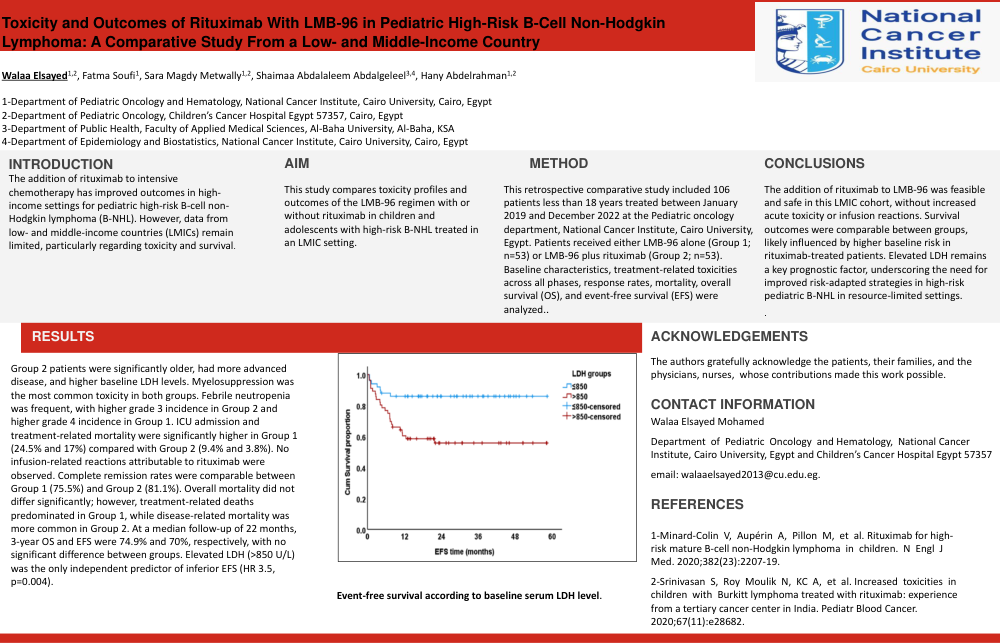
Results: Group 2 patients were significantly older, had more advanced disease, and higher baseline LDH levels. Myelosuppression was the most common toxicity in both groups. Febrile neutropenia was frequent, with higher grade 3 incidence in Group 2 and higher grade 4 incidence in Group 1. ICU admission and treatment-related mortality were significantly higher in Group 1 (24.5% and 17%) compared with Group 2 (9.4% and 3.8%). No infusion-related reactions attributable to rituximab were observed. Complete remission rates were comparable between Group 1 (75.5%) and Group 2 (81.1%). Overall mortality did not differ significantly; however, treatment-related deaths predominated in Group 1, while disease-related mortality was more common in Group 2. At a median follow-up of 22 months, 3-year OS and EFS were 74.9% and 70%, respectively, with no significant difference between groups. Elevated LDH (>850 U/L) was the only independent predictor of inferior EFS (HR 3.5, p=0.004).
Conclusions: The addition of rituximab to LMB-96 was feasible and safe in this LMIC cohort, without increased acute toxicity or infusion reactions. Survival outcomes were comparable between groups, likely influenced by higher baseline risk in rituximab-treated patients. Elevated LDH remains a key prognostic factor, underscoring the need for improved risk-adapted strategies in high-risk pediatric B-NHL in resource-limited settings.