516 posters, 59 topics, 63 sessions, 1,127 authors, 352 institutions
ePostersLive by SciGen Technologies S.A. All rights reserved.
2026 SOAP Annual Meeting
April 29 - May 3, 2026 | Montreal, Quebec Canada

2331363
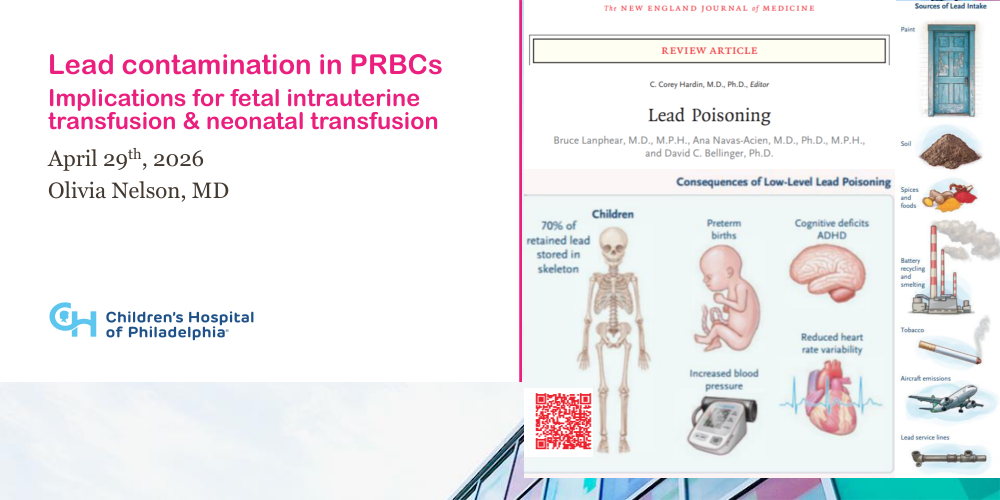
Lead contamination in donated packed red blood cells: implications for intrauterine transfusions and neonates receiving transfusions
Poster Presenter
Authors
Affiliations
Part of Topic
Oral Research Presentations - 1
Lead contamination in donated packed red blood cells: implications for intrauterine transfusions and neonates receiving transfusions
Olivia Nelson,1,2 Christopher S. Thom,3 Natalie E. Rintoul,2,3 Clementina Mesaros,4 Jaleah Hawkins,5 Julia Mewha,6 Allan F. Simpao,1,2 Shelly Soni,2,7 Stella T. Chou6
1) Department of Anesthesiology and Critical Care, Children’s Hospital of Philadelphia and University of Pennsylvania Perelman School of Medicine
2) Richard D. Wood Jr Center for Fetal Diagnosis and Treatment, Children’s Hospital of Philadelphia
3) Division of Neonatology, Children’s Hospital of Philadelphia and University of Pennsylvania Perelman School of Medicine
4) Department of Systems Pharmacology and Translational Therapeutics, University of Pennsylvania Perelman School of Medicine
5) Department of Clinical Pathology and Laboratory Medicine, Children’s Hospital of Philadelphia and University of Pennsylvania Perelman School of Medicine
6) Division of Hematology and Transfusion Medicine, Children’s Hospital of Philadelphia and University of Pennsylvania Perelman School of Medicine
7) Department of Surgery, Children’s Hospital of Philadelphia and University of Pennsylvania Perelman School of Medicine
Background
According to the United States (US) Centers for Disease Control and Prevention, a safe blood lead level has not been identified in infants and children.1 The benchmarking blood lead levels associated with 1 IQ point decrement are 1-10μg/L (0.1-1μg/dL),2 with one expert group recommending steps to decrease the lead level to <10μg/L in all children in the US by 2030.3 Critically ill fetuses and neonates can require multiple blood transfusions, yet donated adult packed red blood cells (PRBCs) are not routinely screened for lead.
Our primary aim was to assess the number of units of adult donated PRBC units with a lead level of ≥ 10μg/L. We secondarily assessed the number of units from which a 15mL transfusion would contain ≥ 0.19μg of lead. As previously reported, this reference dose is associated with loss of 3 IQ points at a population level.4
Methods
This pilot study tested the lead level in 51 deidentified PRBC units from our institution’s Blood Bank. Elevated lead was defined as ≥ 10μg/L since critically ill infants may receive a transfusion volume equal or greater to their circulating blood volume. A threshold of ≥ 0.19μg for a 15mL transfusion was based on a more conservative definition of lead toxicity.4
Samples were obtained from the 1 mL segments on the PRBC units. A 50 μL aliquot was digested overnight in 250μL of nitric acid at 60 °C. Following digestion, samples were diluted to a final volume of 5 mL with metal-free ultrapure water and directly injected into the Thermo iCAP RQ. Calibration curve was prepared concurrently by using a premix of metal ions, starting from 125 ppb by serial dilution 1/2 to 0.015 ppb. The limit of detection was 0.015 ppb.
Results
Lead was detected in all 51 PRBC samples with median 8.1μg/L [IQR 4.6, 14.6]. 43% of donated PRBC units had lead levels of ≥10μg/L (22/51 samples). The median lead dose from a hypothetical 15 mL transfusion was 0.12μg [IQR 0.06, 0.23]. 29% of these transfusions would have contained ≥0.19μg lead (15/51).
Discussion
Although population lead levels in US children have decreased over time, exposure to low levels of lead is associated with decreased IQ and other adverse neurodevelopmental sequela.1-4 We report that lead was present at a level associated with these adverse outcomes in many PRBC units. Fetuses receiving intrauterine transfusions, critically ill neonates undergoing surgery or receiving ECMO support, and premature infants who require serial transfusions are at increased risk of receiving multiple and/or large volume transfusions. Our study results suggest that adult donated PRBC units should be screened for lead contamination to avoid exposure in these patients.
1) MMWR Morb Mortal Wkly Rep 2021;70:1509–1512.
2) Risk Anal. 2013 Mar;33(3):450-61.
3) JAMA Pediatr. 2017 Jul 1;171(7):616-618.
4) Pediatr Res. 2020 Mar;87(4):677-682