516 posters, 59 topics, 63 sessions, 1,127 authors, 352 institutions
ePostersLive by SciGen Technologies S.A. All rights reserved.
2026 SOAP Annual Meeting
April 29 - May 3, 2026 | Montreal, Quebec Canada

2318492
Preeclampsia with Severe Features: How Do We Track Severe Features?
Poster Presenter
Authors
Kristen Harris, Laura Sorabella, Kim Boggess, Marie-Louise Meng
Affiliations
1. Department of Anesthesiology, Vanderbilt University Medical Center, Nashville, Tennessee, Department of Obstetrics and Gynecology, School of Medicine, University of North Carolina at Chapel Hill, Chapel Hill, NC,, Department of Anesthesiology, Vanderbilt University Medical Center, Nashville, Tennessee,
Part of Topic
Oral Research Presentations - 1
Preeclampsia with Severe Features: How Do We Track Severe Features?
Kristen Harris,1 Laura Sorabella,1 Kim Boggess,2 Marie-Louise Meng1,3
1. Department of Anesthesiology, Vanderbilt University Medical Center, Nashville, Tennessee, 2. Department of Obstetrics and Gynecology, School of Medicine, University of North Carolina at Chapel Hill, Chapel Hill, NC, United States.3.
Department of Obstetrics and Gynecology, Duke University Medical Center North Carolina.
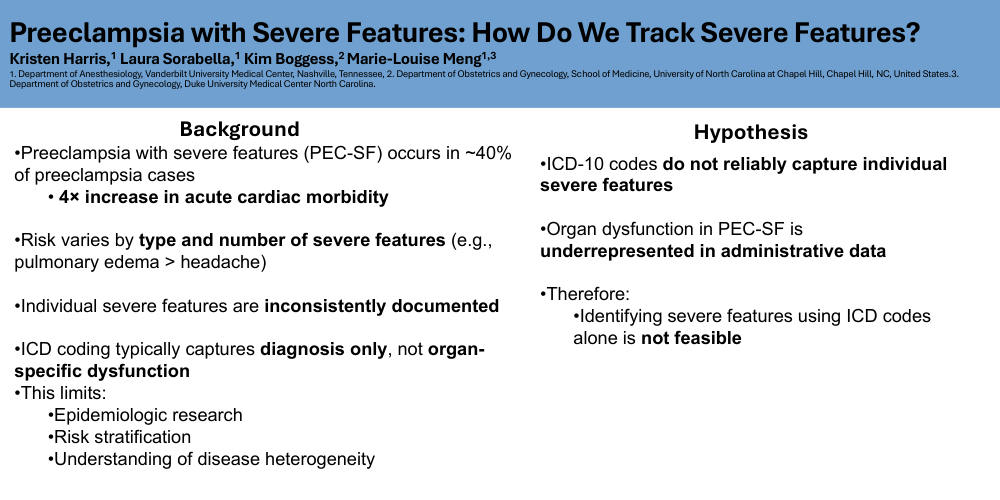
Background
•Preeclampsia with severe features (PEC-SF) occurs in ~40%
of preeclampsia cases
• 4× increase in acute cardiac morbidity
•Risk varies by type and number of severe features (e.g.,
pulmonary edema > headache)
•Individual severe features are inconsistently documented
•ICD coding typically captures diagnosis only, not organ-
specific dysfunction
•This limits:
•Epidemiologic research
•Risk stratification
•Understanding of disease heterogeneity
Hypothesis
•ICD-10 codes do not reliably capture individual
severe features
•Organ dysfunction in PEC-SF is
underrepresented in administrative data
•Therefore:
•Identifying severe features using ICD codes
alone is not feasibleStudy Design and Methods
Study Design
• Retrospective cohort study
• Data source: Premier Healthcare Database
• Study period: 2016–2020 deliveries
• Identified cases using ICD-10 diagnosis codes
• Population: patients w/ ICD codes for
• Preeclampsia with severe features (PEC-SF)
• HELLP syndrome
• Eclampsia
Methods
•Developed code set for organ-specific dysfunction,
including:
•Hypertension
•Neurologic symptoms (headache, visual changes)
•Pulmonary edema, heart failure
•Renal insufficiency
•RUQ pain, hemolysis
•Elevated liver enzymes
•Thrombocytopenia
•Calculated frequency of organ dysfunction codes
within PEC-SF spectrum
•Compared coding rates across: PEC-SF. HELLP, and
EclampsiaResults: Frequency of ICD-10 coding for Organ-Specific Severe
FeaturesConclusion and Discussion
•Preeclampsia with severe features (PEC-SF) is associated with significant maternal and long-term cardiovascular
risk
•ICD-10 codes largely fail to capture organ-specific manifestations, with consistently low coding rates across
severe features
•Current coding practices collapse a heterogeneous condition into a single diagnosis, obscuring variation in
disease severity
•
•This limitation impairs risk stratification and epidemiologic research
•Administrative data likely underrepresents the true burden of organ dysfunction
•Systematic documentation of organ-specific involvement alongside diagnosis is essential
•Improved granularity may enhance:
•Clinical risk assessment
•Research accuracy
•Maternal health outcomes