516 posters, 59 topics, 63 sessions, 1,127 authors, 353 institutions
ePostersLive by SciGen Technologies S.A. All rights reserved.
2026 SOAP Annual Meeting
April 29 - May 3, 2026 | Montreal, Quebec Canada

2341670
Diagnostic Challenges of Postpartum Headache after Neuraxial Analgesia in a Parturient with a Reported History of Idiopathic Intracranial Hypertension
Poster Presenter
Authors
Affiliations
null,
Part of Topic
ELEVATED ICP
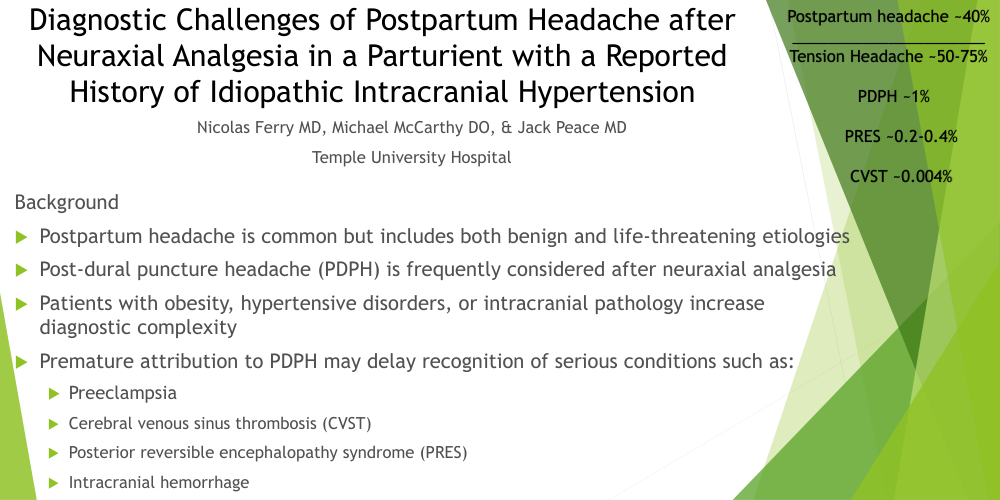
Diagnostic Challenges of Postpartum Headache after Neuraxial Analgesia in a Parturient with a Reported History of Idiopathic Intracranial Hypertension
Background
uPostpartum headache is common but includes both benign and life-threatening etiologies
uPost-dural puncture headache (PDPH) is frequently considered after neuraxial analgesia
uPatients with obesity, hypertensive disorders, or intracranial pathology increase diagnostic complexity
uPremature attribution to PDPH may delay recognition of serious conditions such as:
uPreeclampsia
uCerebral venous sinus thrombosis (CVST)
uPosterior reversible encephalopathy syndrome (PRES)
uIntracranial hemorrhage
Case
uPatient / Peripartum Course
u24-year-old G3P2 at 37+4 weeks; Class III obesity, preeclampsia
uReported history of Idiopathic intracranial hypertension
uLabor epidural placed
uPostpartum day 0: severe headache, initially positional
uClinical Evolution
uMinimal response to conservative therapy
uHeadache became non-positional
uConcern for preeclampsia
uKey Decision Point: Atypical features → PDPH felt unlikely; Epidural blood patch deferred
uImaging revealed (PPD 0 – 2)
uPPD2: generalized seizure → anticoagulation + anticonvulsants
uDischarged PPD10 after improvement w/outpatient f/u
Teaching Points
uConsider horses first – but do NOT forget the zebras
uEvolution of symptoms is a key red flag
uCritical diagnoses include:
uCerebral venous sinus thrombosis
uPosterior reversible encephalopathy syndrome
uIntracranial hemorrhage
uAvoid anchoring bias — reassessment and multidisciplinary input are essential