516 posters, 59 topics, 63 sessions, 1,127 authors, 352 institutions
ePostersLive by SciGen Technologies S.A. All rights reserved.
2026 SOAP Annual Meeting
April 29 - May 3, 2026 | Montreal, Quebec Canada

2341340
Postpartum Plasma-Derived Exosomes Confer Mitochondrial Stabilization and Neuroprotection against Ischemic Stroke
Part of Topic
Rare Conditions
BACKGROUND AND HYPOTHESIS
STUDY DESIGN AND METHODS
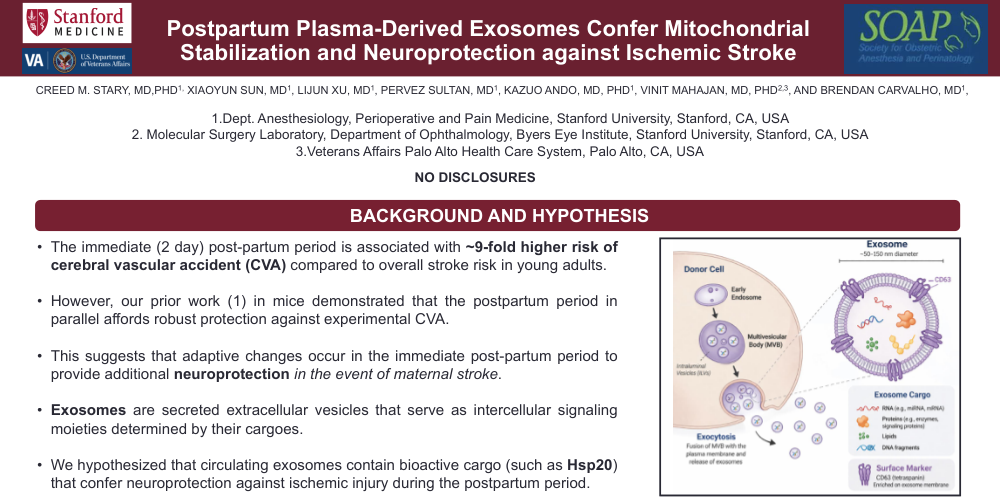
1. Exosomes (Exos) were isolated from plasma of postpartum female mice (ppExos) and from age-matched nulliparous female mice (conExos).
2. In parallel experiments, exosomes were isolated from serial blood samples obtained from healthy human volunteers during pregnancy (3rd trimester) and again on postpartum day 2.
3. Exos proteins were interrogated by proteomics and validated by immunoblot.
4. Protection with exosomes was assessed in vitro using mouse neuronal and astrocyte cultures and human RPE cell line. Reactive oxygen species (ROS), mitochondrial fragmentation and mitochondrial fusion proteins (Mfn2, Opa1) were measured after Exos treatment and simulated ischemia.
5. Neuroprotection in vivo was assessed by measuring infarct volume and neurobehavioral scores 24h after 1h transient middle cerebral artery occlusion (MCAO) with 2hr post-injury Exos intravenous treatment.
RESULTS
1. Mouse ppExos reduced infarct volumes and improved neurological deficits in both young adult males and females, and in aged female mice.
2. Human 3rd-trimester and 2d post-partum Exos significantly reduced infarct volume and improved neurological deficits in male mice.
3. In vitro, both ppExos and 2d postpartum Exos reduced ROS generation in all cell types after simulated ischemia, reduced mitochondrial fragmentation and preserved mitochondrial fusion proteins Mfn2 and Opa1.
4. Heat shock protein 20 (Hsp20) was relatively elevated in both human 2d post-partum Exos and mouse ppExos. Simulated ischemia significantly reduced Hsp20 levels in astrocyte and neuronal cultures, an effect reversed by ppExos.
CONCLUSION AND DISCUSSION