Loading...

516 posters, 59 topics, 63 sessions, 1,127 authors, 352 institutions

ePostersLive by SciGen Technologies S.A. All rights reserved.

2026 SOAP Annual Meeting

April 29 - May 3, 2026 | Montreal, Quebec Canada

2026 SOAP Annual Meeting banner

2326310

A Bundle of Joy and a Bundle of Nerves: Safe Epidural Placement in a Pregnant Patient with a Schwannoma
Part of Topic

Challenging Blocks

Background

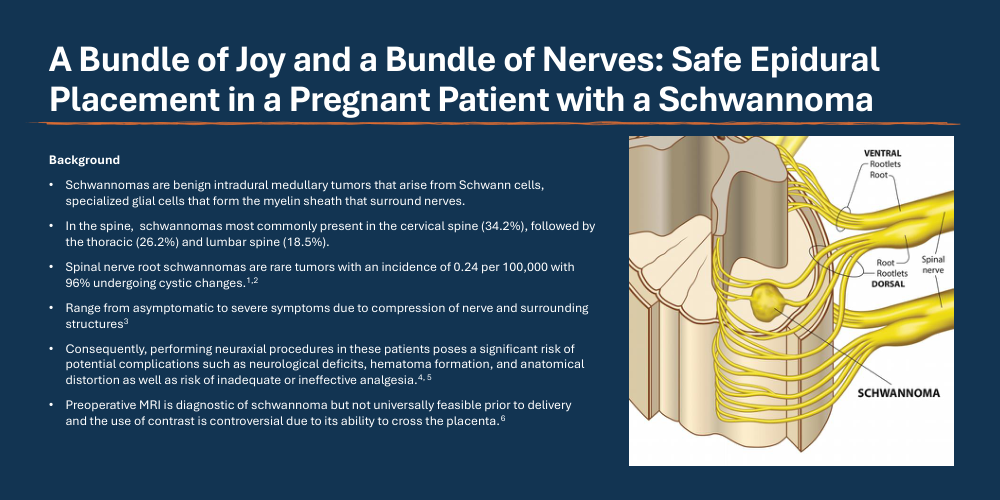
Schwannomas are benign intradural medullary tumors that arise from Schwann cells, specialized glial cells that form the myelin sheath that surround nerves.
 
In the spine,  schwannomas most commonly present in the cervical spine (34.2%), followed by the thoracic (26.2%) and lumbar spine (18.5%).
 
Spinal nerve root schwannomas are rare tumors with an incidence of 0.24 per 100,000 with 96% undergoing cystic changes.
 
Range from asymptomatic to severe symptoms due to compression of nerve and surrounding structures
 
Consequently, performing neuraxial procedures in these patients poses a significant risk of potential complications such as neurological deficits, hematoma formation, and anatomical distortion as well as risk of inadequate or ineffective analgesia.
 
Preoperative MRI is diagnostic of schwannoma but not universally feasible prior to delivery and the use of contrast is controversial due to its ability to cross the placenta.
 
Case

20-year-old female gravida 2 para 0 admitted with preterm labor at 32+2 weeks gestational age with a known right-sided L5 cystic schwannoma with mild radicular symptoms, predominantly shooting right lateral knee pain.

Admitted to antepartum service for preterm labor.

Neurosurgical intervention at an outside facility had been planned but was delayed secondary to unexpected pregnancy. The schwannoma was originally incidentally discovered on imaging during an emergency department visit for abdominal pain. She had not followed up with neurosurgery during this pregnancy.

Patient reports that she was previously advised that neuraxial anesthesia was contraindicated for either vaginal or cesarean delivery.

Most recent imaging was an MRI that was over a year old and prior to pregnancy. After repeat MRI and multidisciplinary discussion between obstetric team, neuroradiology, anesthesiology, and neurosurgery, it was determined neuraxial anesthesia could be safely administered

Patient was ultimately discharged home after preterm labor ceased. She was readmitted for induction of labor at 38 weeks gestational age and was able to undergo successful epidural placement and uncomplicated vaginal delivery with adequate pain control and no neurologic deficits

Teaching Points
 
The presence of a large spinal schwannoma, especially in the lumbar region, in a pregnant patient presents a significant challenge for anesthetic management during labor.
 
Given the rarity of spinal schwannomas, there is a paucity of literature to guide neuraxial anesthetic decision-making in these patients, which may contribute to clinician hesitancy due to potential procedural or anesthetic complications. 
 
Some important things to consider include safety and feasibility of administering neuraxial anesthesia due to location of mass, possible mass effect on the epidural and dural spaces that could impact medication spread, and increased likelihood of ineffective epidural in the region of the schwannoma.
 
This unique case highlights that with careful multidisciplinary planning and detailed pre-procedural evaluation, neuraxial anesthesia can be a safe and viable option for labor analgesia in select patients with neural tumors.
 
soap2026 banner
Copyright © 2015-2026, ePostersLive® SciGen is a registered trademark of SciGen Technologies S.A. Patent pending.

This website and third-party tools we use rely on cookies for the best user experience. By selecting "I agree", you agree to cookie usage as described in our Privacy Policy.