Loading...

516 posters, 59 topics, 63 sessions, 1,127 authors, 352 institutions

ePostersLive by SciGen Technologies S.A. All rights reserved.

2026 SOAP Annual Meeting

April 29 - May 3, 2026 | Montreal, Quebec Canada

2026 SOAP Annual Meeting banner

2318843

Transnasal topical sphenopalatine ganglion block for temporary symptom relief in two parturients with mild to moderate post-dural puncture headache who either declined or deferred epidural blood patch
Part of Topic

Challenging Blocks

Kiyoyuki Miyasaka BS MS MD PhD, Mana Takizawa MD, and Rimu Suzuki RN MSN
Department of Anesthesiology, St. Luke’s International Hospital, Tokyo, Japan

Transnasaltopical sphenopalatine ganglion block for temporary symptom relief in two parturients with mild to moderate post-dural puncture headache who either declined or deferred epidural blood patch

Background

Epidural blood patch (EBP) is the definitive treatment for PDPH. However, it is an invasive procedure with risks that patients with mild to moderate symptoms may be reluctant to accept.

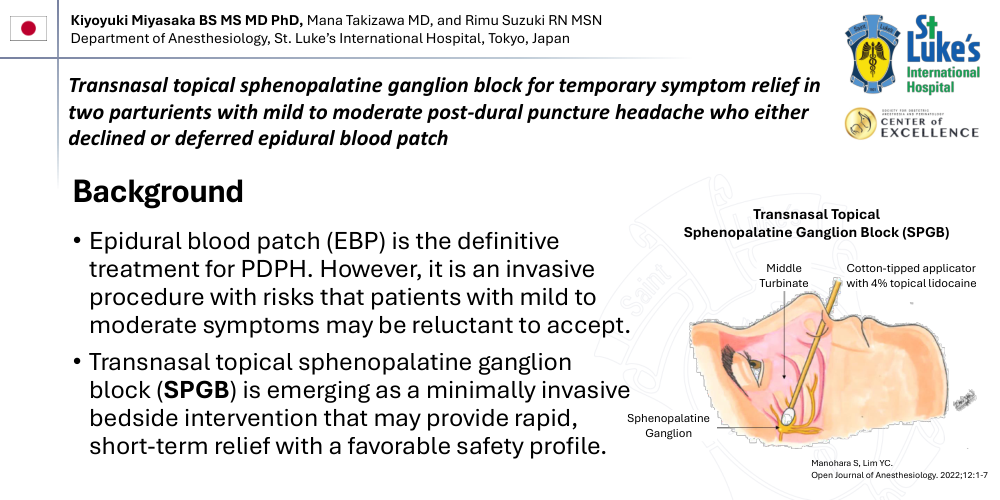
Transnasaltopical sphenopalatine ganglion block (SPGB) is emerging as a minimally invasive bedside intervention that may provide rapid, short-term relief with a favorable safety profile.

Middle Turbinate, Sphenopalatine Ganglion, Cotton-tipped applicator with 4% topical lidocaine

Manohara S, Lim YC. Open Journal of Anesthesiology. 2022;12:1-7

The Cases

Case 1: 33 y/o parturient

Developed mild to moderate PDPH55 hours after labor analgesia by dural puncture epidural (DPE) technique.
Declined EBP but wished to actively pursue other treatment options. SPGBwas performed.
Difficulty accessing the left nasal cavity resulted in partial relief from a right-sided block. A subsequent contralateral block produced complete relief.
Mild symptoms recurred the following day, and a second SPGB was performed at 80 hours post-DPE, after which symptoms resolved.

PDPH→SPGB→SPGB→Resolved

Case 2: 33 y/o parturient

Developed mild PDPH 30 hours after labor analgesia by DPE.
Declined EBP and elected to undergo SPGB, with complete relief lasting approximately 10 hours.
When moderate symptoms recurred, the patient deferred EBP and opted for a second SPGB at 59 hours post-DPE. 
Moderate symptoms persisted the following day, and the patient consented to EBP at 77 hours.
Symptoms resolved shortly after EBP.

PDPH→SPGB→SPGB→EBP→Resolved

Teaching Points

PDPH often resolves with conservative therapy within 24-48 hours.
Early EBP within 24 hours of dural puncture is less likely to succeed.

Kokki M. et al. Int J Obstet Anesth. 2013;22:303.

Patients may experience substantial discomfort during the gap in management between 24-48 hours awaiting optimal timing for invasive EBP. 
Our experience suggests SPGB may be considered as part of a stepwise approach, providing temporary relief while preparing patients for the possibility of EBP.
Like other conservative therapies, SPGB is not a definitive treatment. Randomized trials have shown mixed results, and further study is needed to clarify its role.
Mahanty PR, et al.World J Clin Cases. 2026;14(3):114521.
soap2026 banner
Copyright © 2015-2026, ePostersLive® SciGen is a registered trademark of SciGen Technologies S.A. Patent pending.

This website and third-party tools we use rely on cookies for the best user experience. By selecting "I agree", you agree to cookie usage as described in our Privacy Policy.