516 posters, 59 topics, 63 sessions, 1,127 authors, 353 institutions
ePostersLive by SciGen Technologies S.A. All rights reserved.
2026 SOAP Annual Meeting
April 29 - May 3, 2026 | Montreal, Quebec Canada

2340978
The Pannus Retention System and Hypotension during Cesarean Section; an Observational Study
Poster Presenter
Authors
Affiliations
null,
Part of Topic
Cesarean Delivery and other Surgery
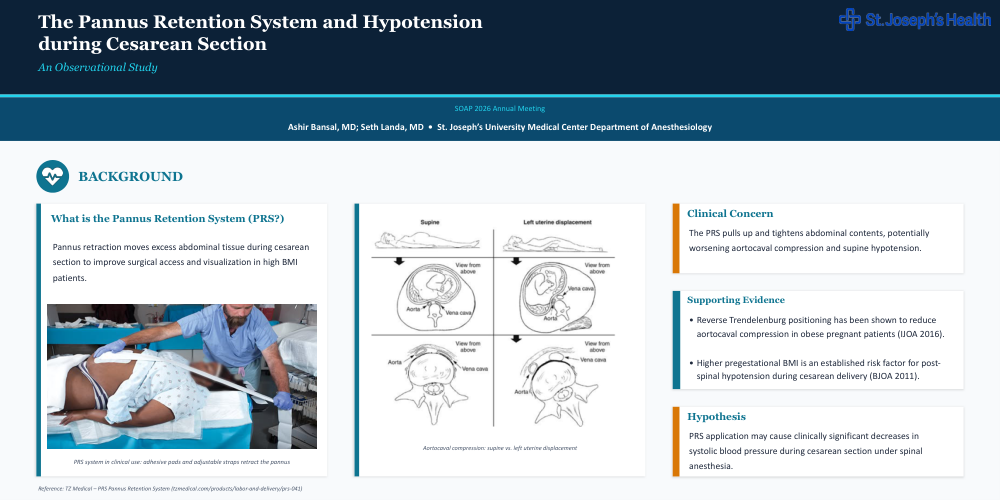
Pannus retraction/retention can be utilized during cesarean section to move excess abdominal tissue in order to improve surgical access and visualization, usually in high BMI patients when a low transverse surgical incision is planned. While this can be accomplished with conventional tape, more sophisticated systems are commercially available providing more effective and secure retraction. The PRS Pannus Retention System (TZ Medical) consists of 4 adhesive pads serving as anchor points - 2 on the abdomen and 2 under the table, with 2 adjustable connector straps between them to retract the pannus(see fig)(1). Because this practice pulls up and tightens the abdominal contents, aortocaval compression might be affected, exacerbating supine hypotension. We studied the immediate effects of the PRS on blood pressure prior to cesarean section.
Methods: We observed systolic blood pressure patterns in 17 patients scheduled for elective cesarean section in whom the PRS was utilized. Average BMI was 42.6 (range 29.7- 56). All patients had spinal anesthesia (hyperbaric bupivacaine 1.8 ml, fentanyl 15 mcg, morphine 150 mcg) resulting in an anesthetic level between T4-6 and were started on a phenylephrine infusion of 50-70 mcg/minute. Once the final anesthetic level was established and following urinary catheterization, when 2 consecutive systolic BP readings were stable and within 10% of each other, the surgeon was allowed to apply the PRS system. BP was then checked at 1 and 3 minutes after application to determine the immediate effects on systolic BP compared with SBP immediately prior to application.
Results: In 15 patients (88%) SBP dropped after application (avg. 16.2 mmHg; range 2–34 mmHg) at either 1 or 3 minutes. Four patients (23%) had a 20% or greater drop, and 2 others had a reduction >15%. In 5 patients (29%) SBP dropped below 100mmHg. Two patients had no drop or a slight increase. All significant drops in BP were easily managed with boluses of phenylephrine or infusion rate adjustments. We saw no association between greater BMI and severity of decrease in SBP.
Conclusion: The PRS system can be safely used during cesarean section provided the anesthesiologist is aware of the potential for significant BP drops and the need for adjustment to vasopressor therapy. Retraction straps should not be tightened in a patient with hypotension or borderline blood pressure until stabilized to an acceptable range.