Loading...

516 posters, 59 topics, 63 sessions, 1,127 authors, 352 institutions

ePostersLive by SciGen Technologies S.A. All rights reserved.

2026 SOAP Annual Meeting

April 29 - May 3, 2026 | Montreal, Quebec Canada

2026 SOAP Annual Meeting banner

2336394

Combined Spinal-Epidural for Cesarean Delivery in Complex Congenital Heart Disease and Recent Stroke: A Case Report
Part of Topic

CAN'T DO A NEURAXIAL?

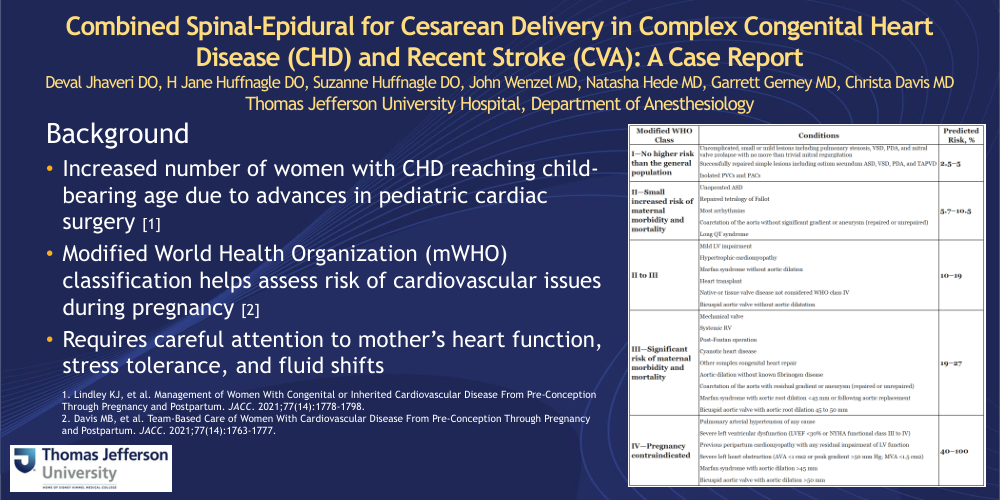
Combined Spinal-Epidural for Cesarean Delivery in Complex Congenital Heart Disease (CHD) and Recent Stroke (CVA): A Case Report
Deval Jhaveri DO, H Jane Huffnagle DO, Suzanne Huffnagle DO, John Wenzel MD, Natasha Hede MD, Garrett Gerney MD, Christa Davis MD
Thomas Jefferson University Hospital, Department of Anesthesiology


Background

•Increased number of women with CHD reaching child-bearing age due to advances in pediatric cardiac surgery [1]
•Modified World Health Organization (mWHO) classification helps assess risk of cardiovascular issues during pregnancy [2]
•Requires careful attention to mother’s heart function, stress tolerance, and fluid shifts
 

1. Lindley KJ, et al. Management of Women With Congenital or Inherited Cardiovascular Disease From Pre-Conception Through Pregnancy and Postpartum. JACC. 2021;77(14):1778-1798.

2. Davis MB, et al. Team-Based Care of Women With Cardiovascular Disease From Pre-Conception Through Pregnancy and Postpartum. JACC. 2021;77(14):1763-1777.


Case

•30-y/o G2P1 term F presented for rC/S; PMHx: congenital critical PS + ASD requiring pediatric pulmonic valve-ectomy with patch enlargement of main PA complicated by R parietal CVA, migraines, gHTN, syncope, anemia
•Prior C/S: spinal with pre-procedure radial A-line, RIJ sheath + PA catheter, PPH QBL 1.6L, CV ICU 2x days post-op
•Current gestation complicated by R insular CVA at 5 weeks --> enoxaparin 120 mg daily
•TTE: severe PS, mod/severe PR, mod dilated RV, normal RV function, mild TR, PAS 36 mmHg, mild MR, small ASD with L-R shunt, normal LV function, EF 60%. EKG: RBBB + LPFB
•mWHO score II to III --> 20% predicted risk of CV event in present pregnancy
•Currently, no signs of decompensated HF but reports DOE
•Multidisciplinary plan with obstetrics, cardiology, neurology, anesthesiology (CSE, without invasive monitoring)
•CV stability, no HF --> NO invasive monitoring
•Prior CVAs --> NO TXA, hold enoxaparin for anesthetic/procedure
•CSE --> prior C/S with PPH (? prolonged duration)
•Uncomplicated C/S, QBL 337mL, epidural dosing not required, enoxaparin restart PPD#1, d/c home PPD#2
 

Teaching points

•Tailored care based on current physiology; don’t rely on past practices --> avoid invasive monitoring with necessary critical supplies; life-saving meds available
•Delivery at III or IV care center with multidisciplinary team, schedule during routine working hours with appropriate staffing for patient acuity
•Planned rC/S: no TOLAC b/o DOE with strenuous activity and prior C/S with PPH
•CSE: possible prolonged surgery, prior PPH --> minimize GA conversion
•Anticoagulation guidelines for neuraxial procedures: hold therapeutic enoxaparin for 24 hours prior to CSE, restart 4 hours post epidural removal
•Omit TXA despite prior PPH: recent CVA and uncertain benefits of prophylactic TXA based on 2024 Cochrane review [3]
 

3. Rohwer C, et al. Tranexamic acid for preventing postpartum haemorrhage after caesarean section. Cochrane library. 2024;2024(11).

soap2026 banner
Copyright © 2015-2026, ePostersLive® SciGen is a registered trademark of SciGen Technologies S.A. Patent pending.

This website and third-party tools we use rely on cookies for the best user experience. By selecting "I agree", you agree to cookie usage as described in our Privacy Policy.