516 posters, 59 topics, 63 sessions, 1,127 authors, 352 institutions
ePostersLive by SciGen Technologies S.A. All rights reserved.
2026 SOAP Annual Meeting
April 29 - May 3, 2026 | Montreal, Quebec Canada

2333922
When Neuraxial is a No-No: General Anesthesia for a Parturient with Heart Failure and Cerebral Midline Shift
Poster Presenter
Authors
Affiliations
Part of Topic
CAN'T DO A NEURAXIAL?
When Neuraxial is a No-No: General Anesthesia for a Parturient with Heart Failure and Cerebral Midline Shift
Taylor Catalano, MD & Hannah Jennings-Davis, MD
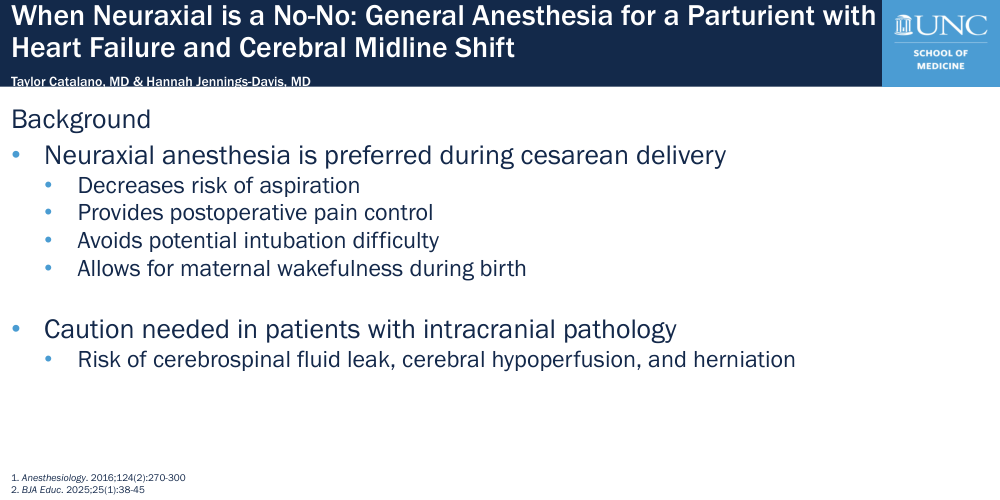
Background
•Neuraxial anesthesia is preferred during cesarean delivery
•Decreases risk of aspiration
•Provides postoperative pain control
•Avoids potential intubation difficulty
•Allows for maternal wakefulness during birth
•Caution needed in patients with intracranial pathology
•Risk of cerebrospinal fluid leak, cerebral hypoperfusion, and herniation
Case Presentation
Patient: 32-year-old G9P3235 with:
•Non-ischemic cardiomyopathy (LVEF nadir 20-25%)
•Congenital arachnoid cyst
•Chronic subdural hematoma with mass effect and midline shift (new since prior delivery)
•Polysubstance use
•Two prior cesarean deliveries with neuraxial anesthesia
Procedure: Cesarean delivery at 36 weeks
Anesthetic Plan: General anesthesia
•Access: 2 peripheral IVs and 1 pre-induction arterial line
•Induction: Rapid sequence intubation with video laryngoscopy
•Maintenance: Propofol infusion
•Hemodynamic Management: Clevidipine for intraoperative hypertension
•Pain control: Fentanyl, Acetaminophen, Ketorolac, Bilateral transverse abdominis plane blocks with liposomal bupivacaine
Outcome and Take-Home Point
Outcome
•Uncomplicated intubation, anesthetic, and extubation
•Cesarean delivery performed without complication (quantitative blood loss of 392 mL)
•Post-operative pain well-controlled with scheduled acetaminophen and ibuprofen and as-needed oxycodone
•Patient was discharged on post-operative day 5
Take-Home Point
•While neuraxial anesthesia is preferred for cesarean delivery, the presence of increased intracranial pressure warrants careful preoperative evaluation and planning to ensure patient safety