516 posters, 59 topics, 63 sessions, 1,127 authors, 353 institutions
ePostersLive by SciGen Technologies S.A. All rights reserved.
2026 SOAP Annual Meeting
April 29 - May 3, 2026 | Montreal, Quebec Canada

2341803
Balancing Relative Contraindications: Epidural Anesthesia in a Pregnant Patient with Cardiac and Hepatic Dysfunction
Poster Presenter
Authors
Affiliations
null,
Part of Topic
CRITICAL DECISIONS
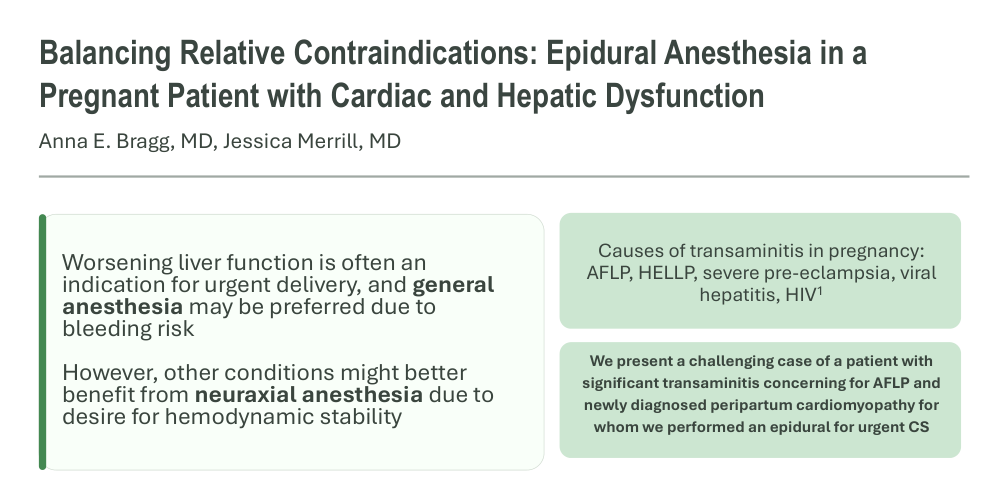
Transamititis in pregnancy can be due to several pathologies, such as AFLP, HELLP, severe pre-eclampsia, viral hepatitis, or HIV (1). While pregnancy is a hypercoagulable state, significant liver disease can disrupt clotting factor production and increase the risk of bleeding complications such as epidural hematomas. Worsening liver function is often an indication for urgent delivery and may precede full diagnostic workup, requiring the anesthesiologist to make a quick decision about whether to offer neuraxial versus general anesthesia. There are many conditions for which neuraxial anesthesia may be preferred due to relative hemodynamic stability. We present a challenging case of a patient with significant transaminitis concerning for AFLP and newly diagnosed peripartum cardiomyopathy for whom we performed an epidural for urgent CS.
38-year-old G2P2002 presented at 28w1d with newly diagnosed HFrEF (LVEF 20%) and transaminitis (ALT/AST 1900s) with concern for AFLP, and ultimately underwent urgent CS due to NRFHT. Medical history significant for Hepatitis C, untreated HIV, asthma, and active polysubstance abuse (meth, THC, MDMA). Initially presented with RUQ pain, N/V, lethargy, and HTN (SBP into the 160s) and was unaware that she was pregnant. Labs notable for mild anemia without hemolysis, leukocytosis, lactic acidosis, AKI with uremia, transaminitis, and prolonged PT/PTT with INR of 1.4. ROTEM without hypocoagulability. Given concern for untreated HFrEF and relatively normal coagulation studies, after discussion of risk/benefits of GA vs NA, patient elected to proceed with neuraxial. Patient remained hemodynamically stable throughout an uneventful low-dose CSE. Epidural catheter removed in PACU and close follow-up revealed no epidural hematoma formation. Liver enzymes continued to trend down with no significant bleeding events. Further workup during immediate postpartum period revealed transaminitis was more consistent with the combination of pre-eclampsia, heart failure, and HIV cholangiography. Postpartum course was complicated by PE and IVC thrombosis and necrotizing surgical site infection.
When medically complex patients with relative contraindications for both neuraxial and general anesthesia present for urgent delivery, it may be beneficial to proceed with neuraxial anesthesia after overt coagulopathy has been ruled out. Given cardiovascular disease is one of the leading causes of maternal mortality in the US and epidural hematoma, while devastating, remains a rare complication, optimizing cardiac function when able is prudent (2).