516 posters, 59 topics, 63 sessions, 1,127 authors, 353 institutions
ePostersLive by SciGen Technologies S.A. All rights reserved.
2026 SOAP Annual Meeting
April 29 - May 3, 2026 | Montreal, Quebec Canada

2322982
Predictors of delayed urinary catheter removal following enhanced recovery after cesarean delivery: a retrospective cohort study
Poster Presenter
Authors
Part of Topic
Recovery: Pain, Sleep, Anxiety
Predictors of delayed urinary catheter removal following enhanced recovery after cesarean delivery: a retrospective cohort study
Sunti Barahi, Aswini Kuberan, Xiang Ye, Ronald B George, Naveed Siddiqui
Background and Hypothesis:
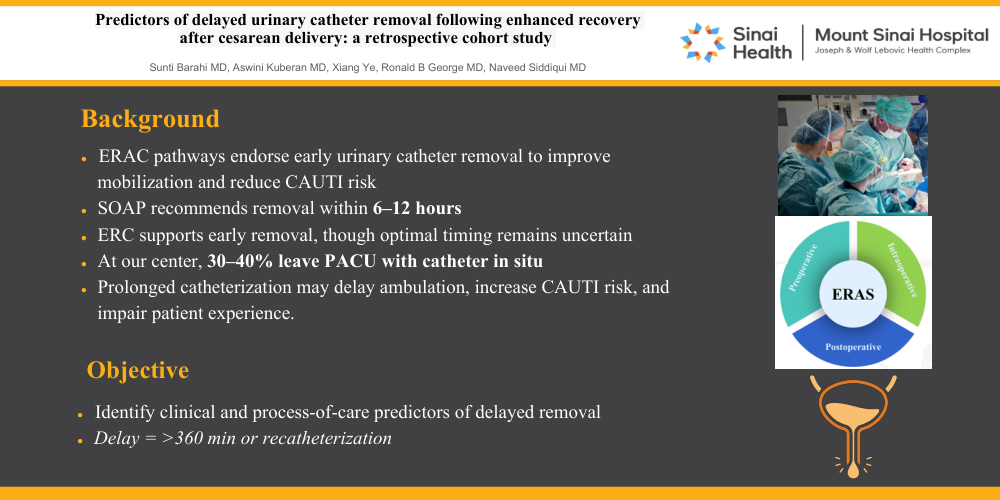
Background
ERAC recommends catheter removal within 6–12 hours
Early removal improves mobilization and reduces CAUTI risk
At our center, 30–40% leave PACU with catheter in situ
Objective
Identify clinical and process-of-care predictors of delayed removal
Delay = >360 min or recatheterization
Study Design and Methods
Design
Retrospective cohort (12 months), n = 337
Population
Age 18–49, all cesarean urgencies
Excluded: conditions requiring prolonged catheterization
Data Collected
Anesthesia type
PACU motor block (Bromage score)
Intraoperative fluids
Surgical duration
Timing & location of catheter removal
Analysis
Multivariable logistic regression
Results
Primary Outcome
44.8% (151/337) had delayed catheter removal
Not Associated
Age, BMI, gestational age, cesarean urgency
Independent Predictors
Denser PACU motor block
Ward vs PACU removal
Higher intraoperative fluids
Delayed motor assessment
Delayed motor recovery
Key Findings
PACU removal ↓ delay: OR 0.13 (0.05–0.33)
+1200 mL fluids → OR 3.12 (1.53–6.35)
Partial motor recovery ↓ odds vs complete block
Conclusion and Discussion
Conclusion
Delayed catheter removal remains common (~45%) despite ERAC
Key Drivers
Modifiable perioperative and workflow factors
Not patient demographics
Clinical Implications
Standardize PACU-based removal
Use Bromage-guided timing
Improve fluid stewardship
Prioritize early motor assessment
Take-Home Message
Improving workflow and motor recovery can enhance ERAC adherence and
patient safety