516 posters, 59 topics, 63 sessions, 1,127 authors, 352 institutions
ePostersLive by SciGen Technologies S.A. All rights reserved.
2026 SOAP Annual Meeting
April 29 - May 3, 2026 | Montreal, Quebec Canada

2336584
Surprise! A Sneaky Invasion of the Bladder by Uterus Causing Massive Hemorrhage.
Poster Presenter
Authors
Part of Topic
Challenging Acuity
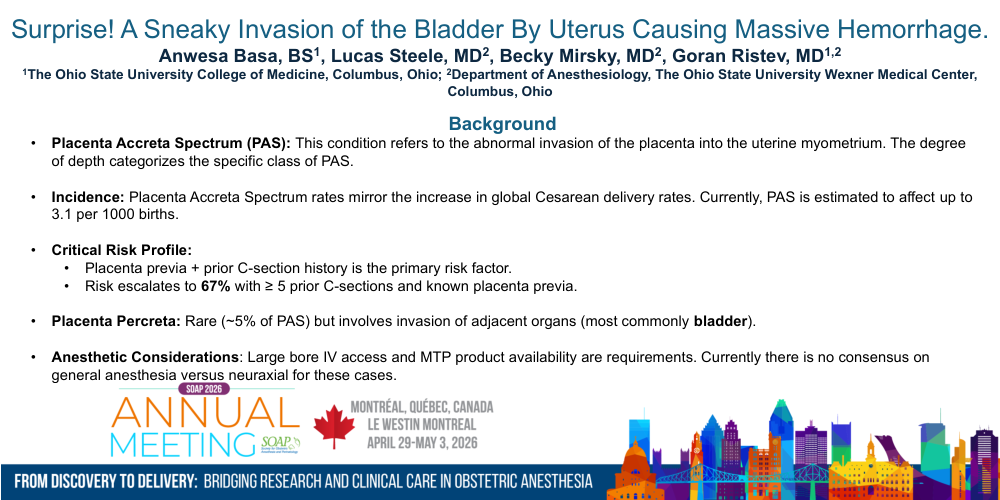
Surprise! A Sneaky Invasion of the Bladder By Uterus Causing Massive Hemorrhage.
Anwesa Basa, BS1, Lucas Steele, MD2, Becky Mirsky, MD2, Goran Ristev, MD1,2
1The Ohio State University College of Medicine, Columbus, Ohio; 2Department of Anesthesiology, The Ohio State University Wexner Medical Center,
Columbus, Ohio
Background
• Placenta Accreta Spectrum (PAS): This condition refers to the abnormal invasion of the placenta into the uterine myometrium. The degree
of depth categorizes the specific class of PAS.
• Incidence: Placenta Accreta Spectrum rates mirror the increase in global Cesarean delivery rates. Currently, PAS is estimated to affect up to
3.1 per 1000 births.
• Critical Risk Profile:
• Placenta previa + prior C-section history is the primary risk factor.
• Risk escalates to 67% with ≥ 5 prior C-sections and known placenta previa.
• Placenta Percreta: Rare (~5% of PAS) but involves invasion of adjacent organs (most commonly bladder).
• Anesthetic Considerations: Large bore IV access and MTP product availability are requirements. Currently there is no consensus on
general anesthesia versus neuraxial for these cases.
Case Presentation
• Patient: 34yo G8P6 (34w) with 6 prior C-sections and a known placenta
previa with suspected accreta.
• Anesthetic: Failed CSE with conversion to general anesthesia with ETT.
She had 2 large bore IVs placed, an arterial line, and a rapid transfuser
primed and connected.
• Surgical Findings: Uneventful delivery followed by the discovery that
the placenta had invaded posterior bladder wall, requiring an
unavoidable cystotomy with urologic repair.
• Massive Hemorrhage: Massive EBL of 17 Liters requiring MTP
activation and a total of 20u packed RBC, 20u FFP, 3u cryoprecipitate,
3u platelets. She also required the use of 4 simultaneous vasopressors
for hemodynamic stability.
• Outcome: Extubated POD1; POD10 discharge with normal voiding and
interval follow-up.
Key Learning Points
Anticipate Catastrophe
• Placenta accreta profiles require immediate MTP readiness and resource availability. Ideally, these cases
should be done at large centers with the resources and facilities capable of supporting these patients.
Survival hinges on prompt recognition and immediate action by the in-room team.
Anesthetic Choice
• The literature remains unclear on using neuraxial or general anesthesia for these cases, however, if
neuraxial is chosen, the patient should receive a CSE with immediate ability to convert to general if required.
The Multidisciplinary Mandate
• Placenta accreta spectrum has a wide range of presentation possibilities and multiple surgical services may
be required, such as the bladder invasion in this case requiring an intra-operative urology consultation for
repair of cystotomy.