516 posters, 59 topics, 63 sessions, 1,127 authors, 353 institutions
ePostersLive by SciGen Technologies S.A. All rights reserved.
2026 SOAP Annual Meeting
April 29 - May 3, 2026 | Montreal, Quebec Canada

2339271
Integrated Ex-Utero Intrapartum Treatment and Postnatal Resection of Giant Cervical Teratoma: Anesthetic Management Across the Perinatal Continuum
Poster Presenter
Part of Topic
A TRAP and many EXITS - FETAL HOUR
Integrated Ex-Utero Intrapartum Treatment and Postnatal Resection of Giant Cervical Teratoma: Anesthetic Management Across the Perinatal Continuum
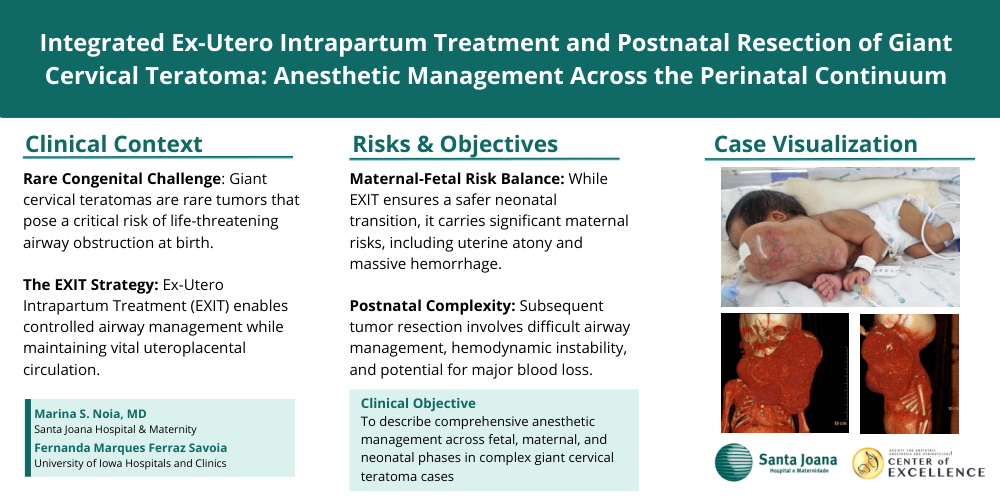
Clinical Context Rare Congenital Challenge: Giant cervical teratomas are rare tumors that pose a critical risk of life-threatening airway obstruction at birth.The EXIT Strategy: Ex-Utero Intrapartum Treatment (EXIT) enables controlled airway management while maintaining vital uteroplacental circulation.
Risks and Objective: Maternal-Fetal Risk Balance: While EXIT ensures a safer neonatal transition, it carries significant maternal risks, including uterine atony and massive hemorrhage. Postnatal Complexity: Subsequent tumor resection involves difficult airway management, hemodynamic instability, and potential for major blood loss.
Clinical Objective: To describe comprehensive anesthetic management across fetal, maternal, and neonatal phases in complex giant cervical teratoma cases
Case 1: EXIT Procedure (Maternal): 36-year-old G1 (IVF) woman at 32w with a prenatal diagnosis of a fetal cervical mass. Developed severe polyhydramnios requiring 2 amniodrainages (30 and 32w), complicated by chorioamniotic separation: earlier delivery planning.
Setup & Induction: Standard monitorization, BIS, 2 IV; CS + GA → Fetal status: USG by MFM team
Uterine Relaxation: Sevoflurane at 3 MAC with Norepinephrine infusion: placental perfusion
Transition Phase: Fetal airway in 7 minutes; switch to TIVA and agressive uteroitonics post clamping
Outcome: Hemorrhage Protocol; blood loss of 2.1L; hemodynamic stability maintained without blood products
Case 2: Neonatal Resection: Delivered via EXIT under GA; Apgar 5/7; BW 2250 g. Intubated, stabilized at delivery → NICU; Initial labs were within normal limits.
Preoperative Findings: Fetal MRI: 9 × 6.0 cm; CT angiography: 11.7 × 12.3 × 7.5 cm; vascular involvement + airway deviation
Indication for Surgery: Tumor progression + anemia → resection at Day 5 of life
Monitoring & Access: Standard + NIRS, Umbilical venous access + PICC + Central venous access
Anesthesia: GA: sevoflurane, fentanyl, ketamine, rocuronium; Active warming
Intraoperative Course: Complex resection + thyroidectomy + tracheostomy
Outcome: EBL 73% of the neonatal blood volume. (130g), tumor weight 220g;
Uteroplacental Perfusion: Deep uterine relaxation with volatile agents combined with vasopressor support (norepinephrine) maintains critical perfusion during EXIT procedure
Multidisciplinary Synergy: Multidisciplinary planning between maternal fetal medicine, obstetric anesthesiology, pediatric anesthesiology, pediatric surgery, advanced airway team and neonatology is imperative for safe delivery across perinatal
Advanced Monitoring: Near-infrared spectroscopy provides real-time tissue oxygenation assessment, supporting early detection of perfusion compromise during major blood loss and airway manipulation
Hemorrhage Preparedness: High risk in both maternal (EXIT) and neonatal phases requires early activation of transfusion protocols and massive hemorrhage management
Perinatal Continuity: The successful outcome of this case highlights the anesthesiologist as a pivotal link in perinatal continuity. By synchronizing specialized teams—including MFM, obstetrics, pediatric surgeons and neonatology—the anesthesiologist facilitated a cohesive transition of care that was vital to managing this complex clinical scenario.