516 posters, 59 topics, 63 sessions, 1,127 authors, 353 institutions
ePostersLive by SciGen Technologies S.A. All rights reserved.
2026 SOAP Annual Meeting
April 29 - May 3, 2026 | Montreal, Quebec Canada

2340270
Ebstein Anomaly in the Parturient: Management Considerations
Poster Presenter
Authors
Affiliations
Part of Topic
Potpourri
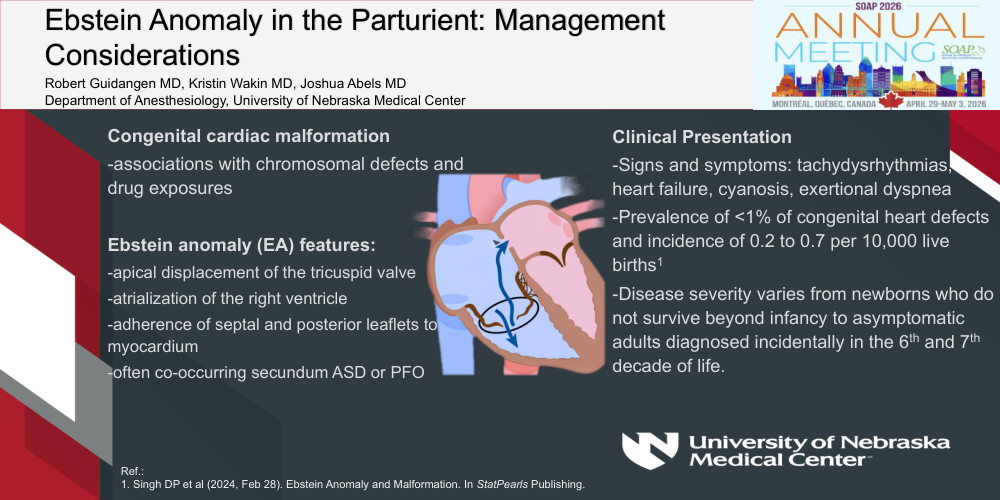
Background: Ebstein anomaly (EA) is a rare cardiac abnormality with an incidence of only 0.5%-1% among cases of congenital heart disease. Further, the variety of symptoms, disease severity, and complications make uniform evaluation difficult. Women born with Ebstein anomaly frequently reach childbearing age, and contemporary literature demonstrate that pregnancy is likely to be well tolerated. However, among pregnant patients with Ebstein anomaly, nearly half may develop a cardiac arrhythmia while as much as 18% have been shown to develop heart failure. We present specific considerations for anesthetic management in a patient with repaired EA complicated by severe right heart dysfunction and significant valvulopathy.
Case Presentation: A 23-year-old G1P0 with intrauterine pregnancy at 36 weeks and 6 days gestation presented for scheduled induction of labor indicated by worsening dyspnea and lower extremity edema in the setting of EA. The patient previously underwent bioprosthetic tricuspid valve replacement with atrial septal defect closure at 5 years old. However, she required transcatheter valve-in-valve implantation at 12 years old secondary to failure of initial replacement. Late in her antepartum course, echocardiography showed prosthetic tricuspid stenosis and severe right ventricular dilation with severe dysfunction. Upon admission to the labor and delivery floor, two large-bore peripheral intravenous catheters were inserted and judicious intravenous crystalloid management was implemented. A radial arterial line was placed shortly before placement of a labor epidural. Successful neuraxial anesthesia was initiated with a slowly titrated infusion of a bupivacaine and fentanyl solution while maintaining hemodynamic stability. Her labor course was uncomplicated with oxytocin augmentation, and she underwent spontaneous vaginal delivery of a healthy infant. The patient discharged home on postpartum day 2.
Discussion: Management of patients with EA– repaired or unrepaired - in labor prioritizes maintenance of normal sinus rhythm and euvolemia while providing sufficient analgesia for vaginal delivery, which is the preferred method of delivery in almost all cases. Additional hemodynamic goals emphasize avoidance of myocardial depression and increases in pulmonary vascular resistance. Further strategies include clear induction plans for emergent cesarean delivery and monitoring requirements while in the labor suite. EA can have variable presentation based on status of repair/replacement, co-occurring valvular disease, and altered cardiac function through the antepartum period. This case highlights the influence of physiologic changes in pregnancy on disease progression and underscores the extensive multidisciplinary planning needed to optimize successful delivery.