516 posters, 59 topics, 63 sessions, 1,127 authors, 352 institutions
ePostersLive by SciGen Technologies S.A. All rights reserved.
2026 SOAP Annual Meeting
April 29 - May 3, 2026 | Montreal, Quebec Canada

2341834
Anesthetic Management of a Parturient with Single-Ventricle Physiology and Congenitally Corrected Transposition of the Great Vessels during Cesarean Delivery
Poster Presenter
Authors
Emily Breland Edwards, Waseem Athar, Matthew Williams, Cash Arcement
Affiliations
Part of Topic
HEART: CONGENITAL AND VALVE CHALLENGES
Anesthetic Management of a Parturient with Congenitally Corrected Transposition of the Great Vessels, Pulmonic Stenosis, and Single-Ventricle Physiology during Cesarean Delivery
Emily Breland Edwards, MD, Waseem Athar, MD, Cash Arcement, MD, Matthew Williams, MD
University of Arkansas for Medical Sciences
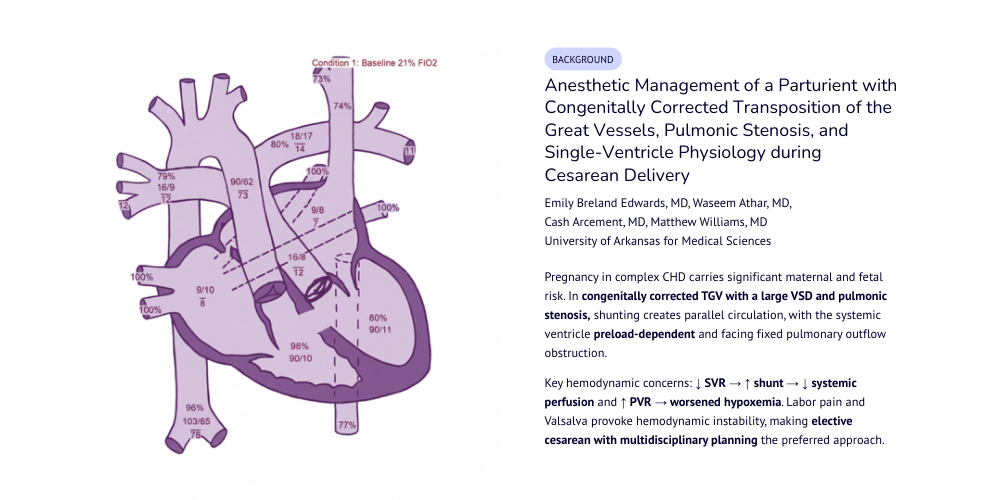
Pregnancy in complex CHD carries significant maternal and fetal risk. In congenitally corrected TGV with a large VSD and pulmonic stenosis, shunting creates parallel circulation, with the systemic ventricle preload-dependent and facing fixed pulmonary outflow obstruction.
Key hemodynamic concerns: ↓ SVR → ↑ shunt → ↓ systemic perfusion and ↑ PVR → worsened hypoxemia. Labor pain and Valsalva provoke hemodynamic instability, making elective cesarean with multidisciplinary planning the preferred approach.
22-Year-Old G1P0: ccTGV with VSD and pulmonic stenosis
Cardiac Profile:
Outcome: Hemodynamically stable throughout. No maternal or fetal complications. Postoperative CVICU monitoring.
Key Principles for Anesthetic Management
Avoid ↓ SVR:
Prevents worsening R→L shunt and systemic hypoperfusion and hypoxia
Maintain Preload:
Single-ventricle physiology is preload-dependent; avoid relative hypovolemia
Titrated Neuraxial:
Low-dose CSE with incremental epidural dosing is safer than single-shot spinal
Vasopressin First-Line:
Supports SVR with minimal effect on PVR — ideal for this physiology
Team-Based Planning:
Multidisciplinary coordination and CVICU care optimize maternal and fetal outcomes