875 posters, 25 topics, 3,440 authors, 1,061 institutions
ePostersLive by SciGen Technologies S.A. All rights reserved.
SAGES 2026 Annual Meeting Emerging Technology Session
March 25-28, 2026 | Tampa, FL, USA

P840
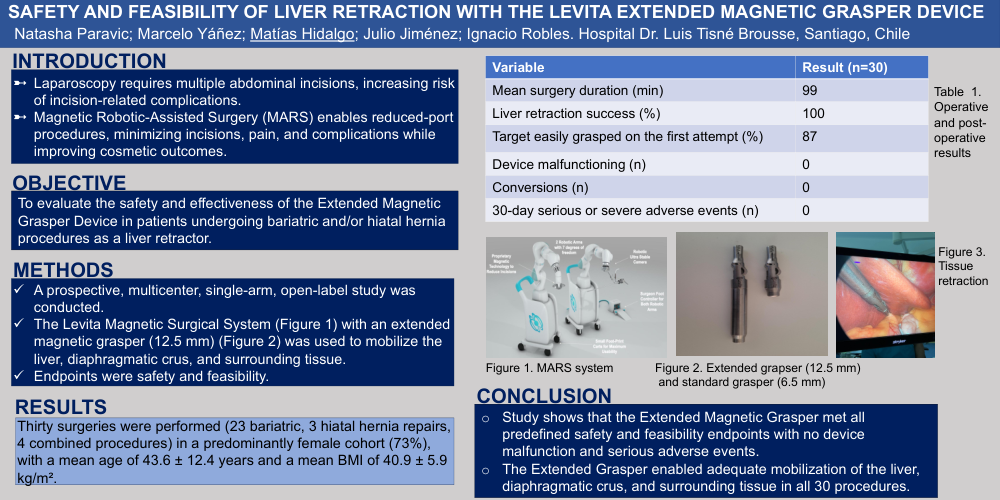
SAFETY AND FEASIBILITY OF LIVER RETRACTION WITH THE LEVITA EXTENDED MAGNETIC GRASPER DEVICE
Poster Presenter
Authors
Natasha Paravic, Marcelo Yáñez, Matías Hidalgo, Julio Jiménez, Ignacio Robles
Affiliations
Part of Topic
Robotics / Advanced Technologies
SAFETY AND FEASIBILITY OF LIVER RETRACTION WITH THE LEVITA EXTENDED MAGNETIC GRASPER DEVICE
Introduction
Since the introduction of minimally invasive surgery, laparoscopy has become the preferred approach for intra-abdominal procedures due to its ability to achieve and maintain adequate visualization of the surgical field. Most laparoscopic instruments require an additional abdominal wall incision, potentially increasing incision-related complications. Magnetic Robotic-Assisted Surgery (MARS), developed by Levita, is a novel platform designed to further enhance minimally invasive surgery by enabling reduced-port procedures, thereby decreasing abdominal incisions, postoperative pain, and complications, while improving cosmetic outcomes and patient satisfaction.
Objective:
To evaluate the safety and effectiveness of the Extended Magnetic Grasper Device in patients undergoing bariatric and/or hiatal hernia procedures as a liver retractor.
Methods
A prospective, multicenter, single-arm, open-label study at three study sites, enrolling 30 patients, was conducted.
The Levita Magnetic Surgical System, comprising an Extended Magnetic Grasper (12.5 mm instead of the standard 6.5 mm), was utilized in bariatric and/or hiatal hernia procedures. This system was utilized for liver, the crus of the diaphragm, and/or surrounding tissue mobilization. Endpoints assessed were safety and feasibility. Statistical analyses were performed using Python.
Results
The cohort included 22 (73%) females and 8 (27%) males, with a mean age of 43.6 (SD=12.4) and a mean BMI of 40,86 kg/m² (SD=5.88). Twenty-three bariatric surgeries, 3 hiatal hernia repairs, and 4 combined procedures were performed. The mean surgery duration was 99 minutes. In 100% of the cases, the target tissue was successfully grasped to retract the liver, and in 87% it was easily grasped on the first attempt, enabling adequate mobilization throughout the surgery. No device malfunctions, conversions to open surgeries, and no serious or severe adverse events at 30 days were reported.
Conclusions
Our results demonstrate that the Extended Magnetic Grasper Device met predefined safety and feasibility endpoints for this study, supporting its potential as a valuable tool for laparoscopic bariatric and hiatal hernia procedures. In all 30 cases, the device was able to adequately mobilize the liver, crus of the diaphragm, or surrounding tissue to achieve an effective exposure, with no device malfunctions. These results suggest that the Extended Magnetic Grasper Device is safe and effective for use in bariatric and hiatal hernia procedures, as no serious or severe adverse events were reported.