875 posters, 25 topics, 3,440 authors, 1,061 institutions
ePostersLive by SciGen Technologies S.A. All rights reserved.
SAGES 2026 Annual Meeting Emerging Technology Session
March 25-28, 2026 | Tampa, FL, USA

P812
Robotic Assisted Median Arcuate Ligament Release; a Case Series of Successful Patient Outcomes
Poster Presenter
Authors
Nicole Hatala, Caleb Hood, Maddie Brune, Molly Gunter, Emily Hartlage, Thomas Xu, Milot Thaqi
Affiliations
Part of Topic
Robotics / Advanced Technologies
Introduction:
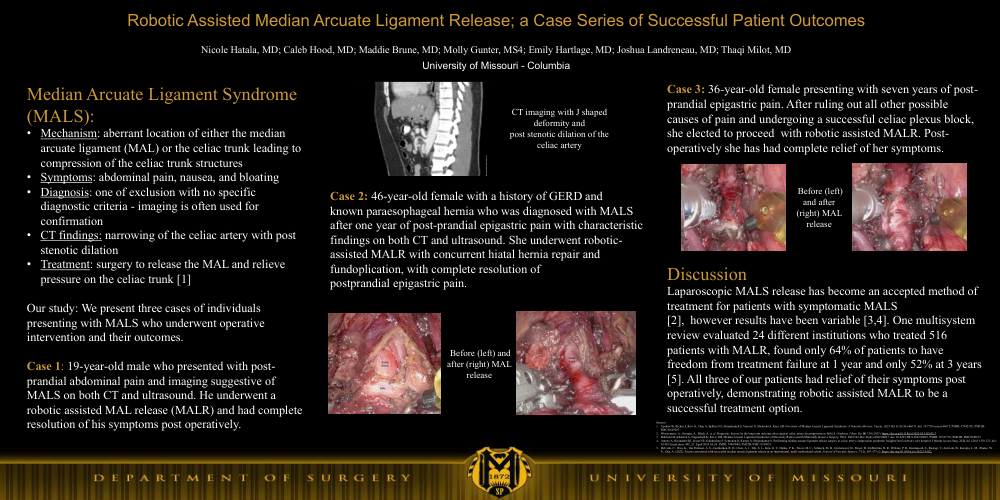
Median arcuate ligament syndrome (MALS) is characterized by compression of the celiac trunk by the median arcuate ligament (MAL). If either the MAL or the celiac trunk is aberrantly located, there can be compression of the celiac trunk, resulting in abdominal pain, nausea, and bloating. While the diagnosis is one of exclusion with no specific diagnostic criteria, imaging is often used for confirmation. Characteristic findings include stenosis of the celiac artery with post stenotic dilation. Treatment involves surgery to release the MAL and relieve pressure on the celiac trunk [1]. We present three cases of individuals presenting with MALS who underwent operative intervention and their outcomes.
Case 1: 19-year-old male who presented with post-prandial abdominal pain and imaging suggestive of MALS on both CT and ultrasound. He underwent a robotic assisted MAL release (MALR) and had complete resolution of his symptoms post operatively.
Case 2: 46-year-old female with a history of GERD and known paraesophageal hernia who was diagnosed with MALS after one year of post-prandial epigastric pain with characteristic findings on both CT and ultrasound. She underwent robotic-assisted MALR with concurrent hiatal hernia repair and fundoplication, with complete resolution of postprandial epigastric pain.
Case 3: 36-year-old female presenting with seven years of post-prandial epigastric pain. After ruling out all other possible causes of pain and undergoing a successful celiac plexus block, she elected to proceed with robotic assisted MALR. Post-operatively she has had complete relief of her symptoms.
Discussion:
Laparoscopic MALR has become an accepted method of treatment for patients with symptomatic MALS [2], however results have been variable [3,4]. One multisystem review evaluated 24 different institutions who treated 516 patients with MALR, found only 64% of patients to have freedom from treatment failure at 1 year and only 52% at 3 years [5]. All three of our patients had relief of their symptoms post operatively, demonstrating robotic assisted MALR to be a successful treatment option.