875 posters, 25 topics, 3,440 authors, 1,061 institutions
ePostersLive by SciGen Technologies S.A. All rights reserved.
SAGES 2026 Annual Meeting Emerging Technology Session
March 25-28, 2026 | Tampa, FL, USA

P808
ROBOTIC VENTRAL HERNIA REPAIR: EARLY INSTITUTIONAL EXPERIENCE FROM A TERTIARY CARE CENTRE
Poster Presenter
Authors
Omprakash Prajapati, Ansin Sreeraj, Venkatesh S, Sanjeet K Rai, Arun Anand, Virinder K Bansal
Affiliations
Part of Topic
Robotics / Advanced Technologies
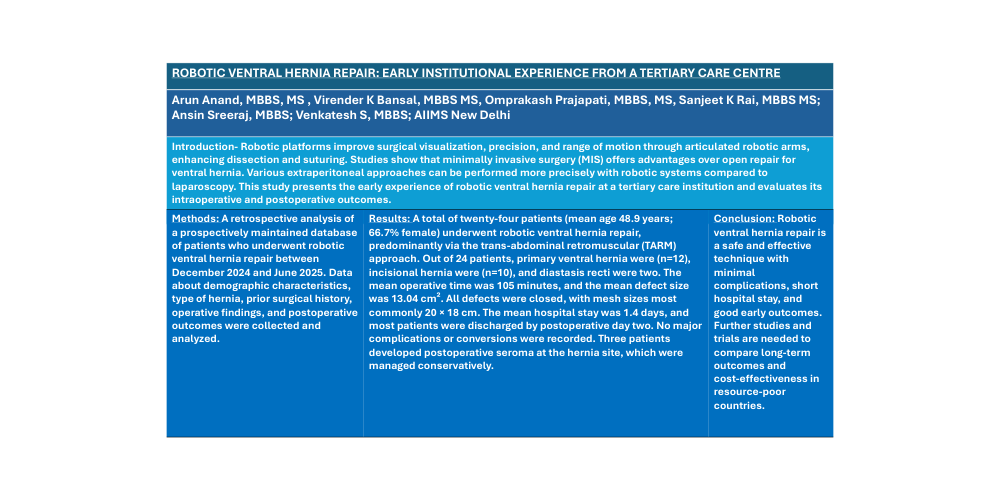
ROBOTIC VENTRAL HERNIA REPAIR: EARLY INSTITUTIONAL EXPERIENCE FROM A TERTIARY CARE CENTRE
Arun Anand, MBBS, MS,Omprakash Prajapati, MBBS, MS; Ansin Sreeraj, MBBS; Venkatesh S, MBBS; Sanjeet K Rai, MBBS, MS, MCh, FCLS; ; Virinder K Bansal, MBBS, MS, FACS, FCLS; AIIMS New Delhi
Introduction: Robotics platforms provide better visualization, an increased degree of freedom, and improved precision for the surgeons. The articulation of the robotic arms has improved both dissection and suturing. Various studies have shown the advantages of MIS over open repair in ventral hernia. Multiple extraperitoneal approaches have been described in the literature, which are being performed by a robotic system in a much precise manner as compared to laparoscopy. This study reports our early experience with robotic ventral hernia repair at a tertiary care institution. This study aims to assess intraoperative and postoperative outcomes of robotic ventral hernia repair.
Methods: A retrospective analysis of a prospectively maintained database of patients who underwent robotic ventral hernia repair between December 2024 and June 2025. Data about demographic characteristics, type of hernia, prior surgical history, operative findings, and postoperative outcomes were collected and analyzed.
Results: A total of twenty-four patients (mean age 48.9 years; 66.7% female) underwent robotic ventral hernia repair, predominantly via the trans-abdominal retromuscular (TARM) approach. Out of 24 patients, primary ventral hernia were (n=12), incisional hernia were (n=10), and diastasis recti were two. The mean operative time was 105 minutes, and the mean defect size was 13.04 cm2. All defects were closed, with mesh sizes most commonly 20 x 18 cm. The mean hospital stay was 1.4 days, and most patients were discharged by postoperative day two. No major complications or conversions were recorded. Three patients developed postoperative seroma at the hernia site, which were managed conservatively.
Conclusion: Robotic ventral hernia repair is a safe and effective technique with minimal complications, short hospital stay, and good early outcomes. Further studies and trials are needed to compare long-term outcomes, cost-effectiveness in resource-poor countries.