816 posters, 24 topics, 3,314 authors, 1,012 institutions
ePostersLive by SciGen Technologies S.A. All rights reserved.
SAGES 2026 Annual Meeting Emerging Technology Session
March 25-28, 2026 | Tampa, FL, USA

P755
Higher Risk of Severe Complications in Non-PDAC Patients After Laparoscopic Pancreatoduodenectomy: A Retrospective Cohort Study
Poster Presenter
Authors
Affiliations
Part of Topic
Pancreas
Higher Risk of Severe Complications in Non-PDAC Patients After Laparoscopic Pancreatoduodenectomy: A Retrospective Cohort Study
Background: Laparoscopic pancreatoduodenectomy (LPD) is increasingly used for periampullary malignancies, yet differential outcomes based on tumor subtype remain poorly understood. This study aims to compare severe complications following LPD between pancreatic ductal adenocarcinoma (PDAC) and non-PDAC periampullary cancer patients.
Methods: We conducted a retrospective analysis of 574 consecutive patients who underwent LPD for periampullary cancer between April 2011 and August 2024. Preoperative, intraoperative, and postoperative data were analyzed. Subgroups included PDAC (n=311, 54.2%) and non-PDAC (n=263, 45.8%), the latter comprising ampullary cancer (57.4%), distal cholangiocarcinoma (30.4%), and duodenal carcinoma (12.2%). Primary outcome was severe complications (Clavien-Dindo ≥ III). Univariate and multivariate logistic regression analyses were performed to identify risk factors.
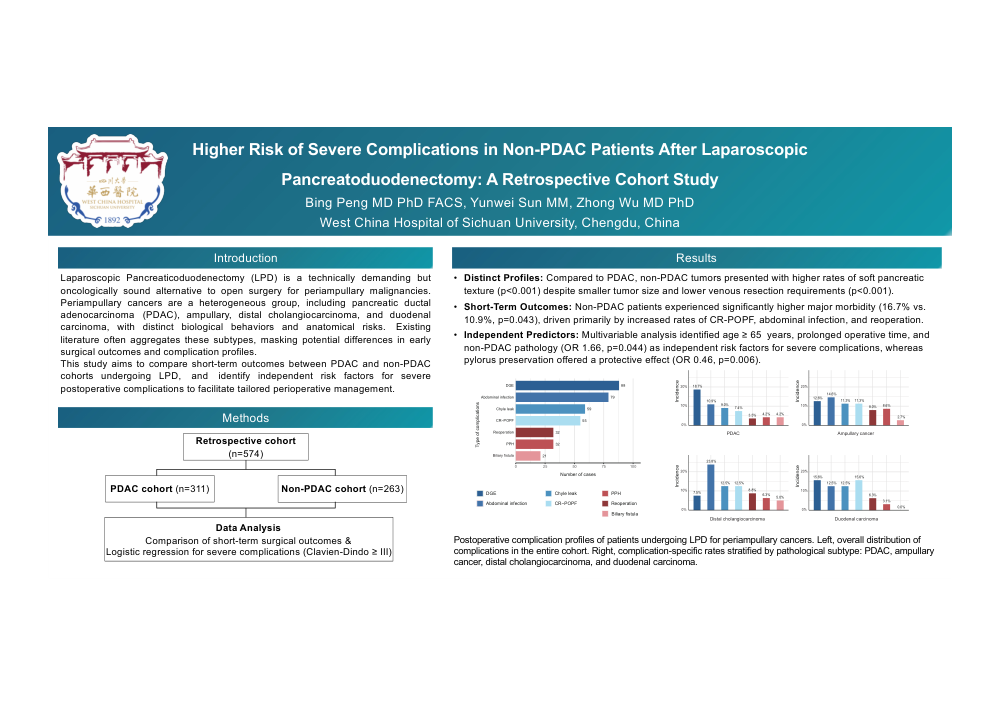
Results: Non-PDAC patients had significantly higher rates of major morbidity (16.7% vs. 10.9%, p=0.043), including clinically relevant postoperative pancreatic fistula (CR-POPF, p=0.001), abdominal infection (p=0.032), and reoperation (p=0.021). PDAC patients had larger tumors (30mm vs. 23mm, p<0.001), more lymph nodes harvested (13 vs. 9, p<0.001), higher venous resection rates (25.1% vs. 8.8%, p<0.001), and a higher proportion of soft pancreas (33.8% vs. 59.7%, p<0.001). Multivariate analysis identified age ≥ 65 years (OR 1.803, 95% CI: 1.092–2.978, p=0.021), prolonged operative time (OR 1.004, 95% CI: 1.001–1.006, p=0.001), and non-PDAC pathology (OR 1.664, 95% CI: 1.014–2.731, p=0.044) as independent risk factors for severe complications. Pylorus preservation was protective (OR 0.460, 95% CI: 0.264–0.803, p=0.006).
Conclusion: Non-PDAC periampullary cancer patients are at increased risk of severe complications after LPD compared to PDAC patients. Older age, longer operative time, and non-PDAC histology are independent risk factors, while pylorus preservation reduces complication risk. These findings emphasize the need for tailored surgical strategies and postoperative care based on tumor subtype.