875 posters, 25 topics, 3,440 authors, 1,061 institutions
ePostersLive by SciGen Technologies S.A. All rights reserved.
SAGES 2026 Annual Meeting Emerging Technology Session
March 25-28, 2026 | Tampa, FL, USA

P736
Continuous Drain Monitoring of pH and Electrical Conductivity Enables Early Detection of Anastomotic Leaks: Results from a Multi-Center Feasibility Study
Poster Presenter
Authors
Emre Gorgun, Joao Rezende-Neto, Khayal Alkhayal, Leilei Zeng, Edward Passos, Nour Helwa, Manaswi Sharma, Olivia Rennie, Alexander Fricke, William Pitman, Abdallah El-Falou, Pablo E Serrano
Affiliations
Cleveland Clinic, FluidAI Medical, St. Michael's Hospital, King Saud University Medical City, ,
Part of Topic
New Technologies / Techniques
Introduction:
Clinical significance of anastomotic leaks
• Anastomotic leaks (AL) are among the most serious complications following hepatobiliary (HPB), colorectal, and upper gastrointestinal (UGI) surgery, contributing to increased morbidity, mortality, and healthcare costs.
• AL often triggers a cascade of secondary life-threatening complications, including intra-abdominal abscesses, sepsis, peritonitis, hemorrhage, and multi-organ failure. It also increases the risk of needing a permanent stoma or major reoperation.
• Patients who develop a leak experience significantly prolonged hospital length-of-stay, higher readmission rates, and frequent unplanned ICU admissions. This prolonged care and need for reintervention impose a massive financial strain on healthcare systems.
Limitations of current detection methods
• Current detection methods rely primarily on clinical symptoms, laboratory markers, and radiologic imaging.
• These approaches typically identify leaks only after significant physiological deterioration has occurred.
• As a result, diagnosis often occurs several days after the leak begins, limiting opportunities for early intervention.
Role of continuous physiological monitoring
• Early biochemical changes may occur before overt clinical symptoms develop.
• Continuous monitoring of peritoneal drain fluid may provides a real-time, objective assessment of the anastomotic site.
• Continuous monitoring captures brief but clinically relevant fluctuations in biomarkers that might otherwise be missed.
• Origin™ continuously measures the pH and electrical conductivity (EC) of drainage fluid:
▪ pH, which may decrease in response to inflammation and tissue ischemia.
▪ EC, which may increase due to inflammatory changes and ion accumulation in drainage fluid.
Study rationale
• Continuous monitoring of peritoneal fluid biomarkers, such as pH and electrical conductivity, captures early physiologic changes associated with AL development that traditional reactive methods often miss.
• Integrating this real-time sensor data with patient-specific clinical variables into a predictive model may allow for the identification of high-risk patients days earlier than standard-of-care, supporting a critical shift toward proactive clinical management and more timely, less invasive interventions.
Objectives and Design
Primary Objectives
1. Observe the change in pH and EC of abdominal drainage fluid in the event of an anastomotic leak.
2. Develop a clinical prediction model based on continuous biomarker data collected using FluidAI’s inline monitoring device (Origin™).
3. Evaluate whether predictive model performance differs across surgical patient populations, including HPB, colorectal, and UGI cohorts.
Results:
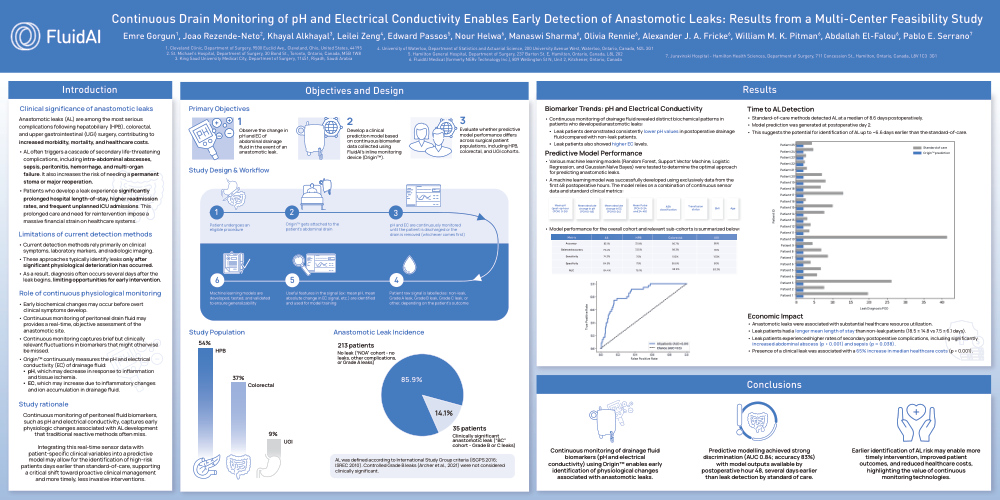
Biomarker trends: pH and EC
• Continuous monitoring of drainage fluid revealed distinct biochemical patterns in patients who developed anastomotic leaks:
▪ Leak patients demonstrated consistently lower pH values in postoperative drainage fluid compared with non-leak patients.
▪ Leak patients also showed higher EC levels.
Predictive Model Performance
• Various machine learning models (Random Forest, Support Vector Machine, Logistic Regression, and Gaussian Naïve Bayes) were tested to determine the optimal approach for predicting anastomotic leaks.
• A machine learning model was successfully developed using exclusively data from the first 48 postoperative hours. The model
Time to AL Detection
• Standard-of-care methods detected AL at a median of 8.6 days postoperatively.
• Model prediction was generated at postoperative day 2.
• This suggests the potential for identification of AL up to ~6.6 days earlier than the standard-of-care.
Economic Impact
• Anastomotic leaks were associated with substantial healthcare resource utilization.
• Leak patients had a longer mean length of stay than non-leak patients (18.5 ± 14.8 vs 7.5 ± 6.1 days).
• Leak patients experienced higher rates of secondary postoperative complications, including significantly increased abdominal abscess (p < 0.001) and sepsis (p = 0.038).
• Presence of a clinical leak was associated with a 65% increase in median healthcare costs (p < 0.001).
Conclusions
• Continuous monitoring of drainage fluid biomarkers (pH and electrical conductivity) using Origin™ enables early identification of physiological changes associated with anastomotic leaks.
• Predictive modelling achieved strong discrimination (AUC 0.84; accuracy 83%) with model outputs available by postoperative hour 48, several days earlier than leak detection by standard of care.
• Earlier identification of AL risk may enable more timely intervention, improved patient outcomes, and reduced healthcare costs, highlighting the value of continuous monitoring technologies.
• Continuous Drain Monitoring of pH and Electrical Conductivity Enables Early Detection of Anastomotic Leaks: Results from a Multi-Center Feasibility Study