875 posters, 25 topics, 3,440 authors, 1,061 institutions
ePostersLive by SciGen Technologies S.A. All rights reserved.
SAGES 2026 Annual Meeting Emerging Technology Session
March 25-28, 2026 | Tampa, FL, USA

P733
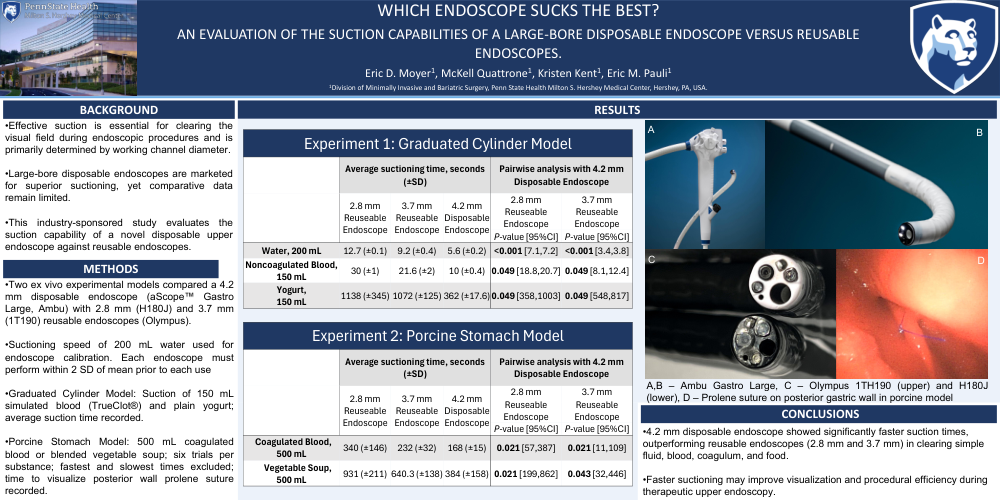
Which endoscope sucks the best? An evaluation of the suction capabilities of a large-bore disposable endoscope versus reusable endoscopes.
Poster Presenter
Authors
Affiliations
Part of Topic
New Technologies / Techniques
WHICH ENDOSCOPE SUCKS THE BEST?
AN EVALUATION OF THE SUCTION CAPABILITIES OF A LARGE-BORE DISPOSABLE ENDOSCOPE VERSUS REUSABLE ENDOSCOPES.
Eric D. Moyer1, McKell Quattrone1, Kristen Kent1, Eric M. Pauli1
1Division of Minimally Invasive and Bariatric Surgery, Penn State Health Milton S. Hershey Medical Center, Hershey, PA, USA.
BACKGROUND
•Effective suction is essential for clearing the visual field during endoscopic procedures and is primarily determined by working channel diameter.
•Large-bore disposable endoscopes are marketed for superior suctioning, yet comparative data remain limited.
•This industry-sponsored study evaluates the suction capability of a novel disposable upper endoscope against reusable endoscopes.
METHODS
•Two ex vivo experimental models compared a 4.2 mm disposable endoscope (aScope™ Gastro Large, Ambu) with 2.8 mm (H180J) and 3.7 mm (1T190) reusable endoscopes (Olympus).
•Suctioning speed of 200 mL water used for endoscope calibration. Each endoscope must perform within 2 SD of mean prior to each use
•Graduated Cylinder Model: Suction of 150 mL simulated blood (TrueClot®) and plain yogurt; average suction time recorded.
•Porcine Stomach Model: 500 mL coagulated blood or blended vegetable soup; six trials per substance; fastest and slowest times excluded; time to visualize posterior wall prolene suture recorded.
CONCLUSIONS
•4.2 mm disposable endoscope showed significantly faster suction times, outperforming reusable endoscopes (2.8 mm and 3.7 mm) in clearing simple fluid, blood, coagulum, and food.
•Faster suctioning may improve visualization and procedural efficiency during therapeutic upper endoscopy.