875 posters, 25 topics, 3,440 authors, 1,061 institutions
ePostersLive by SciGen Technologies S.A. All rights reserved.
SAGES 2026 Annual Meeting Emerging Technology Session
March 25-28, 2026 | Tampa, FL, USA

P693
ANALYSIS OF INCISIONAL INTRADERMAL BUPIVACAINE VS. LIPOSOMAL BUPIVACAINE TAP BLOCK FOR POSTOPERATIVE PAIN CONTROL IN BARIATRIC SURGERY
Poster Presenter
Authors
Affiliations
Part of Topic
Miscellaneous / Other
TITLE: Analysis of Incisional Intradermal Bupivacaine vs. Liposomal Bupivacaine TAP Block for Postoperative Pain Control in Bariatric Surgery
INTRODUCTION
Effective postoperative pain control is central to enhanced recovery after bariatric surgery. Local wound injection with bupivacaine is widely used, while transversus abdominis plane (TAP) blocks with liposomal bupivacaine (Exparel) have been used to extend analgesia and reduce opioid use. This study evaluates the impact of TAP block with Exparel compared to intradermal bupivacaine infiltration peri-incisionally on postoperative pain and analgesic requirements.
METHODS
This study was performed using data from patients at a single institution undergoing robotic assisted laparoscopic (RAL) vertical sleeve gastrectomy, RAL Roux-en-Y gastric bypass or a RAL revision of a previous bariatric surgery. Historical controls received intradermal infiltration with bupivacaine. Current patients prospectively received an Exparel TAP block. Primary outcomes measured were postoperative pain scores (day of surgery (DOS), postoperative day 1 (POD1)). Additional outcomes measured included PRN postoperative opioid use converted to morphine milligram equivalents (MME) and categorical pain assessment at clinic follow-up (None, Mild, Medium, Severe). Independent t-tests were applied to all outcomes. This abstract reports interim results.
RESULTS
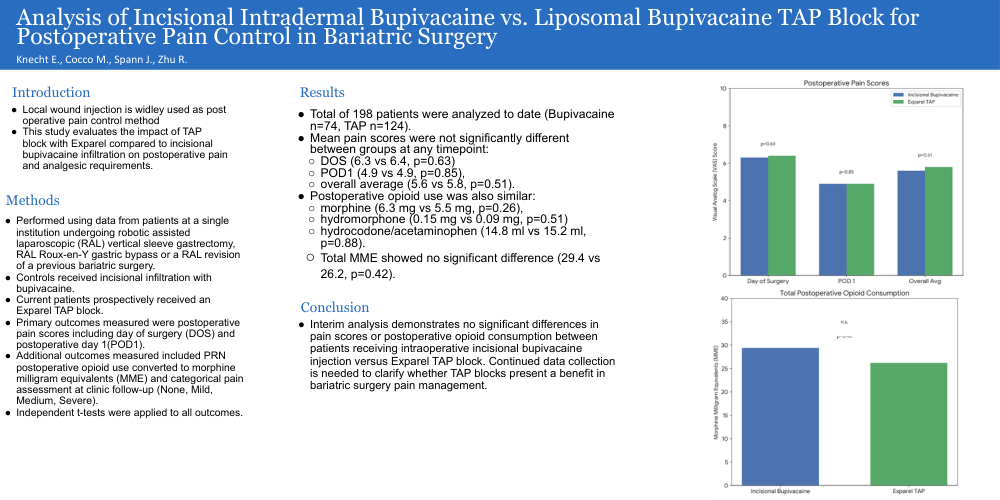
A total of 198 patients were analyzed to date (Bupivacaine n=74, TAP n=124). Mean pain scores were not significantly different between groups at any timepoint: DOS (6.3 vs 6.4, p=0.63) and POD1 (4.9 vs 4.9, p=0.85), overall average (5.6 vs 5.8, p=0.51). Postoperative opioid use was also similar: morphine (6.3 mg vs 5.5 mg, p=0.26), hydromorphone (0.15 mg vs 0.09 mg, p=0.51), and hydrocodone/acetaminophen (14.8 ml vs 15.2 ml, p=0.88). Total MME showed no significant difference (29.4 vs 26.2, p=0.42).
CONCLUSIONS
Interim analysis demonstrates that intradermal bupivacaine injection was not inferior to intraoperative Exparel TAP block for post operative bariatric surgery pain control. Further studies are needed to elucidate the impact of Exparel TAP blocks in postoperative pain control for patients undergoing bariatric surgery.